
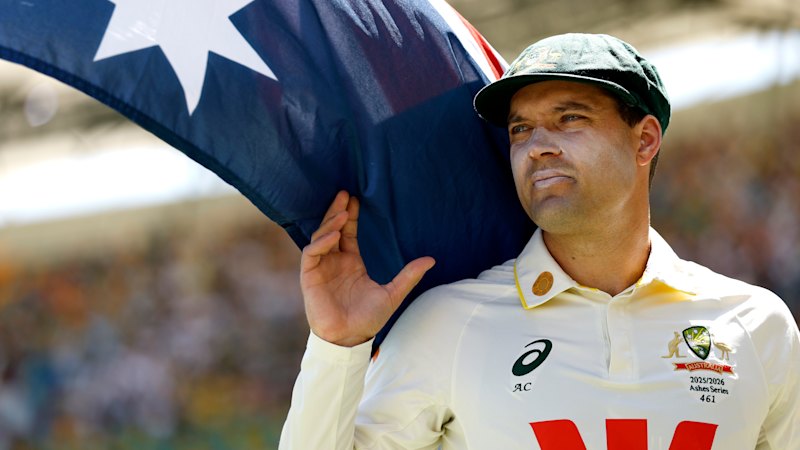
In early 1988, Queensland’s Test keeper in waiting Peter Anderson broke a finger standing up to England great Ian Botham in a Shield game. Healy made his first-class debut in the next match and months later was wearing the baggy green in Pakistan. Anderson moved states to continue his career.
Wicketkeepers, it is said, are doing their job best when they go unnoticed. Not so Carey. Channel Seven posted a highlight reel on social media of Carey at his craft in the second Ashes Test. It has been viewed 386,000 times.
Carey’s performance at the Gabba left his captain Steve Smith in awe, drew rich praise from gloved greats Healy and Gilchrist, and captivated a nation of cricket lovers.
Not least, it proved wrong the surly prediction of England pace great Stuart Broad, who, in the moments after Carey’s controversial stumping of Jonny Bairstow, said that would be all the South Australian would be remembered for.
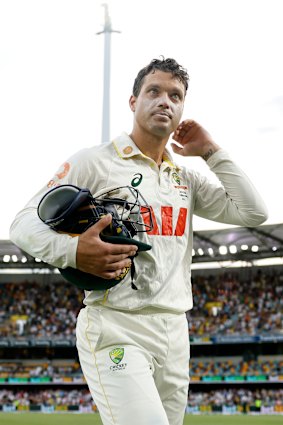
Although Australia didn’t pick a spinner Carey did a lot of his work up to the stumps at the Gabba.Credit: Getty Images
The courage required to do what Carey did
If the Bairstow incident highlighted Carey’s craftiness, then the Gabba was all about his craft – and courage.
It is common for a wicketkeeper to be up to the stumps to medium-pacers but less so for quicks hitting speeds in the mid to high 130km/h range, as Michael Neser and Scott Boland did. At that speed, they have just a few hundredths of a second to react to any deviation off the pitch or the bat.
Healy occasionally kept up to Steve Waugh’s brisk seamers in the 1990s when wicketkeepers were not mandated to wear helmets as they are now. He said there is a “high level of anxiety” over what could go wrong.
“You’ve got to get through that, I don’t know how long that takes,” Healy said. “I don’t think I did it long enough to get through that. I would do it for little bits and pieces, maybe an over here and there.
“He [Carey] probably got through the anxiety and forgot about the number of fingers he could break, or I could get injured here, or there could be something down the leg side, and you start to think too much rather than watch the ball and not worry what might happen.
“There’s that anxiety of the ball coming so fast and the batsman still gets in your way. Forget about the batsman, forget about the speed of the ball and just be ready for it. Getting through that is the key.”
Gilchrist kept up to Glenn McGrath in the 2007 Ashes when the pace great had lost a yard of his speed but was still unerringly accurate. He said the most difficult aspect was when batters moved around.
“I don’t want to sound flippant about it, but at that pace you get a good line of sight on it generally,” Gilchrist said.
As for Carey’s display at the Gabba, Gilchrist cheekily described is as “wicketkeeping porn” in an Instagram post.
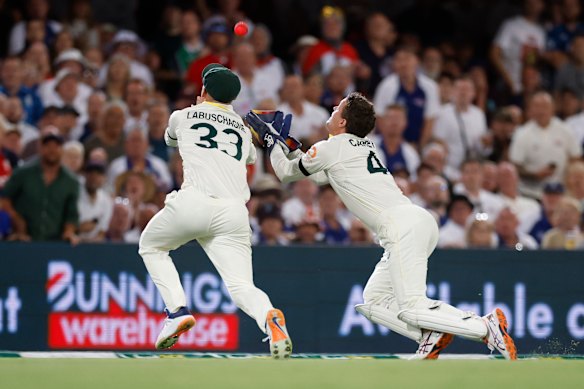
Carey takes a catch to dismiss Gus Atkinson at the Gabba despite pressure from Marnus Labuschagne.Credit: Getty Images
“You practise to be able to accept on the odd occasion that responsibility and have the right technique. The Harry Brook one when he starts playing a ramp short in front of you, that took a lot of courage,” he said.
“The bouncer where he had to jump really high, that took a lot of courage to do that. To be sharp and switched on, there’s nothing easy about it. That’s what you do your training for – hoping one day you get your chance.”
The technique
It’s doubtful any of the 137,152 who walked through the turnstiles at the Gabba were as impressed with Carey as Healy. He and Haddin both compared Carey’s performance to Don Tallon, an Invincible regarded by many who watched him as Australia’s finest technician with the gloves.
There is more to having a cricket ball melt in the gloves than just see ball, take ball. It starts with the crouch and the movement into what Healy describes as a “power position”.
“You can’t move in a crouch,” Healy said. “You just come up a touch. If you come up too high you can’t move strongly sideways. If you don’t come up high enough, you can’t move either, you’re like a duck waddle.
“He’s found the power position. He’s moving to take balls close-ish to first slip without even noticing how wide they are. He’s gliding beautifully because he’s got all this power in his glutes and quads because he’s in the perfect power position to move left or right.
Loading
“You won’t see him diving much any more, unless it’s extremely wide. It looks effortless, but it’s not – there’s lot of work that goes into it. He practises hours and hours on end to get it that way.”
The catch Carey took to remove Ben Stokes, Healy said, spoke volumes of his skill and bravery.
“I was really pleased he got a dismissal as well as doing such a great job,” Healy said. “It’s really difficult to sort of hear an edge and not have time to change anything other than to tighten up your hands a bit. He didn’t. He stayed soft, and it went in because he has such good technique.
“No flinching either. No straightening up too quickly or hurriedly, tensing everything when he hits it and jumping in the air, that type of thing. He stayed on the ground, which is against all your natural instincts.
“His training has got him to the point where he can suppress all natural instincts and concentrate on the ball and get it. It’s very good.”
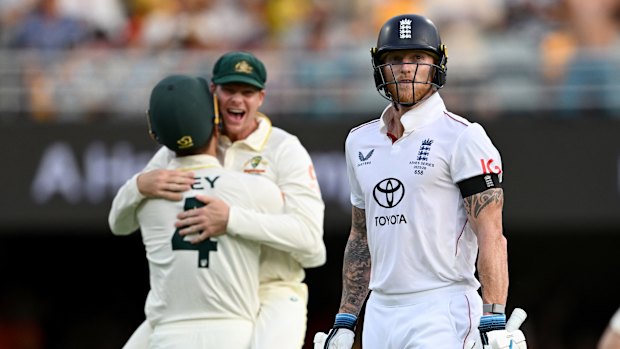
Steve Smith was in awe of Alex Carey’s performance at the Gabba.Credit: Getty Images
Standing at first slip, Smith had the best seat in the house to the keeper’s exhibition. He marvelled at Carey’s skill, which in itself is revealing given his prowess in the field.
“He finds a way to get the ball in his hands,” Smith said. “[It] hits the batter’s pads and it ends up in his hands somehow.
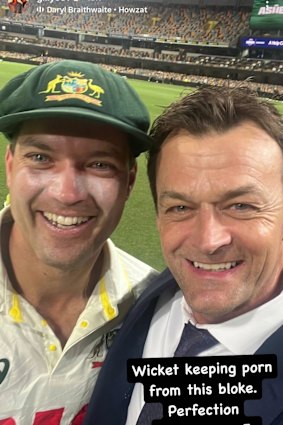
Adam Gilchrist’s Instagram post lauding Carey’s work at the Gabba.Credit: Instagram
“When I was at slip when he was up to the stumps, I was so wide just ’cause of how much he covers. He gets his hands out there, it’s like he knows he’s going to nick it at times and gets his hands out there. That keeping performance was as good as I’ve seen.”
Practise makes perfect, the saying goes, but Carey does not train specifically to stand up to the stumps.
“I train the basics and the fundamentals and then hope for the best,” Carey said this week. “I won’t go up to the stumps to a bowler bowling 130[km/h] in the nets – nah.
“Just do my drill work and go about your business … once you’re in that game intensity, instincts take over a fair bit.”
Why did he do it?
There needs to be a compelling reason to move up to the stumps into a position where regulation edges become difficult to take and the risk of injury escalates.
Boland and Neser are renowned for their metronomic line and length. By leaving the crease, batters can scramble their radar and turn the bowlers’ strength into a weakness. If the wicketkeeper stands up to the stumps, the batter can only advance at the risk of being stumped.
“They can take away that consideration of the batter walking down the crease and hitting them off the line, absolutely,” Gilchrist, a commentator for Kayo Sport’s Ashes coverage, said.
“That plays a huge part in supporting your bowler to get their plans out and execute their plans as best they can.
Loading
“It’s been a huge tactical play and clearly one he was well prepared for and identified. It’s made them [England] alter what comes fairly naturally.”
Healy is emphatic in his belief Carey is the best wicketkeeper in the world. Since the start of last year, no gloveman is close to Carey’s 84 dismissals. Next best, on 60, is Jamie Smith, who put in a shocker in Brisbane.
“He’s clearly the best,” Healy said. “I can’t think of anyone who is even in the same league as Alex Carey.”
What about Carey the batter?
It will surprise many to learn that Carey is scoring at a higher strike rate than India’s dynamic wicketkeeper/batter Rishabh Pant since the start of last year.
In a period where Australia’s frontline batters have struggled, Carey has often bailed his team out of trouble with his counter-attacking knocks in the middle order, headlined by his 98 not out against New Zealand in Christchurch last year which won the game for Australia and saved his place in the team.
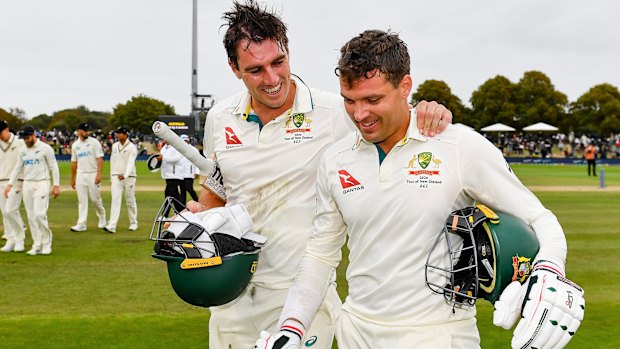
Alex Carey made a match-winning 98 against New Zealand in Christchurch.Credit: Photosport via AP
“He’s just so busy, he’s a classy looking player,” Gilchrist, the greatest wicketkeeper/batter the game has seen, said.
Loading
“If you give him a cover drive he can play it as well as Mike Hussey. Some of his strokes make a statement to the opposition.”
As well as Carey is playing, Healy believes the best is still to come.
“I think the next four years will be as good as we’ve seen,” Healy said.
“He’s spent the last four to five years getting there, which is very normal. He’s got some real good times ahead.”