
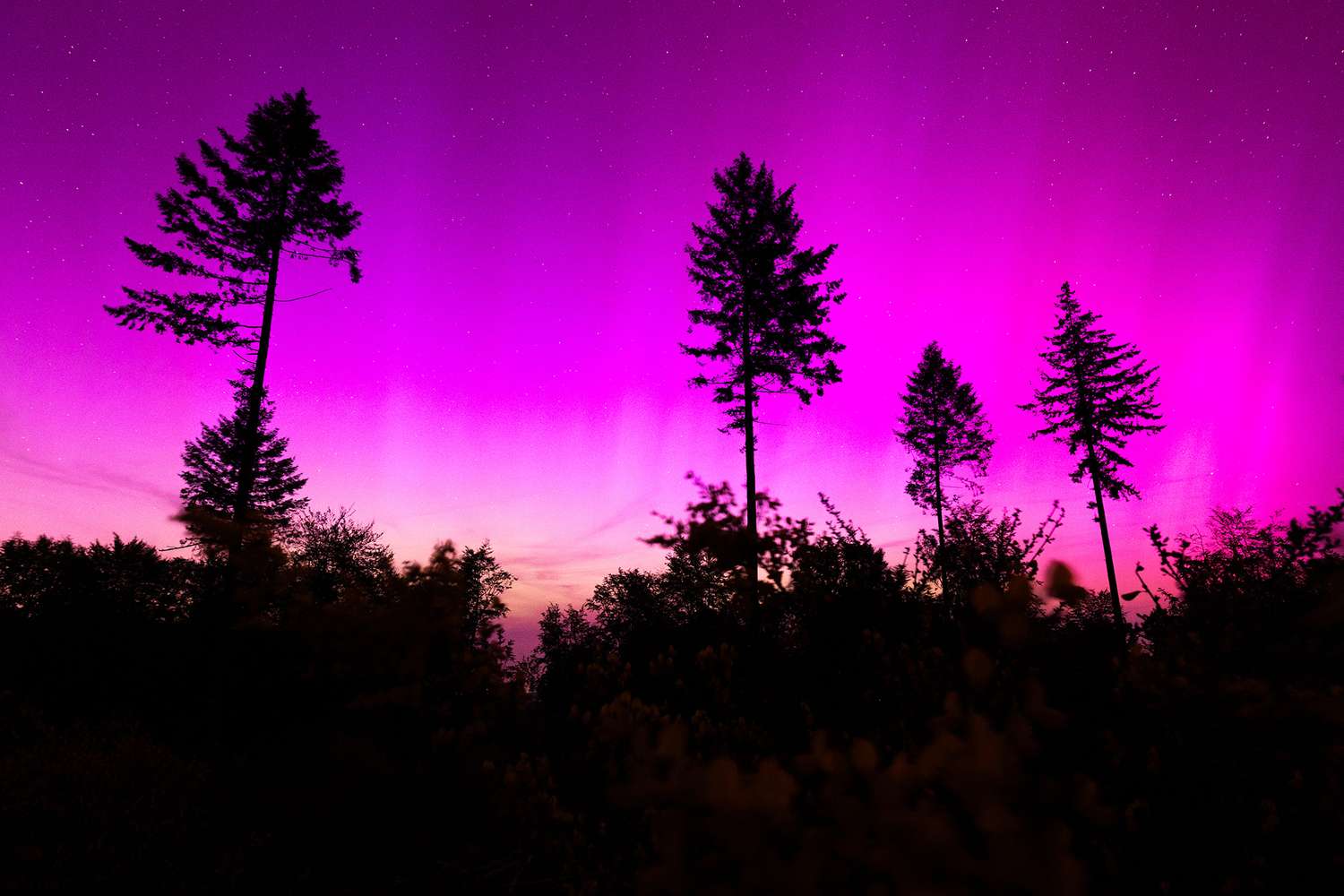
NEED TO KNOW
The northern lights are forecast for back-to-back nights for a second time this week, according to NOAA’s report The auroras have a three on the Kp index, meaning they can be “quite pleasing to look at” under perfect conditionsThe northern lights were forecast earlier this week on Monday, July 14 and Tuesday, July 15
Missed it the first two nights? Have no fear, another round of northern lights are here!
The aurora borealis is expected to be visible from several parts of the United States on Wednesday, July 16 and Thursday, July 17, according to the National Oceanic and Atmospheric Administration (NOAA)’s Space Weather Prediction Center’s forecast.
This marks a second round of consecutive northern lights forecast for this week, per NOAA’s predictions. Similarly, these next two nights of auroras have a three on the Kp index, which measures intensity on a scale that ranges from zero to nine.
According to NOAA, a three on the Kp index means the auroras are expected to move further from the poles, becoming “brighter” with “more auroral activity.” Plus, they can be “quite pleasing to look at” under perfect conditions.
What makes the northern lights even more spectacular than they already are is their ability to be spotted from various locations across the United States. However, only the northernmost areas are in NOAA’s “viewline” this time around.
For a complete guide on how to spot back-to-back northern lights for a second time this week, read on.
When will the northern lights be visible?
Northern Lights (stock image).
Hasan Akbas /Anadolu via Getty
The northern lights are forecast for Wednesday, July 16 and Thursday, July 17, according to NOAA’s report. They are best viewed in the hours surrounding midnight, and are not visible in the daylight.
Both nights have a three on the Kp index, which measures geomagnetic activity and aurora intensity on a scale that ranges from zero to nine. For Kp in the range of three to five, the aurora will move further from the poles and become brighter with more auroral activity (motion and formations).
Never miss a story — sign up for PEOPLE’s free daily newsletter to stay up-to-date on the best of what PEOPLE has to offer, from celebrity news to compelling human interest stories.
Better yet, the auroras can be “quite pleasing to look at” if skywatchers are looking up from the right place on Earth. Plus, other factors, like weather, must also align.
Where will the northern lights be visible?
Several locations across the United States will have a chance to view the northern lights on July 16 and July 17, according to NOAA’s aurora viewline. The northernmost states will have the best shot at catching a glimpse this week.
States include Alaska, northeastern Washington, northern Montana, North Dakota, Minnesota, Wisconsin and the northernmost tip of Michigan.
How to watch the northern lights?
Northern Lights.
Tayfun Coskun/Anadolu via Getty
The best part about the northern lights (aside from their stunning display) is their ability to be spotted from Earth without advanced technology. Simply, the naked eye and perfect weather conditions are all that’s needed to soak in their beauty.
Regardless of a powerful geomagnetic activity, northern light visibility is still in the hands of Mother Nature. That means, cross your fingers that rain and fog aren’t in the forecast on the nights the auroras are expected.
How to take photos of the northern lights?
You know what they say! Take a photo or they didn’t happen, right?
Fortunately, certain smartphones have the high-tech capability to capture the auroras on camera if you toggle on the “Night Mode” settings in your device. Then, all you have to do is point your lens to the sky and snap away!