
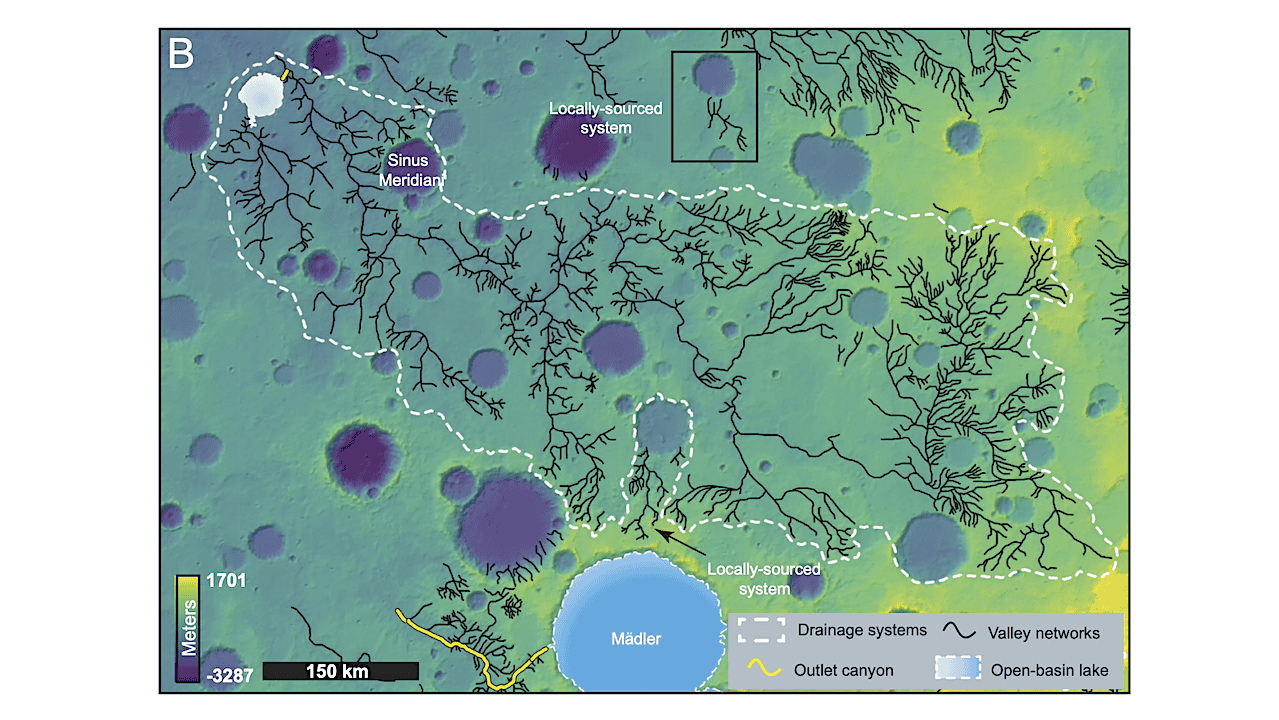
 Large drainage systems on Mars. Image from the study.
We’ve known for a while that Mars was once a wet world. But there’s always been a geological puzzle regarding how and where that water moved.
On Earth, rivers are largely driven by plate tectonics. The shifting of our planet’s crust builds mountains and basins, creating the slopes necessary for water to flow. Mars, however, never had an active tectonic system like ours.
Yet, even without it, the Red Planet managed to sustain impressive waterways. A new study reveals that ancient Martian rivers covered more than 100,000 square kilometers. These rivers acted as massive sediment conveyor belts and, according to researchers, they may act as a treasure map for finding ancient life.
Earth and Water
Life loves rivers. Here on Earth, large drainage basins cover nearly half of the land surface. On Mars, they cover only about 5% of the ancient terrain. Because of this small footprint, it would be easy to dismiss these rivers as minor players in Martian geology.
But Abdallah S. Zaki and his colleagues see it differently. They identified 16 massive drainage systems dating back to the planet’s early history, more than 3.7 billion years ago. Some of these systems cover 100,000 square kilometers, an area roughly the size of South Korea or Iceland.
“We already knew that valley networks on Mars fed lakes and that some of these lakes overtopped and carved large canyons during breach floods,” said Abdallah Zaki, a distinguished postdoctoral fellow at the University of Texas at Austin, who led the study. But no one knew how extensive the ancient river systems were, or how important they were for reshaping the martian surface,” the researcher told Astronomy magazine.
However, until now, no one realized just how extensive these ancient systems were.
 Mars has features that look tantalizingly like river valleys. Image credits: NASA.
“On Earth, our largest rivers and their drainage basins cover nearly half of the continents because climate and plate tectonics work together to build mountains and create space for rivers to flow,” Zaki said. “Mars, however, has no plate tectonics, but it still preserves compelling evidence of ancient valleys and river deposits. We wanted to know whether a planet without plate tectonics could still build large river systems, and how important these systems were for moving sediment and creating potentially habitable environments on early Mars.”
The researchers calculated that these 16 geological “arteries” eroded and transported roughly 42% of all the ancient river sediment on Mars. It was an incredibly efficient system, which raises the question: how does such a system exist without the geological engine to drive it?
Currents in the Deep
 Image from the study.
To understand the difference, you have to look deep underground. Earth’s geology, from the tallest mountain to the deepest canyon, depends on movement in the mantle. The mantle churns with slow, enormously powerful convection currents that drag the Earth’s surface around. The surface itself is broken into rigid plates; when they collide or divide, they create the topography that allows rivers to flow.
Martian rivers relied on a completely different mechanism: craters.
Mars is scarred by impacts. When the planet was wet, these craters acted like isolated bowls, trapping water. Eventually, the water would reach the rim and spill over, carving a massive canyon in the process. This “fill and spill” mechanism stitched together isolated basins, creating long, interconnected chains of water flow.
The study notes that nearly half of the total length of outlet canyons on Mars is found within these 16 large drainage systems.
It is a strikingly different mechanism than what we see on Earth, but the result is the same: flowing water. While Earth’s rivers flow because the ground was pushed up by tectonics, Mars’ rivers likely flowed because the water simply refused to stay trapped, violently breaching barriers and connecting the landscape in a cascading chain reaction.
Why This Matters for Finding Life
We know that Earth’s rivers transport nutrients and carbon, the building blocks of biology. On Mars, these massive systems acted as funnels, directing vast quantities of sediment into specific, deep basins.
If you are hunting for extraterrestrial life, these basins are exactly where you want to look.
These deep, water-rich environments would have been prime real estate for ancient microbial life. If life existed in the Martian hinterlands, evidence of it might have been washed down these great rivers and buried safely in the quiet mud of the deltas, waiting for us to dig it up.
“The presence of liquid water certainly allows for life to have existed at the surface,” said Bruce Jakosky, a professor emeritus at The University of Colorado Boulder and the principal investigator on the Mars Atmosphere and Volatile Evolution (MAVEN) mission. “It’s even possible that life, if it existed then, could still exist today,” perhaps underground.
Mars may be dry today, but this research paints a picture of a world that was once dynamic and aggressively wet. It serves as a reminder that active water systems, and potentially habitable environments, can exist even without Earth-like tectonics. This could be significant for other planets as well.