

The collapse in Australia’s labour productivity is well documented.
An OECD analysis published in The AFR found that Australia ranked second-last among wealthy nations in productivity growth since the COVID-19 pandemic.
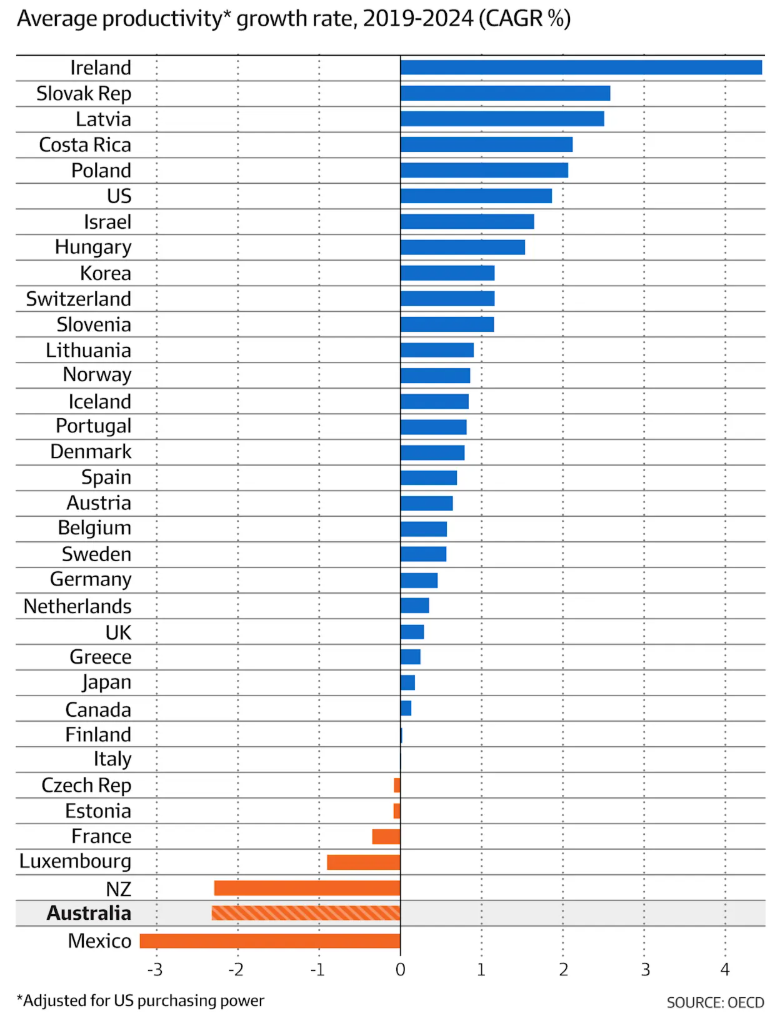
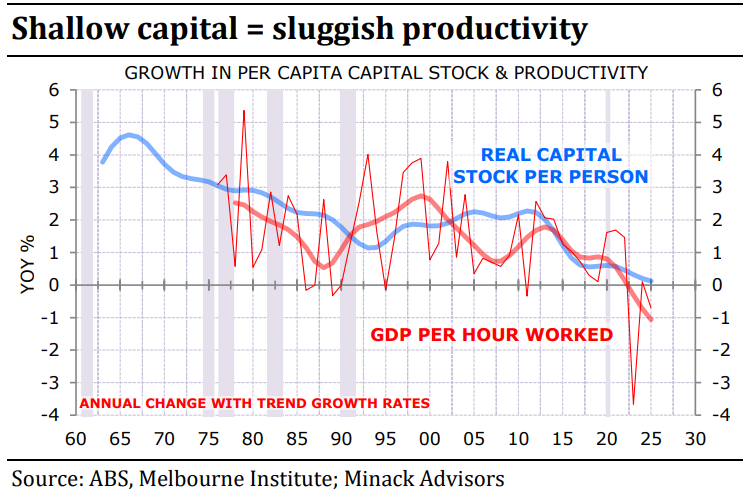
EY’s chief economist, Cherelle Murphy, says the decline in Australia’s productivity is partly attributable to “capital shallowing”—the fact that local companies are not investing enough capital in new equipment to match the growth in their workforce.
“We’ve had strong labour market performance, but at the same time, we have not had particularly strong business investment or innovation”, she said.
Advertisement
“You’re not going to get strong productivity growth because you’re essentially asking workers to work with capital equipment that’s not keeping up with the number of workers”.
Murphy added that corporate Australia’s expenditure on research and development is also below that of other countries.
I have raised similar concerns repeatedly.
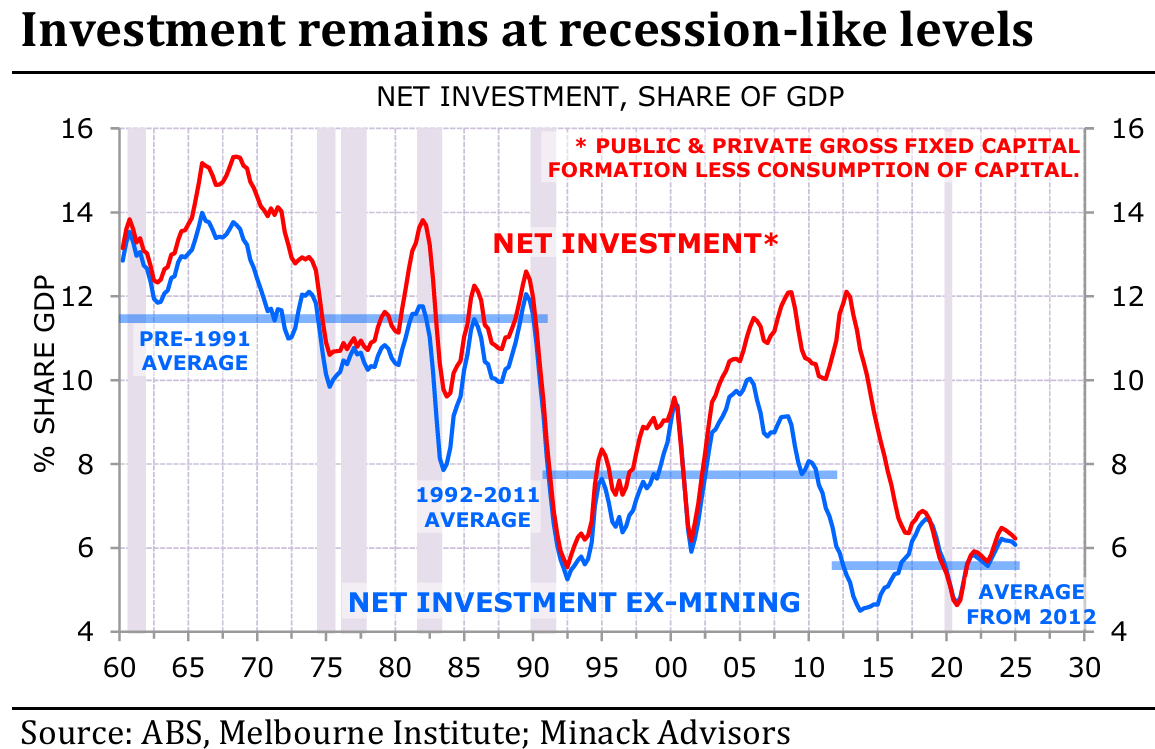
Private business investment as a percentage of GDP is tracking close to recessionary levels, as illustrated below by renowned independent economist Gerard Minack:
Advertisement
As a percentage of GDP, new machinery and equipment—which are essential to raising worker productivity—are tracking at historically low levels, as Alex Joiner of IFM Investors shows below. It is currently around half of what it was twenty years ago, at 4.6% of GDP:
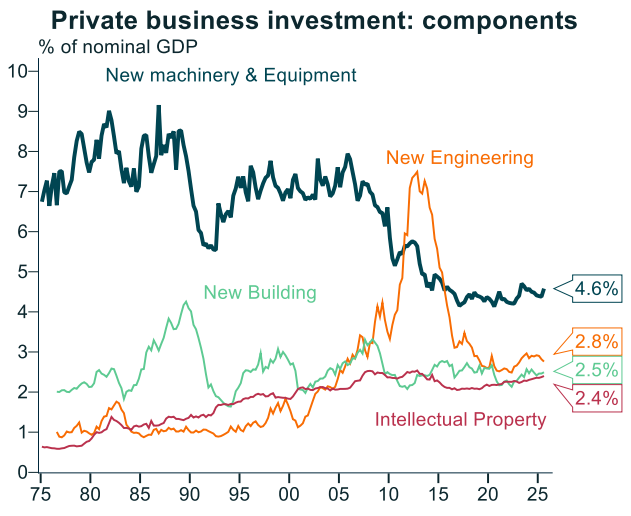
As a result, the numerator of the capital-to-labour ratio has been weak, approaching recessionary levels.
Advertisement
In the meantime, huge volumes of low-skilled immigration have caused the denominator of the capital-to-labour ratio to increase.
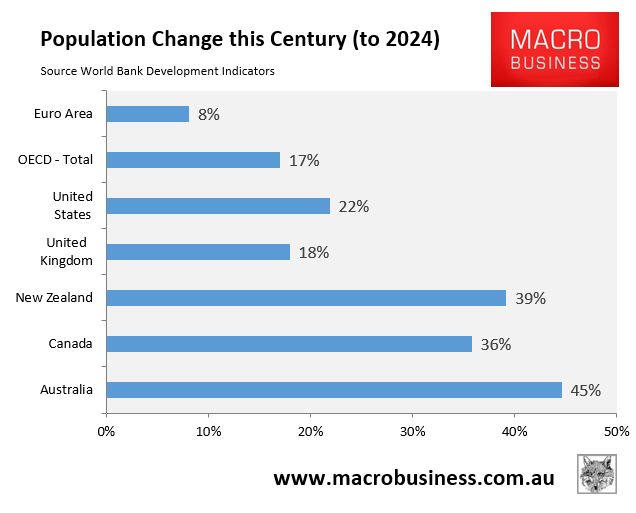
This century, Australia’s population has grown far more quickly than that of other developed countries and has easily exceeded business, infrastructure, and housing investment. This population surge has also contributed to the “capital shallowing” of the country.
Advertisement
Australia has not provided the required equipment, technology, or tools to the millions of new migrant workers. For the millions of extra families, it hasn’t supplied adequate housing and infrastructure.
This ‘capital shallowing’ has reduced the amount of capital invested per person, which has hurt Australia’s productivity. Average quality of life has also declined.
Advertisement
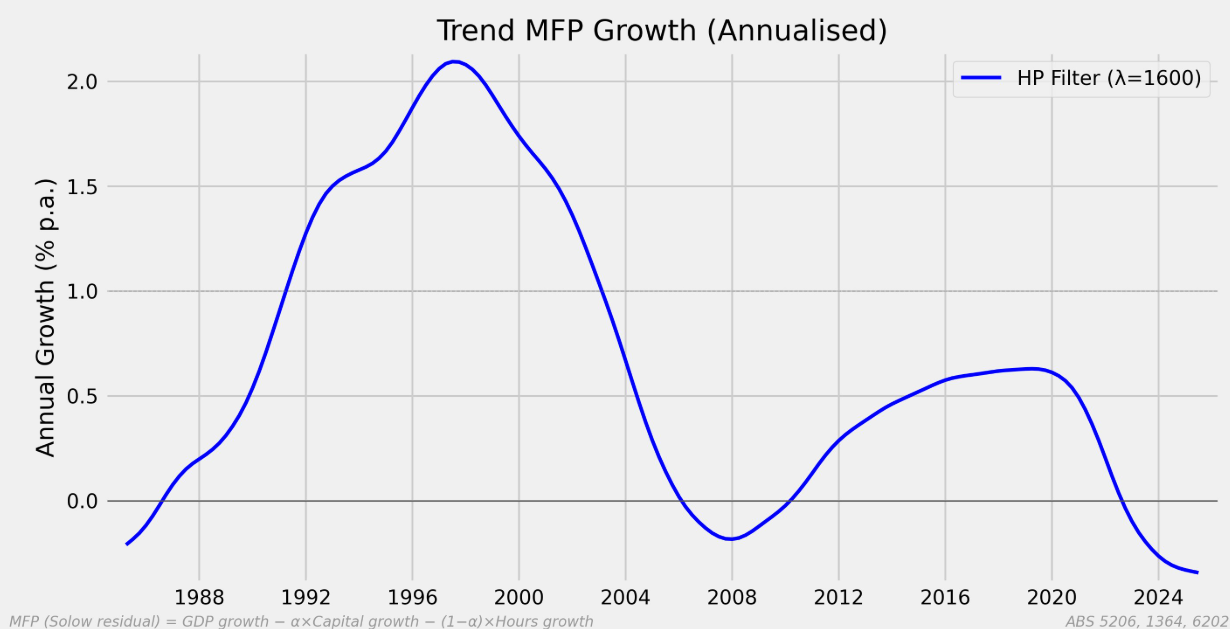
Mark the Graph has published an interesting report on Australia’s multifactor productivity, which paints a similar picture.
“We’re not working smarter”, Mark wrote on Twitter (X).
Advertisement
“Australia’s multi-factor productivity growth has collapsed to zero. GDP growth now comes almost entirely from more labour hours (i.e., immigration), not efficiency/technology gains”.
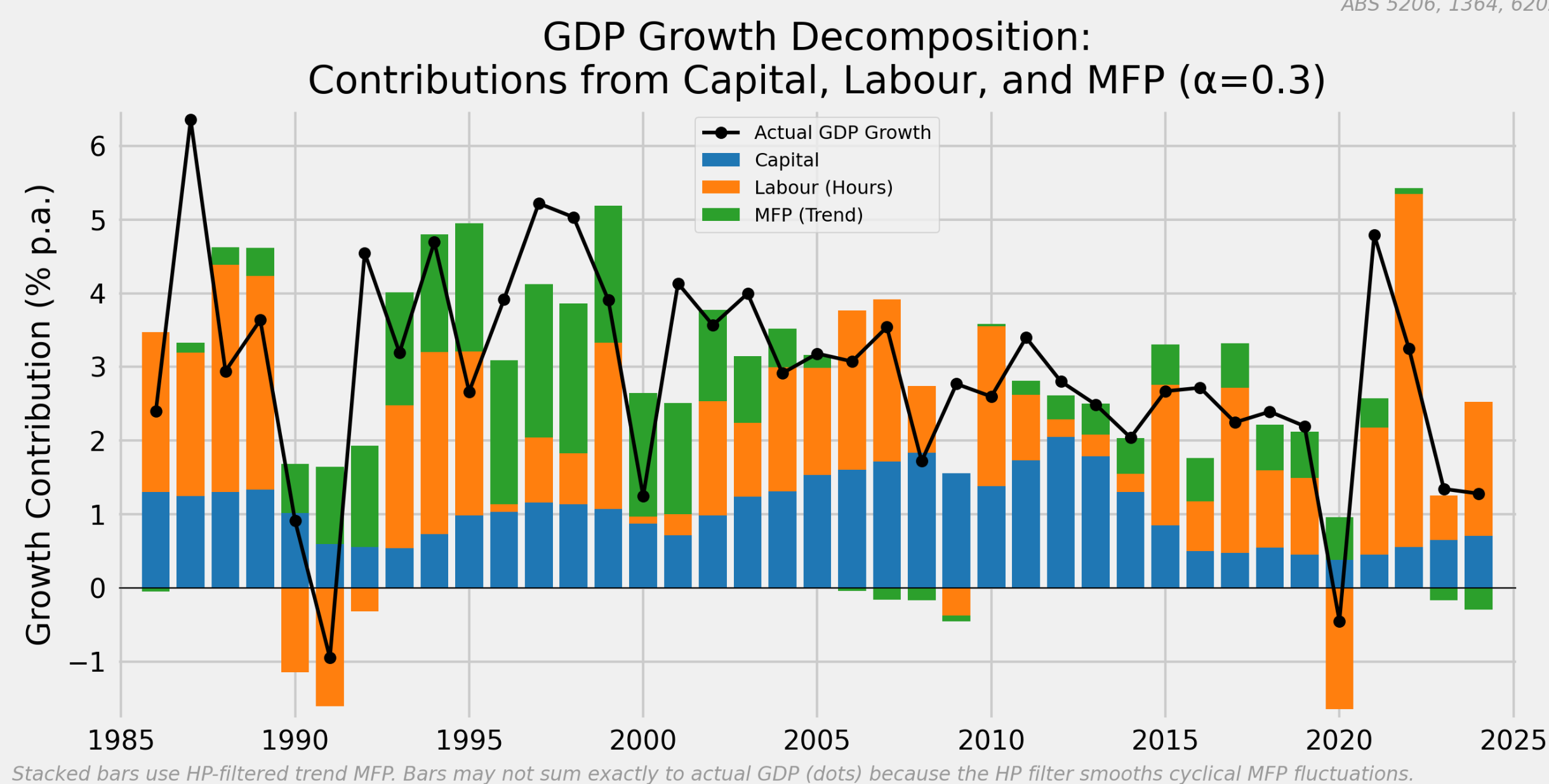
“The 1990s productivity dividend is spent”.
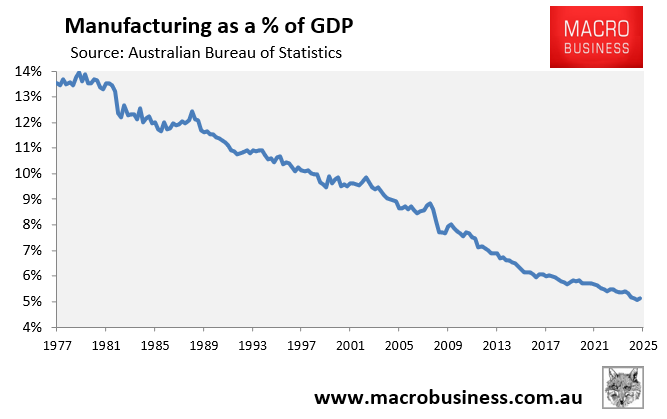
With its manufacturing sector in terminal decline due to skyrocketing energy costs, it is difficult to see how Australia can achieve ‘capital deepening’ or an increase in the capital-to-labour ratio, and boost productivity growth.
Advertisement
As net-zero plans and gas policy failures cause energy costs to skyrocket, Australia will continue to deindustrialise and export its remaining manufacturing sector to countries with lower energy costs. As a result, businesses will make fewer capital investments in Australia.
The federal government also plans to add 13-plus million people to the country’s population during the next 40 years.
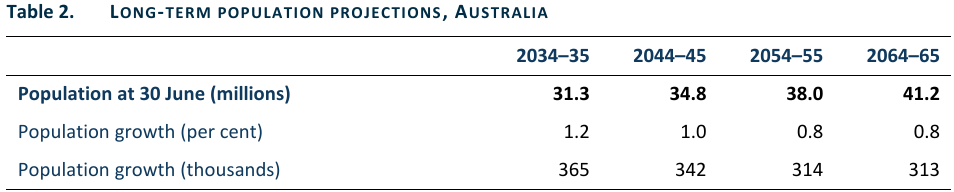
Source: The Centre for Population (December 2024)
Advertisement
In 40 years, Australia’s population will grow by the equivalent of another Sydney, Melbourne, and Brisbane, necessitating an unprecedented level of infrastructure, housing, and business investment to maintain the capital stock per person.
Such historically high levels of investment are not achievable and will inevitably lead to more ‘capital shallowing’ and slower productivity growth in the economy.
In summary, Australia faces a future of low productivity and deteriorating living standards because it is hell-bent on committing energy policy suicide, deindustrialisation, and flooding the nation with low-skilled migrants.
Advertisement