
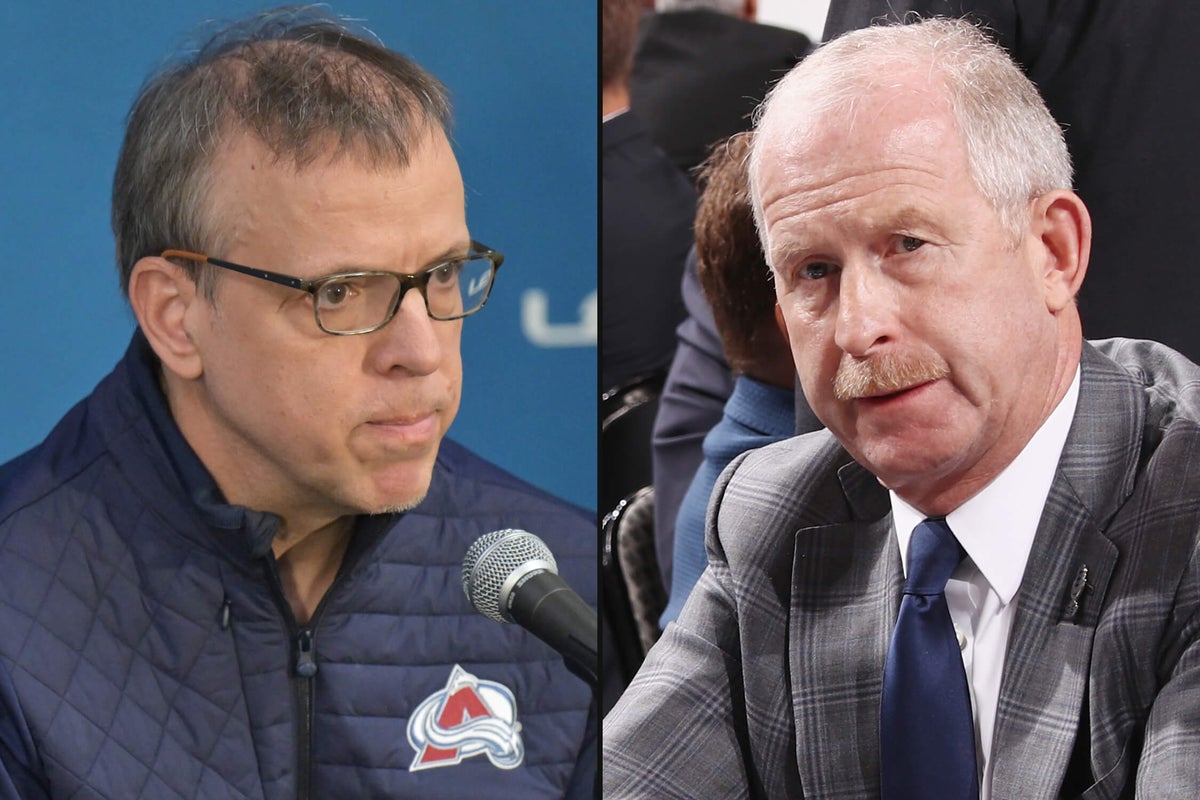
A year ago, it was Chris MacFarland in the middle of all kinds of in-season wheeling and dealing.
There was the Mikko Rantanen-Martin Necas blockbuster, the full-swap of his two-man tandem in goal, the Brock Nelson addition — you name it, and the Colorado Avalanche general manager was in the middle of it.
This season has been more about sitting back and letting his roster settle into itself. And boy, has it ever, led by Nathan MacKinnon’s Hart Trophy-worthy season so far.
But in the meantime, the rival Dallas Stars keeps winning games, too. And the rising Cup contender Minnesota Wild just took the biggest swing of all with the Quinn Hughes blockbuster. And let’s not forget the Winnipeg Jets, who are struggling these days but won the Presidents’ Trophy last season with the top record in the NHL.
The Central Division, yeesh.
“That was a big trade for both teams and those deals are not easy to get over the finish line, so you have to give Billy (Guerin) and Patrik (Allvin) a lot of credit for finding common ground,” MacFarland told The Athletic on Monday. “Obviously, there are so many good teams in our division, and it will make for some great hockey the rest of the way in what should be an exciting second half.
“Minny was already a very good team, and adding an impact player like Quinn Hughes will only make them that much tougher.”
A year ago, the Stars jumped at a chance they never could have envisioned in getting Rantanen from the Carolina Hurricanes at the deadline. Now it’s the Wild’s turn.
“Great move by Billy,” Stars GM Jim Nill told The Athletic on Monday. “There was an opportunity, and they grabbed it. The part that people don’t understand is they had the assets to do it. So they’ve done a good job to have the assets to make that trade. It’s similar to the trade we made for Rantanen last year. I don’t think Billy Guerin started the year thinking, ‘Boy, we’re going to get Quinn Hughes. Let’s plan for that.’ You can never plan for those things, much like we didn’t plan for Rantanen. But if you’ve done a good job with your organization and your team, and you have the assets, it gives you a chance to get those types of players.
“So hats off to him. That’s a great job.”
In the meantime, the NHL’s top division just got even tougher.
“That’s what makes us all better, though,” Nill said. “We keep challenging each other. It’s the competition part we all love, and I think it’s made all our teams better.”
If the Hughes blockbuster has emphasized anything now in the crazy Central Division, it’s this: There’s a hell of a carrot to finish in first place.
Because second and third mean the nightmare matchup in the opening round.
A year ago, that nightmare matchup was Colorado and Dallas, a series of Western Conference-final level that predictably went seven games, with Rantanen playing the role of hero and villain all at once.
If the playoffs started today, it would be Dallas and Minnesota in a behemoth of a first-round series.
Not that there are any easy first-round matchups in the playoffs anymore, but first place in the Central at the moment means a first-round matchup with the San Jose Sharks or Utah Mammoth. A little more favorable than playing any of the Colorado-Dallas-Minnesota juggernaut triumvirate.
“You’re always trying to be the best you can be during the season,” said Nill, the winner of the NHL’s past three GM of the Year awards. “I don’t think the regular season gets enough recognition. To be first in your division or first in the league is a pretty big honor over 82 games. I think that’s the goal of everybody. But in saying that, does it matter in the playoffs? I don’t think it matters. Maybe a Game 7, it’s nice to have a Game 7 at home.
“But in the end, you’ve got to beat everybody to win it all anyway. You hope you’re healthy when you go into it and give yourself a fair chance. That’s all you can do.”
After losing that gut-wrenching Game 7 in Dallas last spring, the Avalanche have seemingly used the devastating experience as rocket fuel, coming out of the gates on fire this season. Their players look extremely motivated.
“They do,” Joe Sakic, the Avs’ president of hockey operations, said last week at the NHL Board of Governors meeting. “It was a tough way to end the season last year, the way it happened. The guys were very disappointed. They came to training camp and they were hungry. You play a long regular season — you’ve got 82 games — now you’re positioning. You want to play well every day. You want to be prepared. You know you want to play your best at the end of the year, but you want to play for home ice as well. Try to get home ice if you end up in a Game 7.”
And Sakic was saying that a few days before Hughes ended up on a division rival.
Those comments about wanting a Game 7 at home have taken on even more emphasis now.
Still, it’s interesting how he just came out and said that’s what they wanted, flying in the face of the modern discourse in the parity-filled NHL. Usually you hear, “Just get in and anything can happen.” And there’s some truth to that.
But also, if the Avs have a third consecutive date with Dallas in the spring, of course they’d rather have Game 7 at home.
“At the end of the day, you want to get in, because there’s a lot of parity in the league,” Sakic said. “But ultimately, if there’s a Game 7, you’d prefer it at home.”
So the Avs are approaching the grind of an 82-game season like every game matters, which is not easy mentally or physically, especially not with the condensed schedule of an Olympic season.
“It’s a good group. They believe in each other,” Sakic said. “The goaltending has been great. I will say, the team has been good — you’re not always going to be on, but on those nights, the goalies have been good. So it’s just been everybody as a whole has had a great start.”
Another piece of motivation for the Avs? They’ve got just one playoff series win since lifting the Stanley Cup in June 2022. There are legitimate reasons for that — losing Nazem Kadri and Darcy Kuemper to free agency, captain Gabriel Landeskog to a career-threatening knee injury and Valeri Nichuskin because of off-ice issues. Still, had someone told Sakic as he left Tampa that night in June ’22 after his team won the Cup, he would have been surprised to learn the Avs would win one playoff series over the next three years.
“For sure,” he said. “We’re in that window where you want to win every year. Salary cap-wise, we weren’t able to keep that ’22 team together, so we did lose some guys. But now we feel we’re as deep as that team. Having our captain back. The depth of our team. It’s a cohesive unit right now.”
So deep that the Avs don’t feel the stress of needing to make a big in-season move, though Cup contenders always look to see what’s there closer to the deadline to add depth.
“Will you look to add? Yeah,” Sakic said. “But for the most part, our team is together from the start of the year, and they can grow together.”
In the meantime, the first-place chase is real. For Colorado, for Dallas, and now realistically for Minnesota.
It’s also a reminder yet again that the NHL needs to dump its current playoff format and go back to the traditional conference seeding — 1 vs. 8, 2 vs. 7, etc. The vast majority of team executives I’ve talked over the past few years are in favor of that, and so are many players, as I found out in September in Las Vegas at the player media tour.
But that’s a change that won’t come until there’s a new commissioner aboard. Gary Bettman strongly supports the current format.
And in that format, avoiding the 2-3 matchup in the Central has never been more pressing.