
By the time you read this, day one of the third Test will have gently unfolded/catastrophically unspooled. You will already have some inkling of how (un)likely it is that England will be able to haul in Australia’s 2-0 lead and claw back the urn.
As you also probably know, only one side has overcome a 2-0 deficit to win a series, and that side was Australia, and that Australia included Don Bradman.
The year was 1936. England boarded the Orion at Southampton docks in gabardines and trilbies to sail away on their first Ashes tour since Bodyline. The MCC had done its best to smooth over relations with Australia, including sending a side over the previous winter on a friendship mission, but sensitivities were still heightened. There was certainly no Bodyline meal at the Piccadilly Hotel this time around.
The father of leg theory, Douglas Jardine, had pretty much retired from cricket in 1934, and in his place as England captain was the top-notch establishment man Gubby Allen. England were also without Harold Larwood who, top of the national averages with 119 wickets that 1936 summer, had refused to apologise for Bodyline. His partner in crime, Bill Voce, did make the voyage, however, after Allen persuaded him that it would be worth his while to atone for past sins. (Larwood was briefly furious with his friend – and later turned down an opportunity to go to Australia as a journalist with the Sunday Dispatch.)
The squad of 17 players on Allen’s “tour of peace” also included Wally Hammond, Hedley Verity, Maurice Leyland, Les Ames and George Duckworth, plus a baggage man and a manager. Len Hutton, too young, and Herbert Sutcliffe, too old, were left at home.
Despite the boredom of a four-week voyage and an iffy settling-in period, England started the series with a bang, winning the first two Tests. Bradman, the captain who had collected 38, 0, 0 and 82 in his first four innings was under intense scrutiny for his leadership, his man-management and his form. In hindsight, that falling off of runs was more than understandable: Bradman’s first-born son had died only six weeks before the series began. “In the lives of young parents, there can scarcely be a sadder moment,” he later wrote in his autobiography Farewell to Cricket.
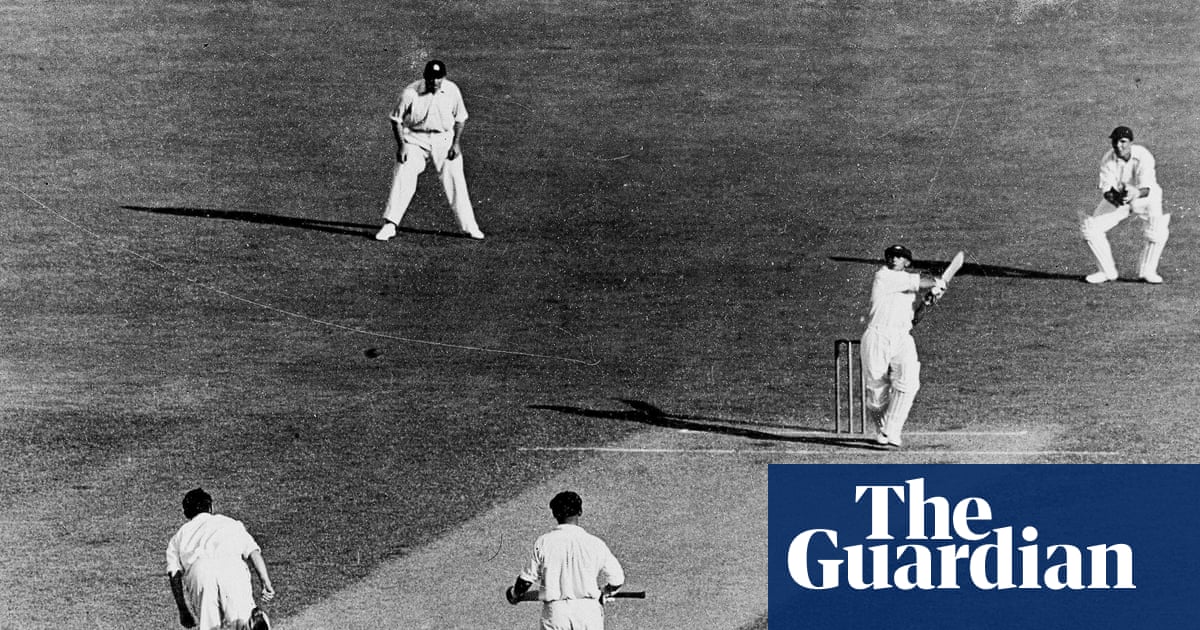
Australia’s Stan McCabe pulls away in the final Test of the 1936-37 series, an innings victory for the hosts. Photograph: Popperfoto/Getty Images
Neville Cardus was covering that tour for the Manchester Guardian, his beautifully written reports later gathered together within the pages of Australian Summer. In his own cracking book The Great Romantic, Duncan Hamilton reports that Cardus told Allen the night before the third Test: “For heaven’s sake clinch the rubber at once. Bradman cannot go on like this much longer.”
Cardus’s premonition was right. The third Test was at Melbourne, where, similar to the recent pink-ball Test at Brisbane, playing the conditions was as important as playing the ball. Thick, fat rain started to fall late on the first day and into the second, and the players were presented with a classic sticky dog. Bradman declared at 200 for nine and England were soon all in a tangle. With wickets falling quickly, and desperate not to have to bat again that afternoon, Bradman instructed his bowlers to send the ball wide of the wicket and dispatched his prowling close catchers away into the outfield. The next day was to be a rest day and the weather forecast was for hot sunshine. But Allen refused to gamble on bowling Australia out for a second time. He pressed on, and on, till England had lurched to 76 for nine, batting out precious overs as he did so.
Bradman then pulled out all his trump cards. He feigned ignorance of Allen’s declaration, politely insisting that the umpires went up to the English dressing room to confirm it, eating up precious minutes as they went. Then he instructed his tail-enders to pad up and sent them out to protect himself and the rest of the top order. Australia only had to bat for 18 balls before bad light closed the curtains. Thirteen wickets had fallen in three hours. It would be the pivotal day of the series.
More than 87,000 people crowded into the MCG when the Test resumed, and Bradman eventually came to the crease with the Australian lead 221. By the time he left it seven hours and 38 minutes later he had 270 runs to his name, he and Jack Fingleton had put on a world-record 346 for the sixth wicket and England needed 689 to win. Reader, they didn’t make it.
Allen had been out-thought by a master tactician. He deflated miserably, confidence now crumbs on the tea table. Already dismissive of the northern professionals he had to put up with, he dipped his pen in poison and in letters home dismissed his own side as “rotten”, Voce as a “fat pig” and complained about having to “give up almost all private parties just before or during big matches”.
Bradman went on to dance to a glorious 212 in 437 minutes at Adelaide, where Australia’s 148-run win drew them level. And a triumphant 169 in their innings and 200-run thrashing of England in the final Test completed Australia’s comeback.
In 2001, Wisden.com announced Bradman’s 270 as the greatest innings of all time (beating Brian Lara’s 153 not out against Australia at Bridgetown in 1998-99 into second place, with Graham Gooch’s unbeaten 154 against West Indies at Headingley, third).
Cardus, by now totally in love with Australia, summed things up. “The failure, as Australians realistically perceived and as they frankly stated – though in different words, was, at the pinch, a failure as much of character as of technique.”
Bradman never did lose a series as captain.
Tribe providing Jersey joy
Sometimes a cricket match pops up just when you need it, like 18 miles into the Málaga marathon. Last Sunday, the Spin’s ridiculously fit brother Tom had just reached that marker, with few runners and fewer spectators for company, when the route took him past a large expanse of asphalt.
There a game was in full swing, with a well-set field and proper stumps. He just had time to watch a beefy slug to midwicket before his legs led him away, past the Málaga FC stadium and on through the athletics stadium into the final quarter of the race. It was, he messaged afterwards, “a rare bright spot” in a tough last 50 minutes of running.
Though on the surface an unlikely place to come across a cricket game, Málaga is the home of European cricket. The Cartama Oval, nestled in the hills above the city, has hosted the final of the European Cricket League since 2022.
Asa Tribe has impressed for England Lions in Australia this winter. Photograph: Albert Perez/Getty Images
This year’s champions are the Jersey club Farmers, who defeated the Italian club Roma by 42 runs at the final back in March. Farmers, who qualified after winning their national Twenty20 competition, were captained by Zak Tribe, whose brother Asa toured Australia with the England Lions this winter. Asa earned his place after a breakthrough county season in 2025, helping Glamorgan to win promotion to Division One of the Championship and hitting the first first-class double century by a man from Jersey on the way. As an added bonus, he did it wearing glasses.
More runs have come in Australia, where his 129 not out during the Lions’ innings-and-127-run thrashing by Australia A has been the highlight of a tour that is proving tough terrain. In fact, unless something unexpected happened overnight, Tribe and Joe Root are the only English batters to collect hundreds against Australians this winter. Rare bright spots indeed.
Quote of the week
Lives lost senselessly, families shattered, the Bondi community traumatised. There are no words – only heartbreak” – Australia’s Usman Khawaja after the terrorist attack on Bondi beach during the Chanukah by the Sea celebration.
Memory lane
In December 1935, that man Bradman made his Sheffield Shield debut for South Australia, after moving from New South Wales, partly to take over as captain at Adelaide, partly to further his stockbroking career. He hit 117, against his old team, and in his next two innings for South Australia piled up 233 and 357.
Don Bradman, pictured batting at Lord’s in 1930, ended his first-class career with 117 hundreds. Photograph: Chronicle/AlamyStill want more?
The Christmas Test is a window to the world as Australia reels in wake of Bondi atrocity, writes Barney Ronay.
Geoff Lemon looks back at three tales from Adelaide Oval’s rich history as it hosts the third Ashes Test.
And here’s Barney again, visiting Square One, the big barn offering English cricket a brighter future.
… by writing to tanya.aldred.freelance@theguardian.com.
In?
To subscribe to The Spin, just visit this page and follow the instructions.