
NEW YORK — New York Rangers fans must be getting sick of hearing (and reading) the same comments.
Tuesday was yet another night when the Rangers talked about the scoring chances they created and offensive-zone time they generated, but it was also another occasion in which they failed to turn any of that into what they needed most: goals.
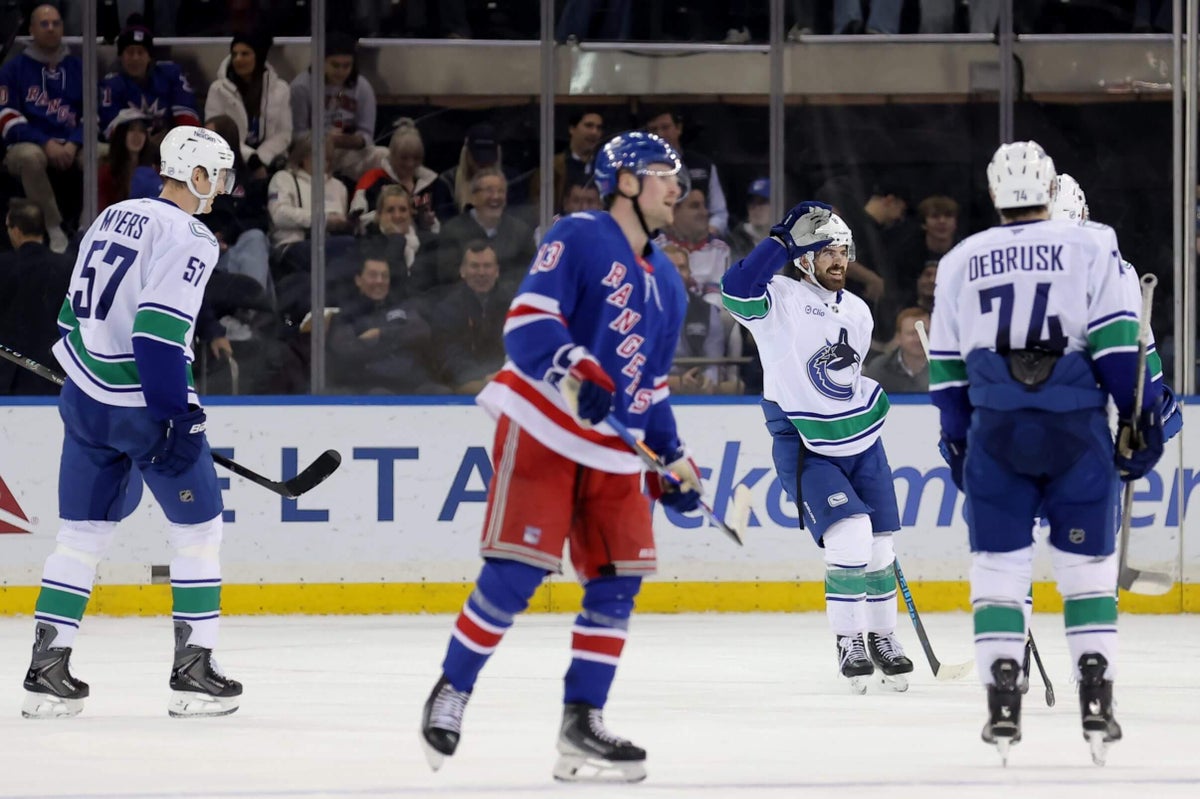
A 3-0 loss to the lowly Vancouver Canucks at Madison Square Garden — New York’s seventh shutout loss of the season and sixth on home ice — was the latest example. It was the third time this season the Rangers lost to a team that sat dead last in the NHL standings, as well as their sixth loss in as many tries (0-5-1) in the second game of a back-to-back situation.
“It’s really frustrating,” captain J.T. Miller said. “I feel like it’s happened too many times, where we’ve outplayed the opponent and we’re not coming out with a win. Once or twice is fine, but it’s happened a lot — especially at home, unfortunately. Our standard can’t be just playing well and not scoring.”
“We feel good during the game but right now it sucks. This can’t be the standard we expect to play to. Go home tonight and feel we outplayed the other team. We didn’t score. To come up 0-2 this week at home it sucks. Same thing every game it feels like”
– J.T. Miller pic.twitter.com/3LNglRcyM9
— Rangers Videos (@SNYRangers) December 17, 2025
The struggles at MSG have been most alarming, as evidenced by a 4-10-3 home record, but New York’s offensive limitations have been plain to see all season, regardless of venue.
The “it’s early” excuse no longer applies. As they approach the midseason point, the Rangers have only won 16 of 35 games overall. That’s a large enough sample size to draw conclusions, and their average of 2.51 goals per game, which ranks 30th in the league, tells us that this team has a serious finishing issue.
It’s left them searching for answers they admittedly can’t find. The harsh reality is they might not exist with the current personnel group.
“If I had the solution, we would certainly bring it,” said exasperated coach Mike Sullivan. “We’re doing our best to control the process, because that’s really, at the end of the day, what’s within our control. … I thought we defended hard. I thought we controlled territory. We had a significant amount of O-zone time. The power play had a lot of good looks, so I feel like we’re trying to solve it, for sure. But is it a little bit concerning at this point? Yeah.”
Here are eight more observations from another discouraging night at the Garden:
1. It’s a drum we’ve been beating most of the season, but it bears repeating: The Rangers’ top forwards are on the downside of their primes and the depth behind them severely lacks scoring punch. And without Adam Fox, who’s missed eight games and counting with a left-shoulder injury, the blue line can’t be counted on to contribute any offense at all. That’s not a winning recipe.
For perspective, Artemi Panarin and Mika Zibanejad are tied for the team lead with 11 goals apiece, which puts them on pace for about 25 each. The next-highest scorers are Miller and Will Cuylle, who both have nine and are trending toward 20 or so. If those paces hold, it would mark the first time since the 2020-21 COVID-19 shortened season (56 games) that the Rangers don’t have a 30-goal scorer. The last full season without a 30-goal scorer was 2017-18, when multiple players were shipped out at the trade deadline. Even then, though, three players scored 25.
“There needs to be more — more from me, more from the next guy, from whoever,” Miller said.
2. All the numbers were in New York’s favor — other than goals. The Rangers outshot the Canucks, 23-17, and had a clear advantage in possession. They registered six high-danger scoring chances in the first period alone, according to Natural Stat Trick, while limiting Vancouver to one. But it was another disappointing third. They entered trailing 2-0, but rather than desperately trying to mount a comeback, it looked like they had accepted their fate.
“To be honest with you, in the moment, it felt like we were dominating the game,” Miller said. “Then you get down to three minutes, you look up, and it’s 2-0. You’re thinking, ‘I can’t believe we’re pulling our goalie again.’”
3. Five of the first-period high-danger chances came from the power play, which earned three opportunities in the opening 20 minutes and four in total. The five-forward unit the Rangers have been rolling out since Fox went down looked as good as it has at any point in the last couple weeks, but it didn’t matter. The PP is now 2-for-22 since Fox’s injury, with neither of those goals coming with that five-forward grouping on the ice.
Cuylle had a prime chance on a redirect on the first power play that was saved by Canucks goalie Thatcher Demko, who later robbed Miller with a diving save on PP No. 2. He also stopped Vincent Trocheck from the slot on the third opportunity, while several other quality chances were wasted. The Rangers attempted 14 power-play shots in total, but only five went on net.
4. News flash: The Canucks aren’t very good. They just traded their best player to the Minnesota Wild and have effectively tanked their season. They aren’t particularly fast or skilled, and there are holes all over their defense. Give Demko some credit because he had a handful of really nice saves, but the Rangers squandered plenty of prime opportunities. Panarin had one that stood out late in the second period, when he was wide open in front of Vancouver’s net but seemed to hesitate or fumble the puck for a moment before shooting it right into Demko’s stomach.
“In a lot of instances, that’s the difference between scoring and not,” Sullivan said. “It’s not always the velocity of the shot as (much as) it is the release, or how quick you get it off so you don’t give the goalie an opportunity to get set. It’s just a little bit deliberate in the process. We’re trying to get better at that, with releasing pucks and things of that nature. That’s all part of it.”
5. On the other end, it wasn’t Jonathan Quick’s sharpest game. The goal he allowed to Liam Öhgren, who was part of the package the Canucks received from the Wild for Quinn Hughes, went off Quick’s right pad and trickled in to give Vancouver a 2-0 lead 3:24 into the second period. But when your team doesn’t score, there’s no sense in blaming the goalie.
6. The refs aren’t to blame for the Rangers’ scoring woes, but they didn’t do them any favors, either. They were definitely at fault on Vancouver’s first goal, when one effectively set a pick on defenseman Matthew Robertson to give Evander Kane an uncontested path to the net. There were also some very shaky calls. A couple penalties on Trocheck (slashing at 8:29 in the first period) and Noah Laba (tripping at 18:37 in the second) were debatable, at best.
7. After 11 straight games without a point, Brett Berard was a healthy scratch Tuesday. The 23-year-old frankly hasn’t made enough of an impact since being recalled last month, with a -2.2 net rating in this latest stretch, according to Hockey Stat Cards. He plays hard, but that aggression can get him caught in no man’s land at times. Making matters worse, the shooting reputation he brought from the AHL has been MIA, with only 10 shots on goal across those 11 appearances. The Rangers don’t have any great alternatives and are quickly reaching the point where they should lean into their youth and allow them to work through the growing pains, but the call-ups who have received looks so far this season haven’t exactly seized their opportunities. Add that to New York’s list of problems.
8. As soon as I saw Zibanejad in the postgame locker room, I approached him to ask for his side of the story that made waves Monday. Sullivan scratched him from what turned out to be a 4-1 loss to the Anaheim Ducks after the 32-year-old center missed a team meeting that morning. The coach cited “logistical challenges,” which Zibanejad said was a traffic jam caused by an accident while driving from his home in the city to the MSG Training Center in Tarrytown, N.Y.
“It’s my 10th season here,” he said. “I know what the (traffic) challenges are and whatnot, but it was an unfortunate situation. I got stuck. They had an accident. I’m just hoping everyone in that accident was fine. But rules are rules and I was late, so there’s not much else to say, honestly.”
The timing (the day of Chris Kreider and Jacob Trouba’s return to MSG) led to some outlandish conspiracy theories, but the real story isn’t nefarious. Zibanejad didn’t seem thrilled about it — and you could certainly make the case that encountering a car crash is a legitimate excuse — but Sullivan preaches accountability and believed it would set a bad precedent to make an exception. I don’t sense it’s any deeper than that.