
There is no denying it, most Brisbane people dislike King George Square. It is concrete, hot, and bland. Council argues that the current concrete slab serves as a great space for seasonal pop up events and commercial installations, but at what cost? Can a balance be struck to achieve a design that caters for moments like the lighting of the Christmas tree while still providing Brisbane with a genuinely enjoyable public space for the other 95 percent of the year?
The issue is not only one of functionality, but of philosophy. For decades, Brisbane has pursued the language of modernism without thinking about the warmth or civic grace that classical design once brought to public places. In doing so, the city has traded detail for efficiency and permanence for expedience. The result is a landscape of minimalism without memory, spaces that are clean but characterless, useful but unloved.
Across Europe, there is a noticeable shift back toward architecture with character and permanence. Countries like Poland, Germany and the Netherlands are reviving traditional building styles, and in Budapest the National Hauszmann Program is taking that idea even further. Entire palaces and civic buildings are being rebuilt in classical form, not as nostalgic replicas, but as new public landmarks designed for contemporary use. It shows what can happen when a government decides that beauty, craftsmanship and identity still matter in a modern city.
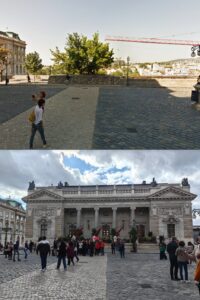
The Főőrség, or Guard House, is a newly rebuilt feature of Buda Castle in Budapest. 2015-2025
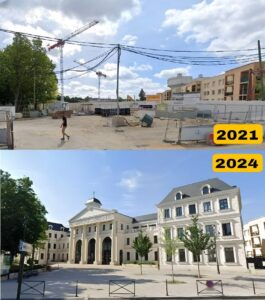
Clamart, France.
Before (2021):
The top image shows the construction site in 2021, with cranes and ongoing building work visible.
After (2024):
The bottom image displays the completed school complex in 2024, showcasing its classical architectural style.
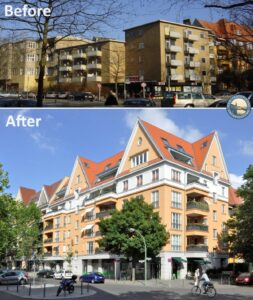
New buildings built in Berlin (Germany)
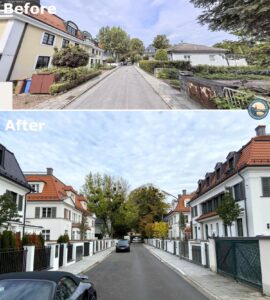
– Munich Germany. Project completion: 2025
Architect firm: Sebastian Treese Architekten with developer Dieter Berger Wohnbau GmbH (https://db-wohnbau.com/)
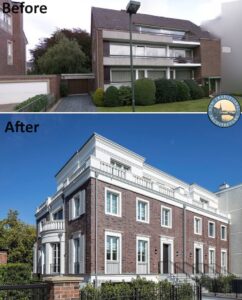
Düsseldorf, Germany. Project completion: 2025
Architect firm: Sebastian Treese Architekten (http://www.sebastiantreese.de/) with developer Dieter Berger Wohnbau GmbH (https://db-wohnbau.com/)
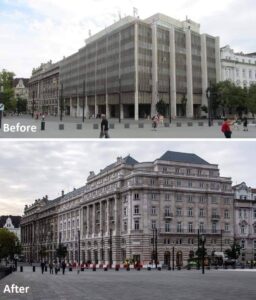
New building at Kossuth Square in Budapest, Hungary
Reintroducing classical design principles does not mean turning the city into a museum piece. It means rediscovering proportion, symmetry, rhythm, and a sense of human scale. It means creating places that are not only practical but emotionally resonant, spaces that uplift rather than simply accommodate. City Hall endures because it embodies these timeless qualities. It is grounded, beautiful, and built to last.
King George Square should reflect that same pride. Instead, it has become a flat expanse of stone that feels more like a transport interchange than the heart of a capital city. What Brisbane needs now is not just a redesign, but a rediscovery of beauty. By blending classical order with contemporary sustainability, the city could finally reclaim a civic square that feels both timeless and distinctly Brisbane.
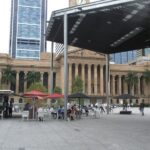
The current state of King George Square
The current square feels designed to survive rather than inspire. Functionally, it works, the buses run beneath, and the events still happen, but it is a space shaped by engineering rather than livability. It offers little shade, limited seating, and almost no water elements to offset the subtropical heat. For most of the year, it sits empty, radiating warmth back into the city like a tiled frying pan.
Cities such as Singapore and Seoul have shown what can be achieved when civic ambition meets climate intelligence. So why does Brisbane keep settling for mediocrity?
The 2008 redesign cost $28 million and gave us more concrete, not more character. This is a city with the climate, setting and cultural momentum to create something truly world class.
Each of the following ideas imagines how King George Square could transform into a civic heart worthy of City Hall, spaces where classical architecture, greenery, and water combine to create comfort, beauty, and a sense of belonging.
Brisbane Development incorporates AI-generated imagery to visualise design concepts. All ideas are independently conceived and editorially produced.
A Green Classical Heart for Brisbane’s CBD
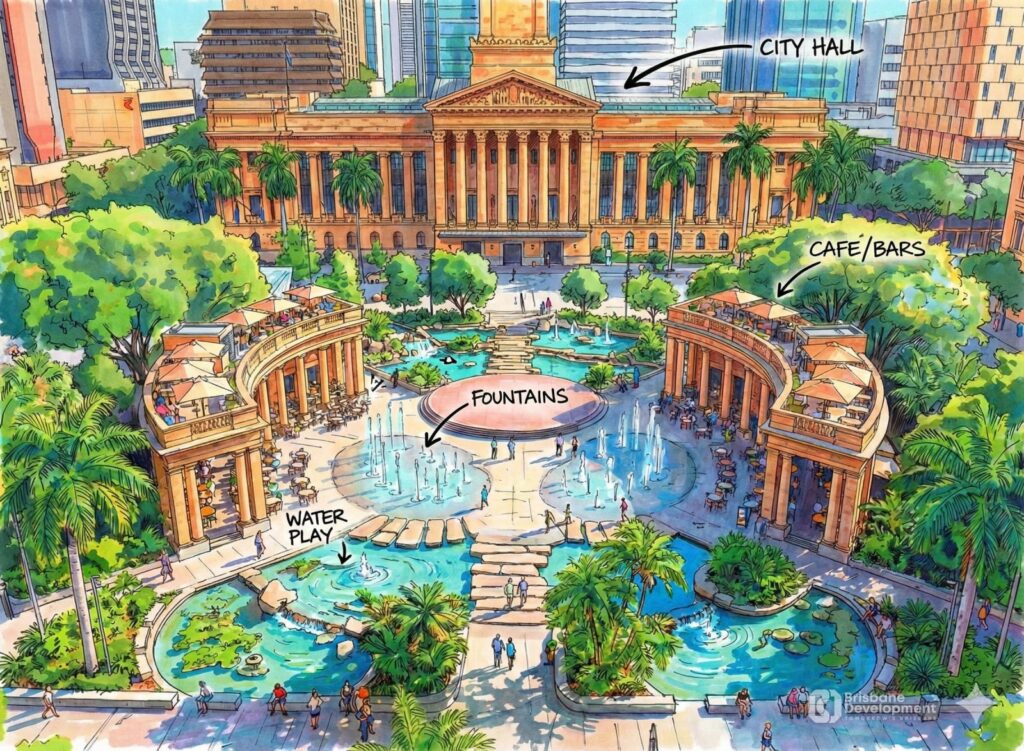
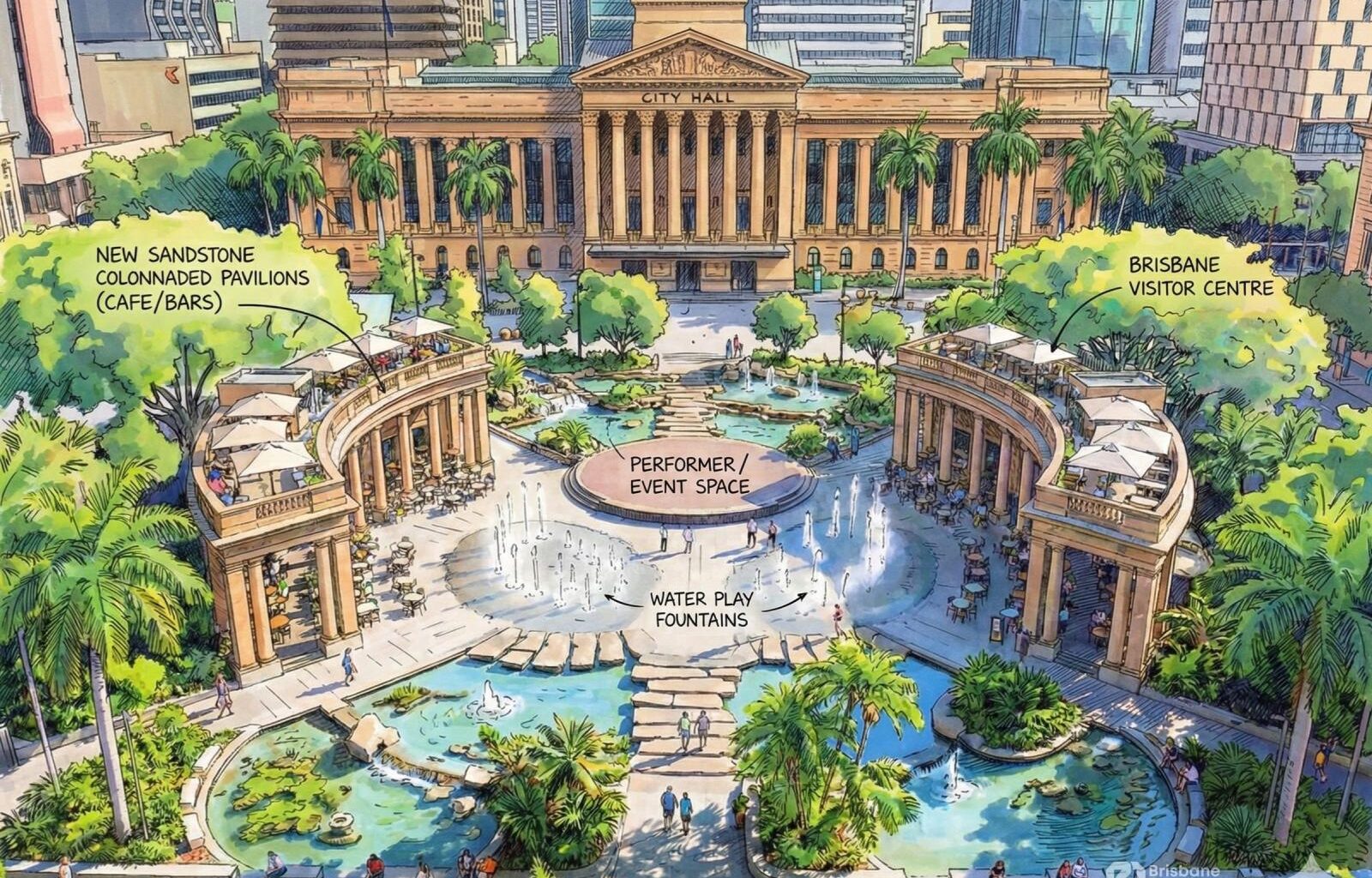
Conceptual sketch of a new King George Square highlighting water play areas, central fountains, café terraces and the City Hall frontage.
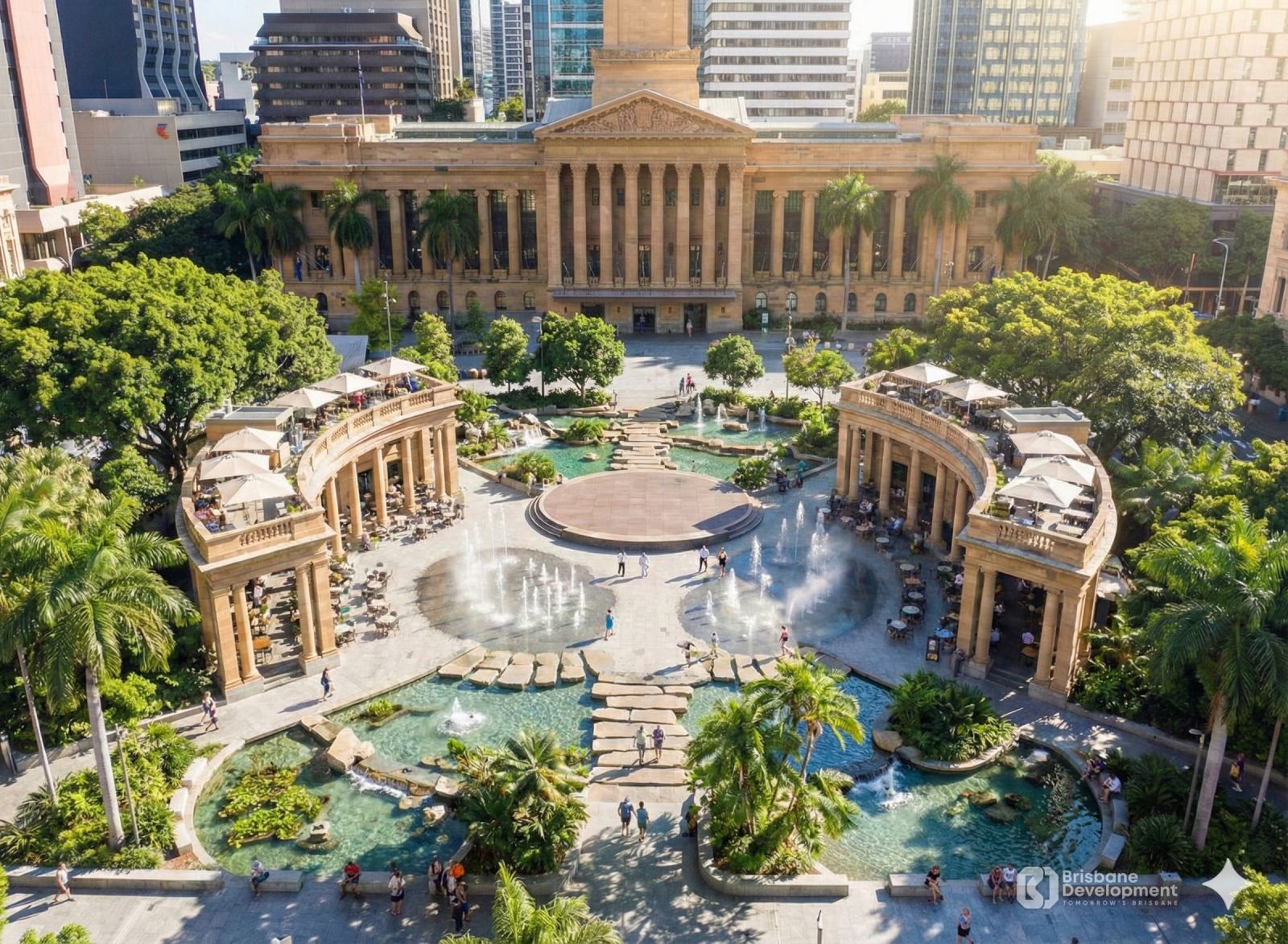
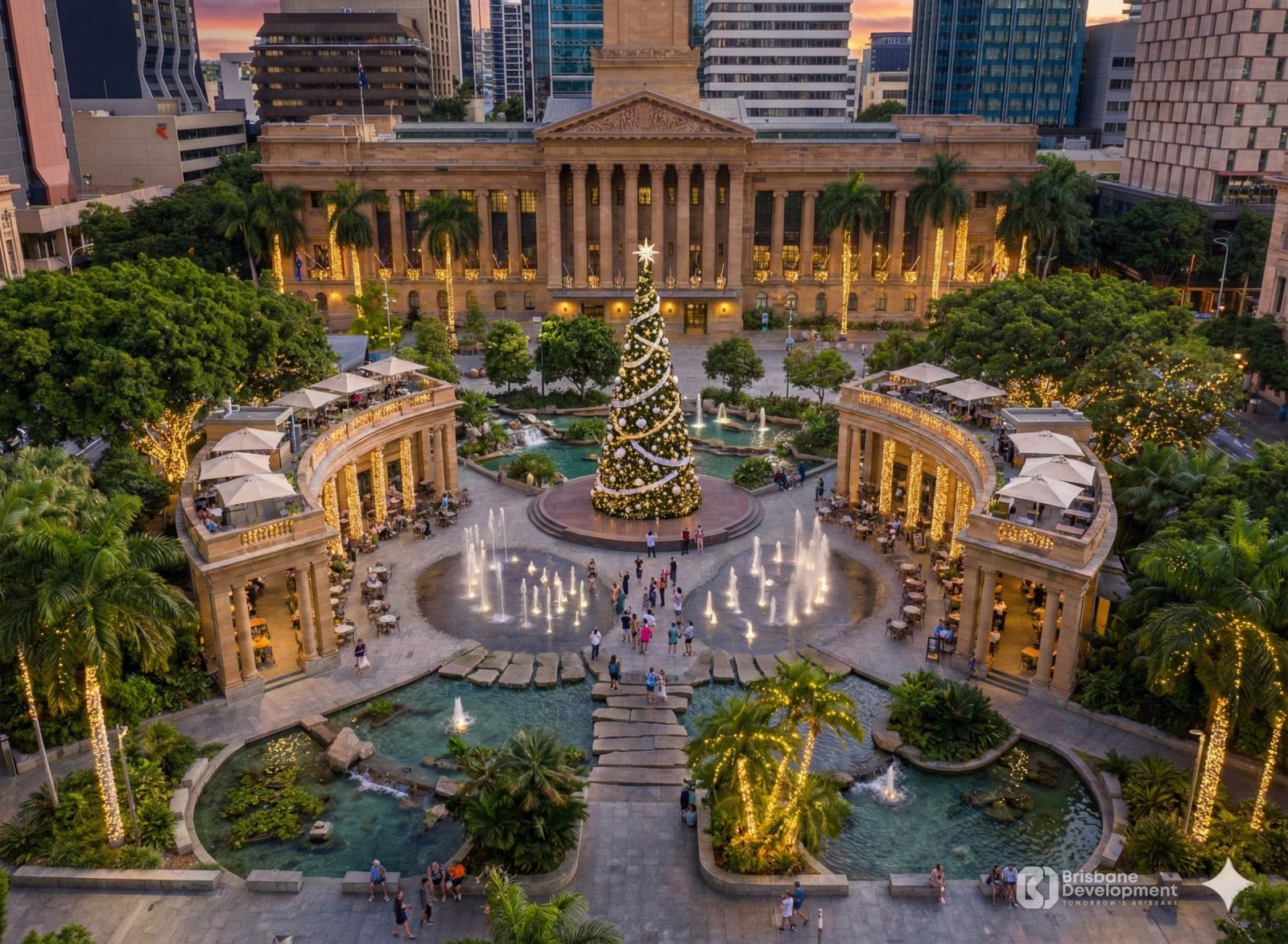 Concept rendering of a King George Square redesign showing water gardens, stepped pools, fountains, Christmas Tree and curved café terraces in front of Brisbane City Hall.
The concept design proposes a substantial reshaping of King George Square, replacing much of the existing hard paved surface with water gardens, stepped pools and programmable fountains. A central circular platform becomes the primary event space, while shallow water edges and stepping stones introduce informal pedestrian routes through the square. The design integrates more shade and subtropical planting to improve comfort and soften the space, while maintaining City Hall as the visual anchor.
Two new curved colonnade structures frame the square, each accommodating cafés or small hospitality tenancies at ground level with shaded rooftop terraces above. Their sandstone form echoes the architecture of City Hall, extending its presence into the public realm. These activated edges overlook the water features and create new vantage points across the space.
Together, the elements signal a shift toward a cooler, more recreational civic environment, with water gardens, planting and flexible event areas designed for everyday use as well as seasonal programming.
The proposal also raises a broader question about how civic spaces should serve a growing city. Large open plazas accommodate occasional major events, yet they often sit underused for much of the year. Conversely, spaces shaped for shade, water and everyday comfort support continuous public life but reduce the footprint available for one off gatherings. This concept leans toward the latter, suggesting that trading some event capacity can yield a square that genuinely works for people 95 percent of the year, rather than being defined primarily by infrequent spectacles or paid marketing campaigns.
City Hall Heritage Fountains
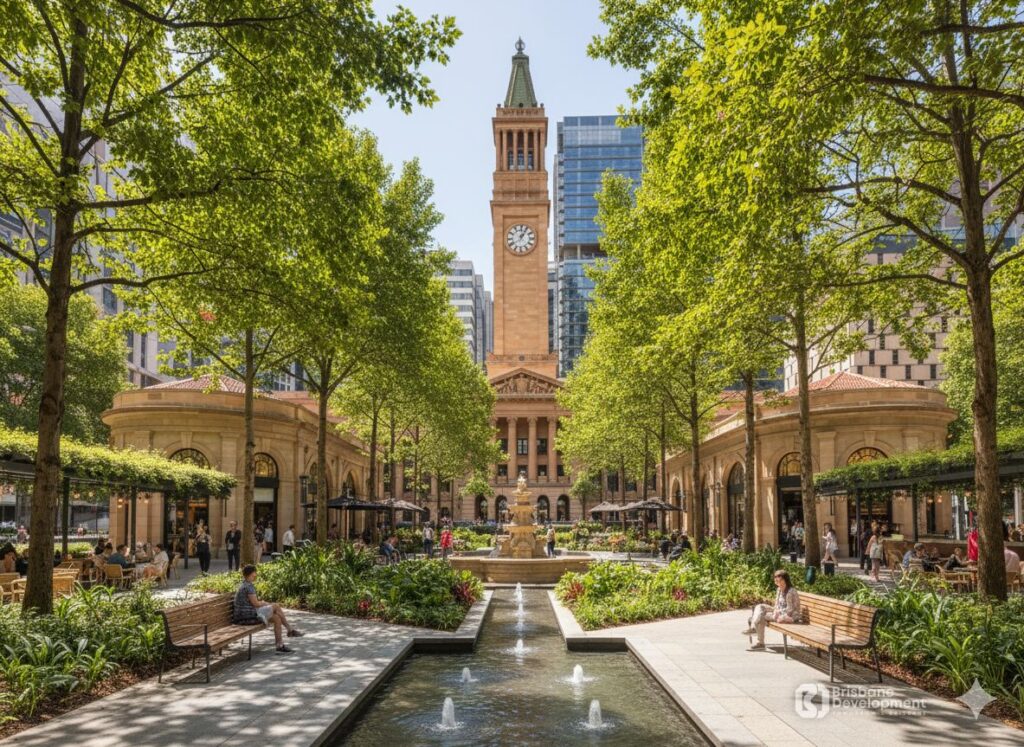
Concept rendering of the proposed City Hall Gardens concept for King George Square showing new classical style pavilions, a tree lined avenue, and a central water feature designed to complement City Hall’s architecture.
This concept proposes reimagining King George Square as a civic garden framed by architecture that speaks the same language as City Hall, sandstone colonnades, arched windows, and formal symmetry. Rather than competing with the heritage landmark, this design celebrates it by building new old style architecture that complements its character.
Tall shade trees form a green canopy leading directly toward the clock tower, while a long central water feature introduces reflection, movement, and cooling. The sound of water replaces the current echo of concrete, softening the atmosphere and reconnecting the square to its human scale.
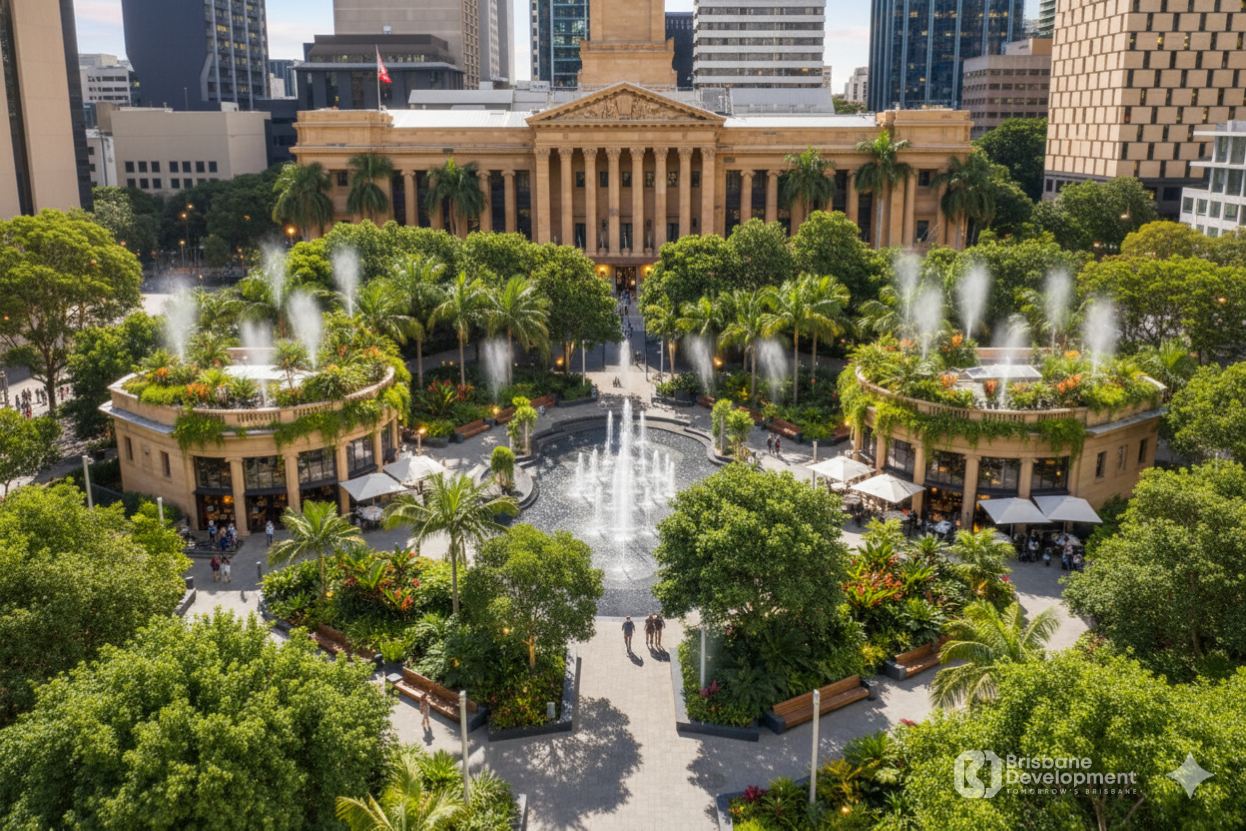
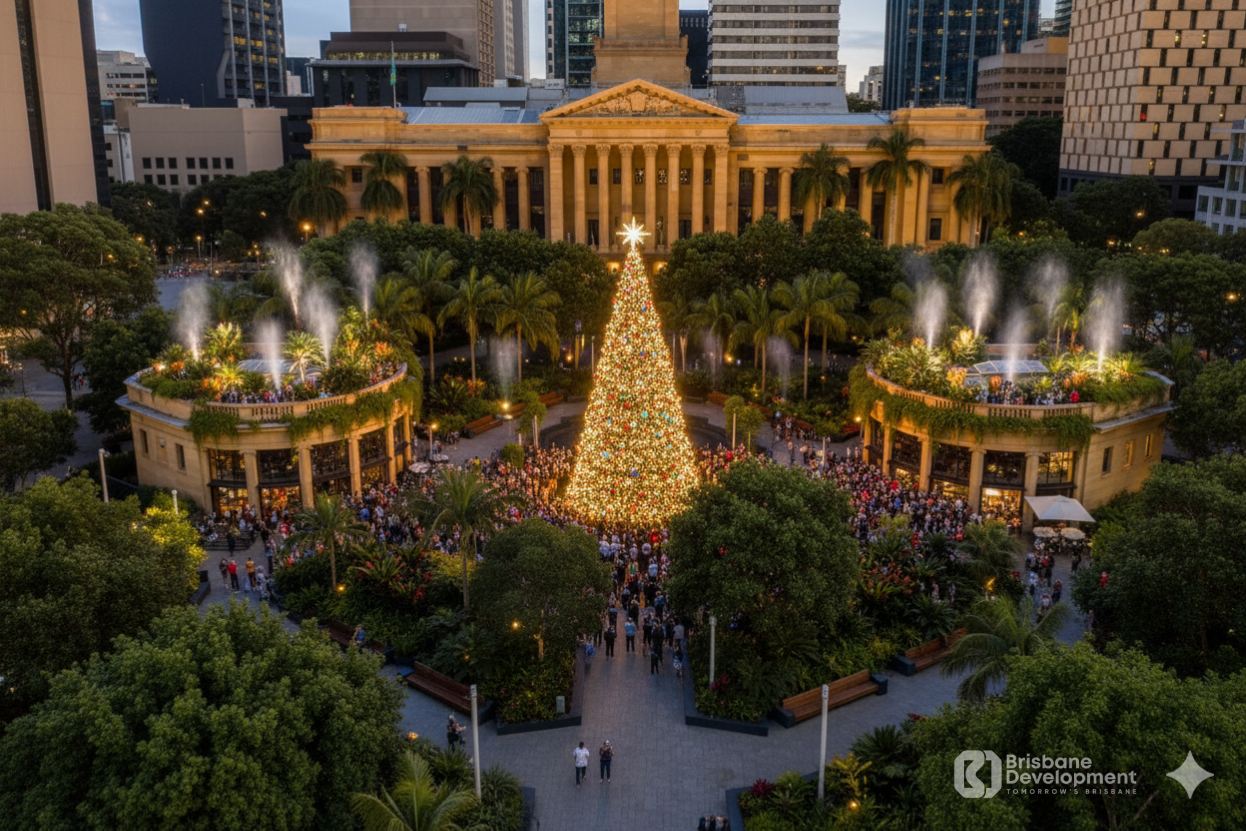 Concept rendering of the proposed City Hall Heritage Fountains concept showing a seasonal central Christmas installation framed by landscaped terraces and activated pavilion structures.
Architectural rendering of the City Hall Heritage Fountains concept showing curved sandstone pavilions, rooftop planting and a redesigned central fountain plaza.
Architectural rendering of the City Hall Heritage Fountains concept illustrating a stepped amphitheatre layout, integrated water features and landscaped pavilions framing the civic forecourt.
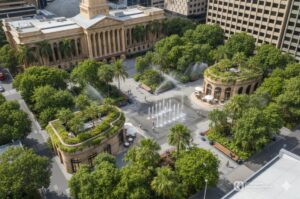
Architectural rendering of the City Hall Heritage Fountains concept highlighting the reconfigured plaza with upgraded water play elements, expanded greenery and rooftop terraces overlooking the square.
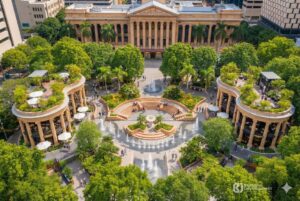
Architectural rendering of the City Hall Heritage Fountains concept featuring tiered seating terraces, water cascades and activated pavilion structures alongside dense subtropical planting.
New sandstone pavilions on either side restore enclosure to the space, housing shaded cafés, bars, and a proper Brisbane Information Centre that finally gives the city a dedicated civic welcome point that isn’t an afterthought. A central water feature provides movement and cooling, with fountains that can be turned off during major events to retain full flexibility. This ensures the square stays functional without losing its everyday atmosphere.
Together, these new buildings create a true civic courtyard that feels welcoming and alive throughout the day. The City Hall Heritage Fountain concept proves that boldness does not always mean futuristic form, sometimes the most radical thing a city can do is rediscover elegance.
Structural constraints are often raised as a reason why King George Square cannot support anything more substantial, since the existing design was kept lightweight to sit above the car park below. But when there is genuine civic ambition, these challenges do not have to dictate the outcome. If creating a world class public space requires additional structural support, then sacrificing a small number of car spaces in the basement to accommodate new footings is hardly an unreasonable trade. Cities that value their public realm find solutions rather than excuses, and Brisbane should be no different.
The Active Square
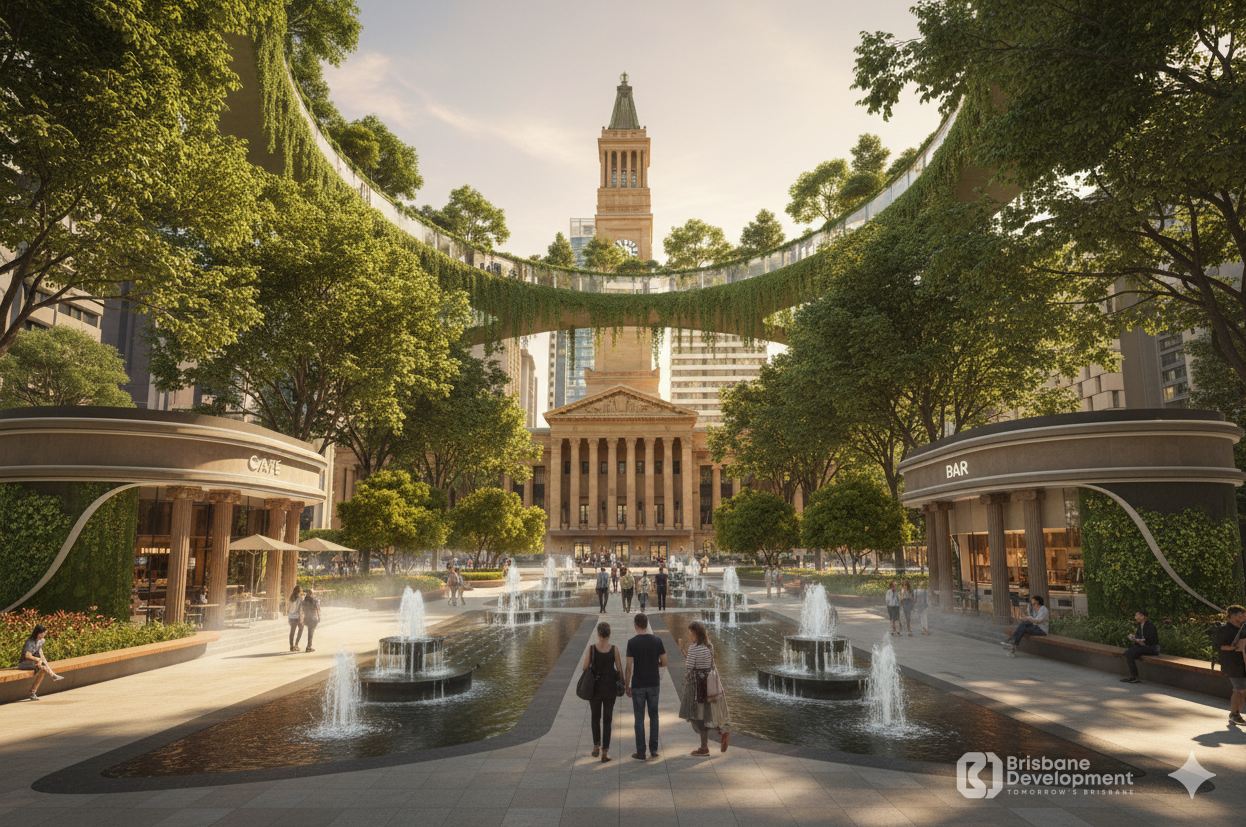
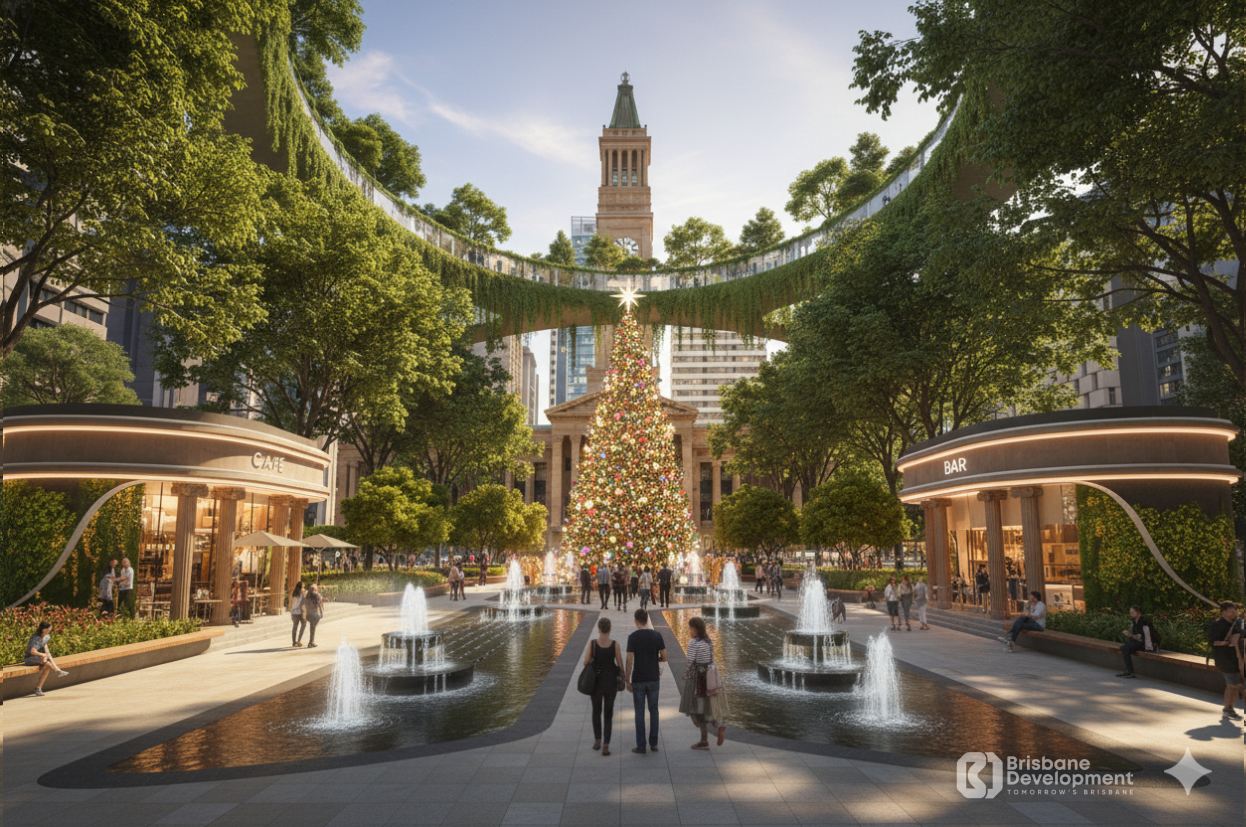 Concept rendering of the proposed Heritage Canopy concept for King George Square showing a tree lined civic plaza with cascading water features, curved café and bar pavilions, and a suspended green walkway framing City Hall.
This concept envisions King George Square as a layered civic garden where heritage and modernity coexist. The design respects the classical lines of City Hall while introducing contemporary elements that soften and cool the space.
A central reflecting pool anchors the plaza, bordered by fountains that provide both sound and motion. Textured stone surfaces replace the glare of bare concrete, while subtropical plantings bring vibrancy and resilience. Above, a sweeping elevated walkway draped in vines forms a living canopy, offering shade, new viewpoints, and a framework for art installations or lighting.
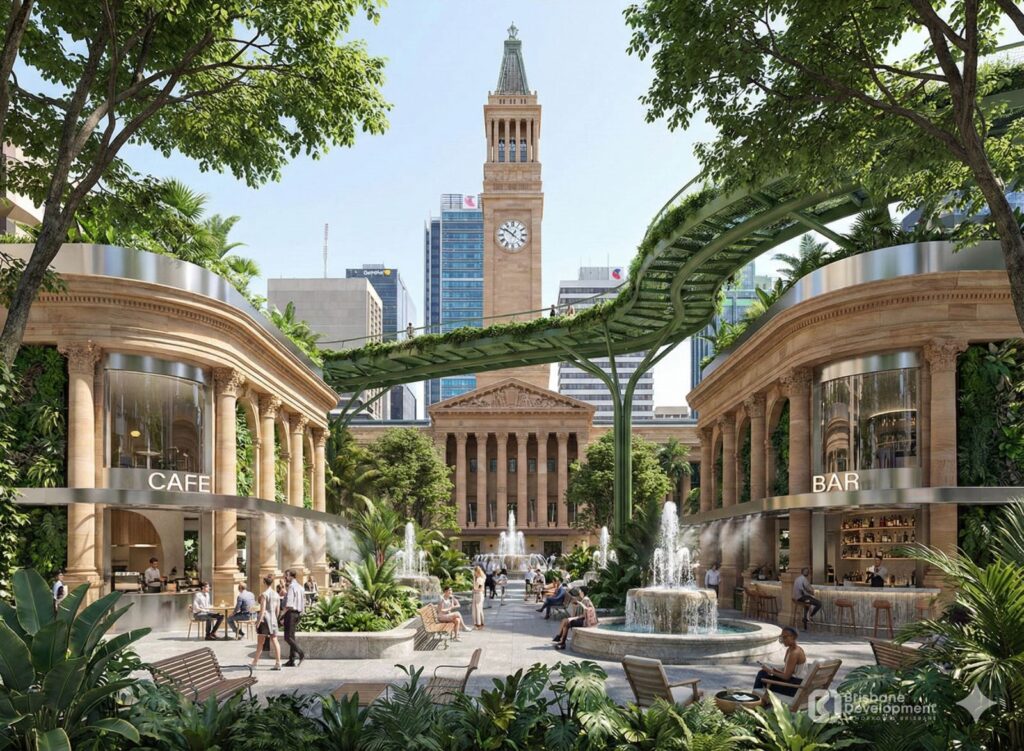
Concept rendering of a reimagined King George Square featuring new classical pavilions for dining, lush planting, active water features and an elevated garden walk aligned with the Brisbane City Hall clock tower.
Curved pavilions on either side mirror City Hall’s materials and rhythm, housing cafés that activate the square throughout the day. The open central spine remains clear for civic traditions like the Christmas tree lighting. The Living Square shows how design rooted in classical balance can still feel progressive, a civic space that feels alive without losing its identity.
The Garden Terrace Square
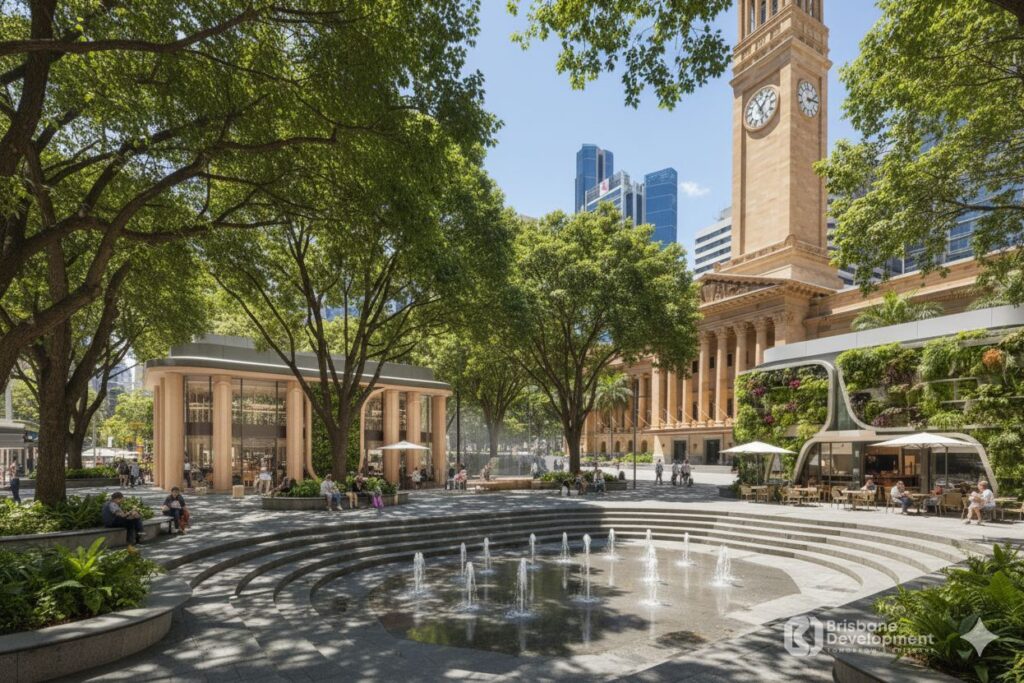
Concept rendering of the proposed Civic Terraces concept for King George Square showing shaded mature trees, tiered seating around a circular fountain, and heritage inspired pavilions integrated with green walls beside City Hall.
This concept reimagines King George Square with large mature trees that form a continuous shaded canopy, while curved stone terraces descend toward a water feature that anchors the space.
A shallow circular pool with playful jets introduces sound, movement, and cooling, and the tiered layout improves seating, accessibility, and visibility for events. What is now a flat, sunbaked expanse becomes a cooler, more human scaled plaza shaped for everyday use as well as civic gatherings.
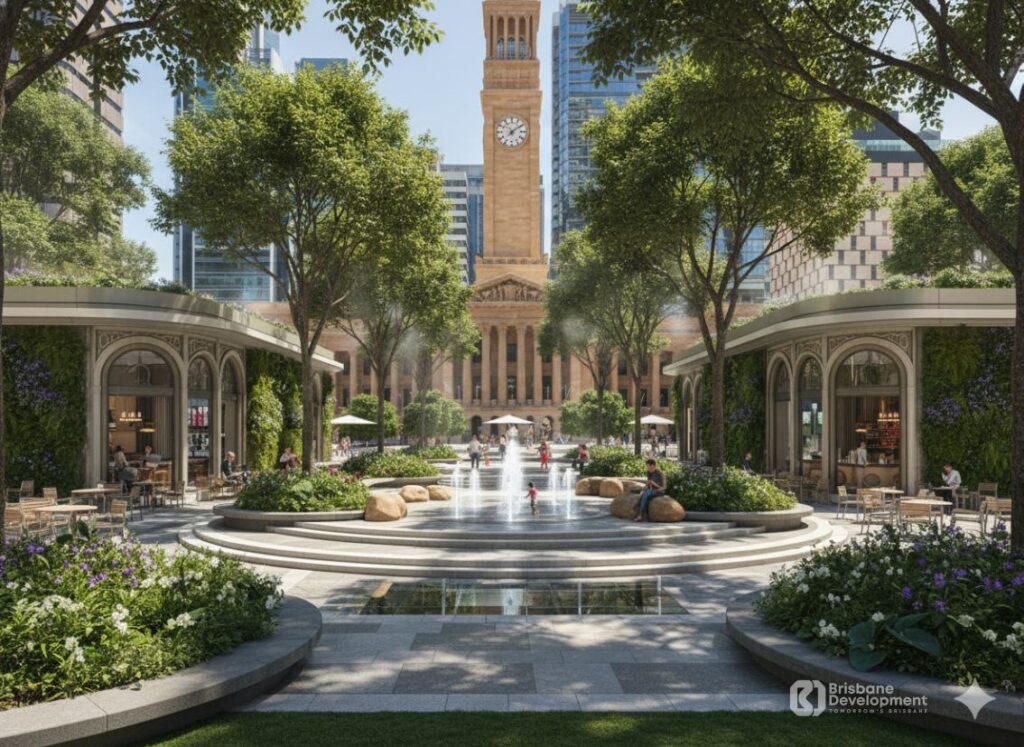
Concept rendering of the proposed Garden Pavilion Square concept for King George Square showing arched pavilion buildings with green façades, central fountains, and lush subtropical planting designed to complement City Hall.
Elegant pavilion buildings frame the edges of the square, echoing City Hall’s rhythm through sandstone toned colonnades, arched windows, and green facades. These pavilions house cafés, community spaces, and shaded outdoor seating that bring daily activity back into the square.
A vertical green wall adds texture and cooling, while layered subtropical planting softens the architecture and reinforces Brisbane’s sub-tropical identity. Together, the terraces, water features, trees, and classical inspired pavilions transform the square into a living extension of City Hall, a civic heart defined by symmetry, shade, water, and fine grained architectural detail.
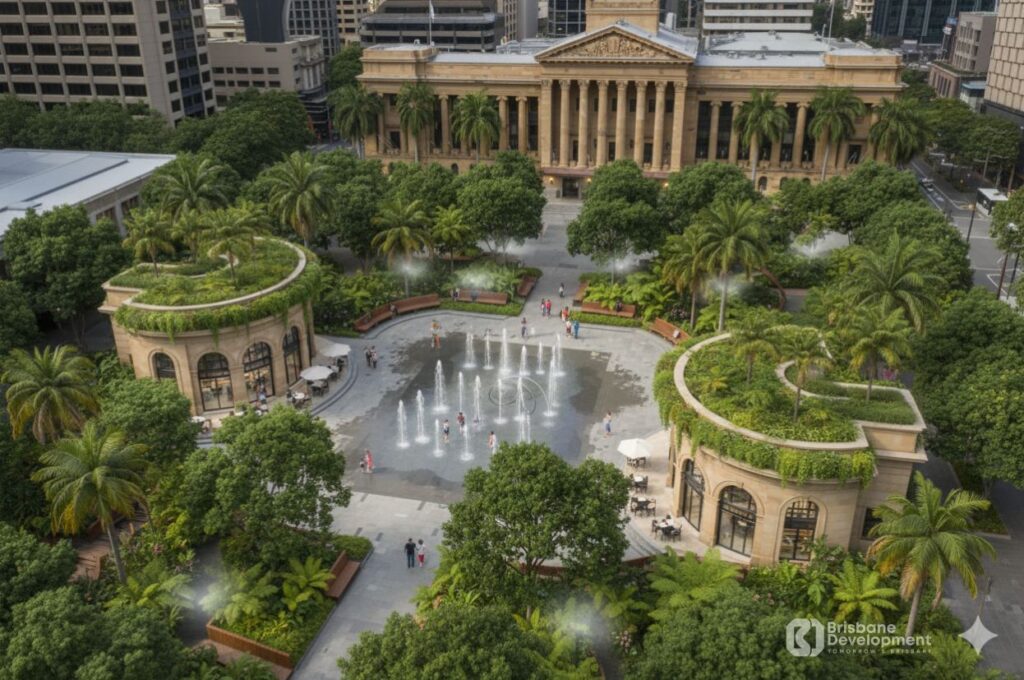
Concept image of King George Square’s proposed pavilion design with fountains and rooftop gardens facing Brisbane City Hall.
The path forward lies in flexibility and imagination, creating a space that can host thousands of people one night and still feel intimate enough for a lunchtime coffee the next day. This means introducing shade, trees, and water while maintaining an open civic core for major gatherings.
But beyond practicality, Brisbane needs to rediscover beauty. A new design of King George Square is due and should not only solve heat and usability, but also reawaken the city’s architectural spirit. Classical principles such as proportion, rhythm, and permanence can guide that process. They remind us that public spaces are not just backdrops for events, but expressions of civic pride.
Across all of these concept directions, there is a common thread: every idea, whether focused on greenery, water, heritage, experience, or performance, acknowledges that the square must become more human. A new square design needs to recognise that shade, comfort, identity, and a sense of place are non-negotiable if King George Square is ever going to feel like the civic heart of Brisbane rather than a thoroughfare. The debate is not about style; it is about raising expectations.
City Hall has stood for nearly a century because it was built with intent, craftsmanship, and belief in the value of beauty. The square in front of it should aspire to the same standard. By blending timeless architectural values with modern sustainability, Brisbane has the chance to create a civic space that looks forward while honouring the past, a place that feels not temporary, but enduring.
These ideas show that boldness does not have to mean experimental minimalism. It can mean building something dignified, beautiful and lasting, something that future generations will still look at and think, “they actually got that one right.”
So the question is not whether we can fix King George Square. It is whether we will ever choose to.
Because really, at some point Brisbane has to stop saying “yeah… that’ll do” and start asking, “why can’t we have world class civic spaces in this city?”