
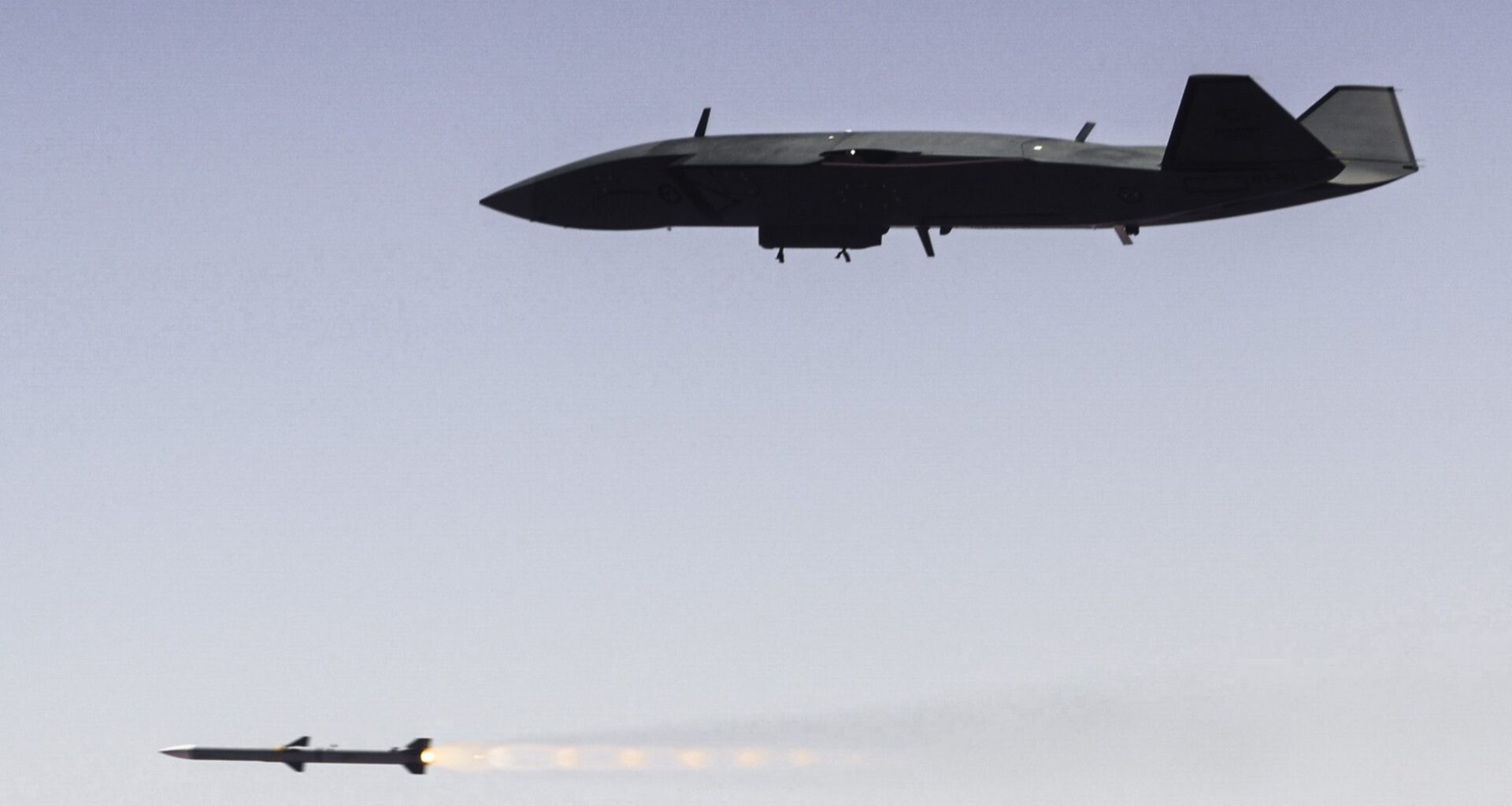
 An MQ-28A Ghost Bat Block 1 aircraft fires an AIM-120 AMRAAM missile as part of Trial Kareela 25-4. (ADF)
Boeing Defence Australia securing an additional order for seven MQ-28A Ghost Bats underscores Australia’s commitment to the type as its selected future collaborative combat aircraft (CCA) under the Project Air 6015 Autonomous Collaborative Platforms – Air programme.
The latest order, announced by Boeing Defence Australia on 9 December, confirms a third tranche of MQ-28As – six in Block 2 configuration, plus a further one as the first Block 3 aircraft.
Valued at A$754 million (US$500 million), the acquisition adds to eight MQ-28A Block 1 aircraft currently supporting tests and evaluations with the Royal Australian Air Force (RAAF). Three other Block 2 aircraft, ordered in February 2024, will enter assembly in 2026 and roll out towards the end of the year.
The RAAF said the latest order will grow the total MQ-28 fleet to ten by 2030, implying that only Block 2 and 3 aircraft are seen as part of the force’s operational capability.
In a press conference in Sydney the same day, Minister for Defence Industry Pat Conroy also confirmed that Australia will move the Ghost Bat from testing and prototyping status into production, and that this CCA will enter service with the RAAF.
Conroy also disclosed that the MQ-28 had successfully conducted its first air-to-air live-fire test with the launch of an AIM-120 AMRAAM advanced medium-range missile against a drone target on 8 December.
During the mission, the MQ-28 operated alongside and received sensor and targeting data from an RAAF F/A-18F Super Hornet, whilst an E-7A Wedgetail provided overwatch.
For the trial, the AIM-120 was carried externally on the aircraft’s underside due to the absence of an internal weapons bay. However, Block 3 aircraft are expected to incorporate such a feature.
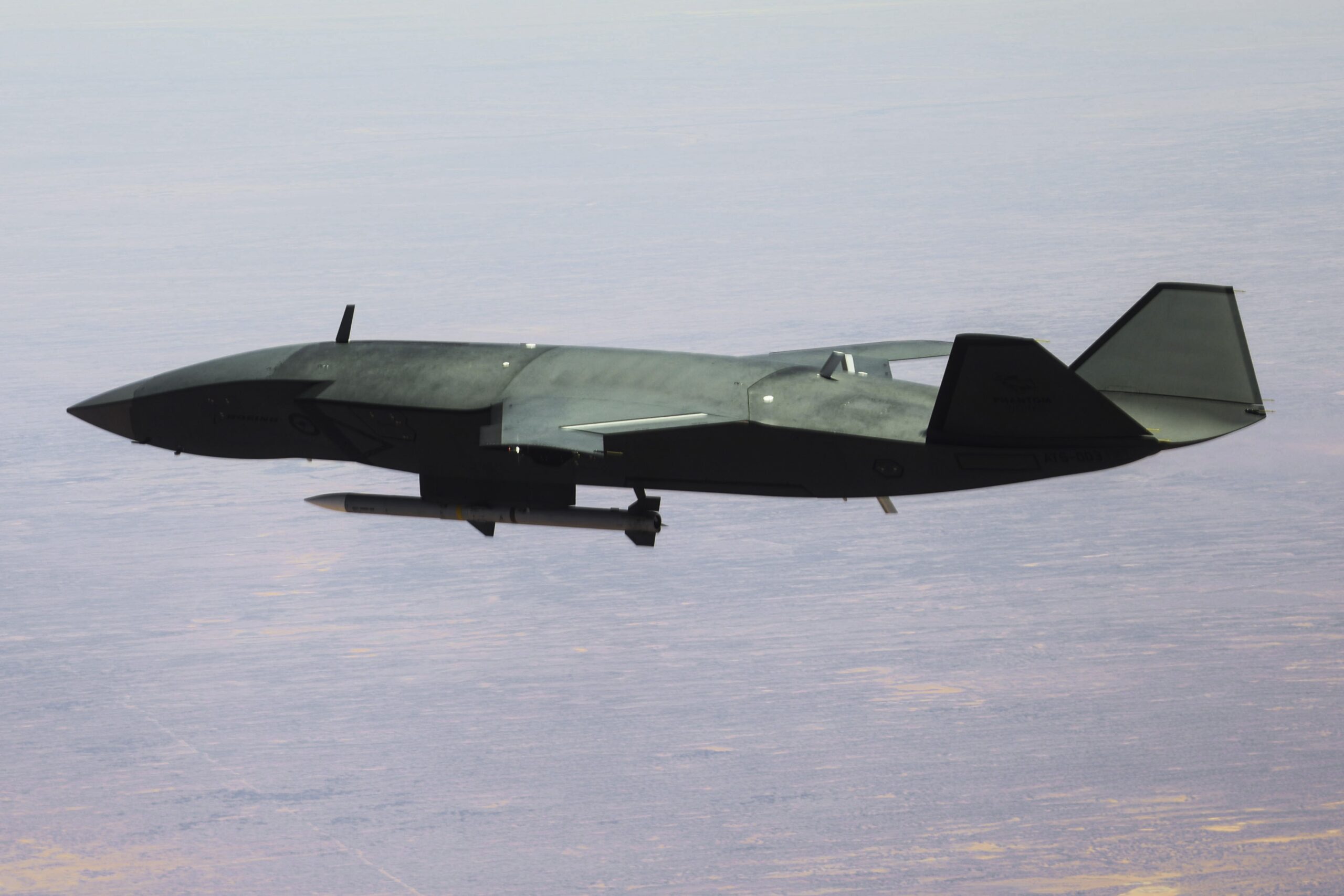 As the current configuration of the MQ-28A lacks an internal weapons bay, the AMRAAM was carried on a belly weapon station. (ADF)
The announcements cement the MQ-28A as the RAAF’s CCA platform. Anduril had previously sought to interest the RAAF in its Fury unmanned platform, which was down-selected by the US Air Force for Increment 1 of its CCA programme last year. It is designated the YFQ-44, and Anduril had exhibited a model of the Fury at the Avalon International Airshow in March 2025.
As Australia takes gradual steps in the MQ-28A programme – after all, it is the country’s first combat aircraft designed and built domestically in more than 50 years – it remains to be seen how the Ghost Bat will evolve.
A higher-end CCA or even a fighter-like unmanned combat aerial vehicle (UCAV) that emphasises performance, endurance and low observability could be a possibility.
Australia is seeking to expand its long-range deterrence capabilities and operate at greater distances across the region, including in scenarios such as a Taiwan contingency or in response to attempts to block key maritime choke points in the Indo-Pacific. In this context, UCAVs – whether operated with a human in the loop or with a higher degree of autonomy – could play a valuable role in projecting airpower at greater range.
Follow-on unmanned platforms could also leverage the back-end architecture that has been established for the MQ-28A, reducing development risk and accelerating capability maturation.
This may come as Australia recapitalises its air combat fleet, and might see the introduction of a family of systems.
This may comprise, for example, a sixth-generation fighter akin to the multinational Global Combat Aircraft Program, as well as longer-range and harder-hitting munitions like the Hypersonic Attack Cruise Missile, which Australia will receive in the years ahead.
by Roy Choo