
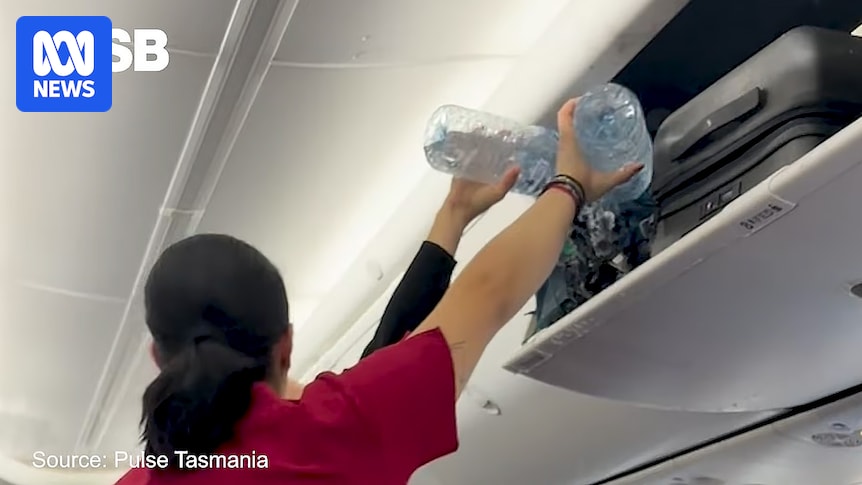
Australia’s transport safety regulator has reiterated warnings about the use of power banks on airplanes, in its report into a fire on a passenger flight earlier this year.
The Virgin Australia Airlines Boeing 737-800 was travelling from Sydney to Hobart on July 21.
About 10 minutes prior to landing, cabin crew were doing final checks when one member heard “a popping and hissing sound”.
They then spotted flames and white smoke coming from an overhead locker.
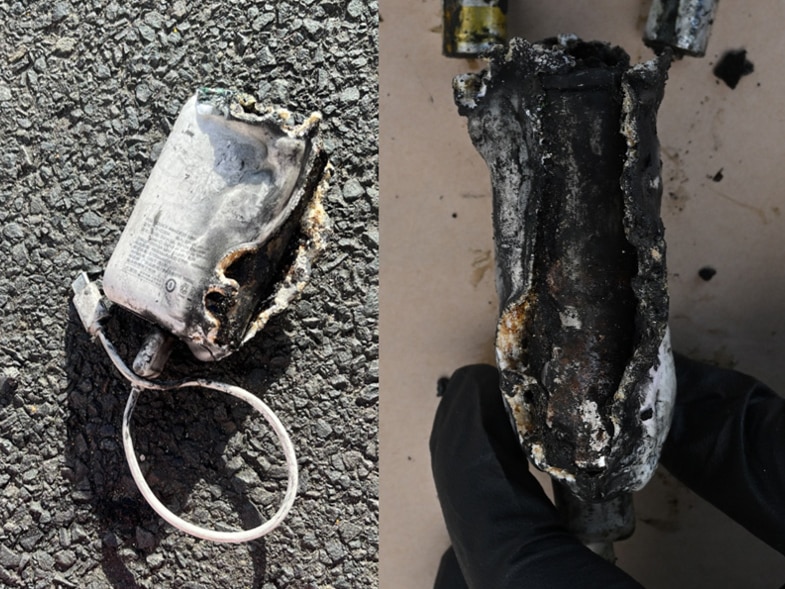
The investigation found the fire started after the lithium-ion battery in the power bank “experienced a thermal runaway”. (Supplied: ATSB)
Nearby passengers were instructed to move away from the area and into other seating on the aircraft.
When the crew member opened the locker, they found a backpack on fire.
They were able to extinguish the flames and poured water on the backpack until it stopped smoking.
The plane was then landed safely.
An inspection found the fire caused minor damage to the overhead locker.
After landing, firefighters boarded the aircraft and found a burnt power bank inside the backpack.
Fire was caused by ‘thermal runaway’
In its report, the Australian Transport and Safety Bureau (ATSB) found the lithium-ion battery in the power bank “experienced a thermal runaway” that resulted in a fire.
Thermal runaway is a chain reaction, often caused when a battery cell short-circuits, which leads to rapid and uncontrolled temperature increase.
The ATSB said the owner has informed Virgin the power bank had been purchased in 2024, had no pre-existing damage, was fully charged with no prior issues and had not been dropped, exposed to moisture or heat prior to the incident.
In its report the ATSB also found that while cabin crew “attempted to use the protective breathing equipment provided by the operator, difficulties during its fitment meant that they did not find it effective in this incident”.
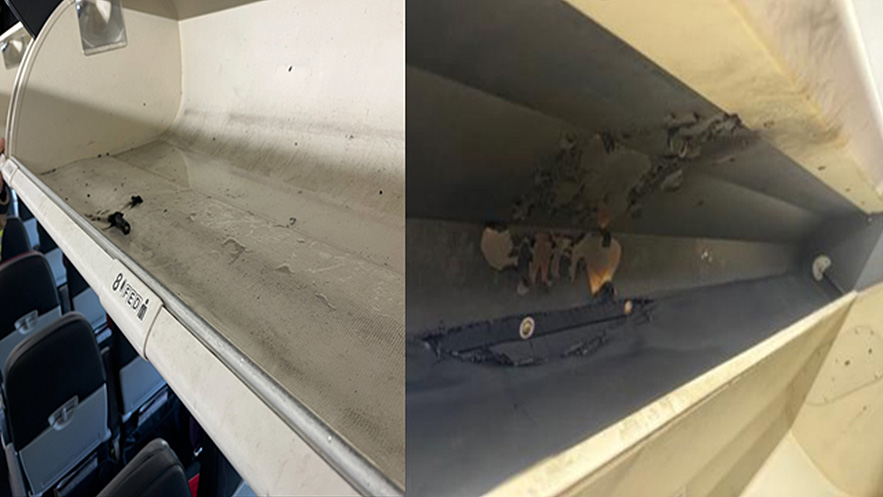
The overhead locker on the Virgin Australia flight suffered damage as a result of the blaze. (Supplied: ATSB)
The incident was the first time in Australia that a power bank had caught fire on a plane, although there had been previous incidents where smoke was reported emanating from a power bank in a plane’s cabin.
Internationally, there have been a number of significant fires resulting from power banks, including a South Korean flight in January, where the plane had to be evacuated and the aircraft was destroyed.
In the past 10 years, the ATSB said there were four in-flight fires on Australian flights as a result of mobile phones.
Three of these fires occurred when the phone was crushed by the seat and the lithium battery was damaged, while the cause of the fourth is unknown.
Airline updates rules
Virgin Australia has since reviewed its policy around the carriage of power banks and spare batteries.
While they were previously carry-on only, there were no restrictions for their use on board and they could be stored inside a bag.
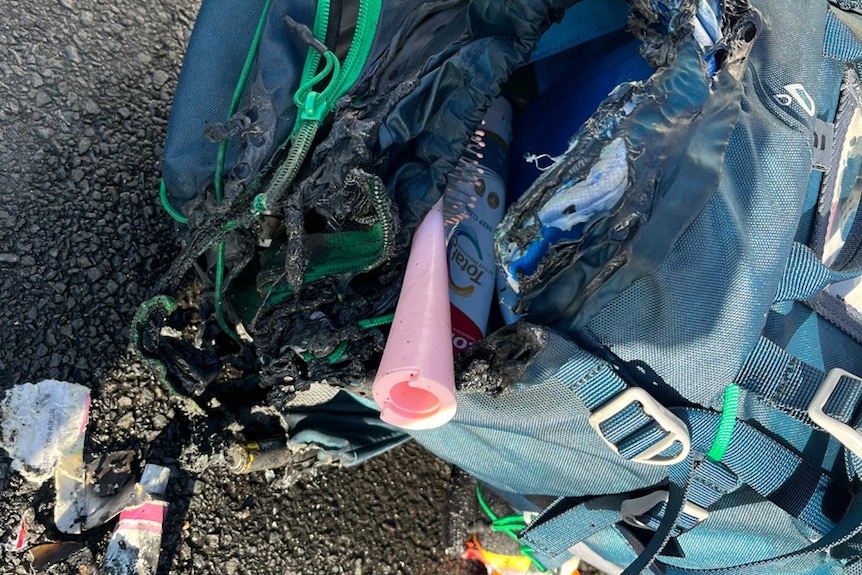
The remains of the backpack in which the battery pack was being stored during the fire. (Supplied: ATSB)
As of December 1, power banks, spare and loose batteries must be stowed in the seat pocket, under the seat in front or kept in people’s hands.
They cannot be stored in overhead lockers or used on board.
On top of that:
Each battery and power bank must be individually protected to prevent short circuiting by placing it in the original retail packaging, in a separate plastic bag, a separate protective pouch or insulating the terminals by applying tape over the exposed terminals.Only bring batteries and power banks that are clearly labelled and made by reputable manufacturers. Unlabelled, damaged, leaking, subject to product recall, and counterfeit batteries or power banks must not be brought on board the aircraft.Power banks must not be used to charge other devices on board the aircraft. Even when not in use, remove all cables/USB cables connected to power banks and batteries.Power banks and batteries must not be recharged using the aircraft’s power supply.