
The nation’s second-largest telco failed to adequately execute a service upgrade on September 18.
The misstep has been linked to two deaths.
Experienced executive Kerry Schott was tasked with getting to the bottom of what happened, why it happened, and what to do about it.
The report titled The Triple Zero Outage At Optus: 18 September 2025 has been published.
It reveals numerous errors by Optus, both in the implementation of the network upgrade and the risk management procedures the telco had in place to troubleshoot the problem.
Most troubling, perhaps, is the use of the word “urgent” in the report.
It says that despite the failure by Optus to facilitate the Triple Zero emergency service twice, in 2023 and 2025, and the work the board has already done to rectify the problems, more work needs to be done “urgently”.
Essential services catching up with technology
In the early hours of September 18, and for the following 14 hours, 605 callers sought Triple Zero emergency services and assistance of some kind.
Most of those callers were met with silence on the other end of the phone.
Ms Schott appears concerned that there is an ongoing problem between the Triple Zero service and the phones being connected to it.
Senate estimates heard thousands of devices were being tested for Triple Zero connectivity. (ABC News)
“It is a highly regulated system that was originally designed in a world of 2G and 3G,” she says.
“Australian networks have essentially disabled 3G and run on 4G and 5G.
“Devices have become far more sophisticated and new models typically include various changes in their operating characteristics.”
Schott ‘puzzled’ by inconsistencies Optus held triple-0 crisis meetings before telling government
Independent telecommunications analyst Paul Budde has linked a technology mismatch between modern mobile networks and the Triple Zero service, and the time it took some Optus customers to be connected to emergency services.
The report suggests that if some callers had held on for longer, they would have eventually been connected.
In total, 605 people tried to connect to the Triple Zero service, and 150 were successful.
Ms Schott thought this was “puzzling”.
“Why the camp-on procedure did not work is a puzzling feature of this incident,” she wrote.
Telcos are required to have camp-on features, which re-route callers to available networks during an emergency.
Most callers over those 14 hours did not get rerouted, but some did.
“What emerged from the behaviour of devices at the time is that for many calls it may take 40-60 seconds to camp-on,” Ms Schott wrote.
“In an emergency, people are unlikely to hang on for this length of time, especially when the only response they are getting is silence on the line.
“There were calls from the same mobile phone models and types that were both successful and unsuccessful.”
How the Optus triple-0 outage unfolded
Mr Budde said it was an “alarming finding”.
“In a real emergency, people don’t wait that long. That’s a national problem, not just an Optus one,” he said.
“It is amazing that we didn’t know this earlier, as this has been going on now for several years.
“This should at least have been picked up with the closure of the 3G network.”
Optus incident riddled with errors
That is just one key issue in a 40-page report referencing numerous mistakes made by Optus and its contractors in implementing upgrades and rectifying mistakes.
Indeed, the report notes the instructions about the change needed for this upgrade, given by Optus to its contractor Nokia, “were incorrect”.
It set off a chain of events riddled with mistakes.
Ms Schott notes: “At a general level, risk management must be elevated so that all three lines of defence in risk management are working properly.”
Alarmingly, she added that, “this is not the case at present”.
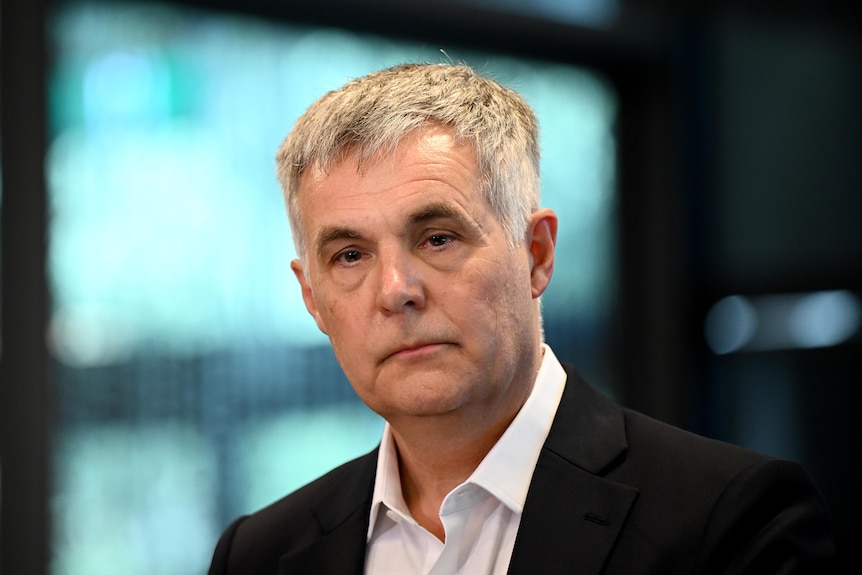
Optus chief executive Stephen Rue. (AAP: Bianca De Marchi)
Communications Minister Anika Wells summoned Optus parent company Singtel’s boss, Kuan Moon Yuen, to Sydney to meet with her and Optus’s chairman John Arthur and CEO Stephen Rue.
At a press conference, Mr Yuen said Mr Rue had his support because he was there to whip Optus into shape.
This report highlighted that Mr Rue still had catching up to do:
“The work in the risk management and audit areas is being oversighted by the two relevant Board Committees at Optus, led by two Directors with appropriate expertise.
“However, because the local Board has only recently been strengthened, their oversight work, and that of the CEO, has just started.”
Mr Budde said, candidly, there was not a moment to lose in this risk management and audio work Optus was undertaking.
“I am still worried about very strong immediate and structural action,” he said.
“We have not just this Optus incident, but several similar incidents from all the major players.
“So the Optus issue should be treated as a warning, not an anomaly.
“Unless we start governing telecommunications as critical infrastructure, similar failures are inevitable,” he said.Repeated mistakes
As with any tragedy, following the shock, sadness, and anger, those affected simply want reassurance that the incident won’t happen again.
At the very least, people want to know everything possible is being done to prevent a repeat.
The Schott report makes clear that, following the 2023 Optus network outage, the recommendations made in a report by Richard Bean, “had been implemented by Optus”.
However, Ms Schott adds that “further improvements are possible to go beyond the regulated requirement.”
The board is now tasked with “strengthening the resilience and reliability of the network; streamlining complex IT architecture and critical platforms to reduce complexity for employees and customers; and working urgently to improve processes, the need for which has been highlighted by this incident.”
It is clear then that Optus is in a race against time to ensure it can guarantee customers will be able to reach help in their time of need.