
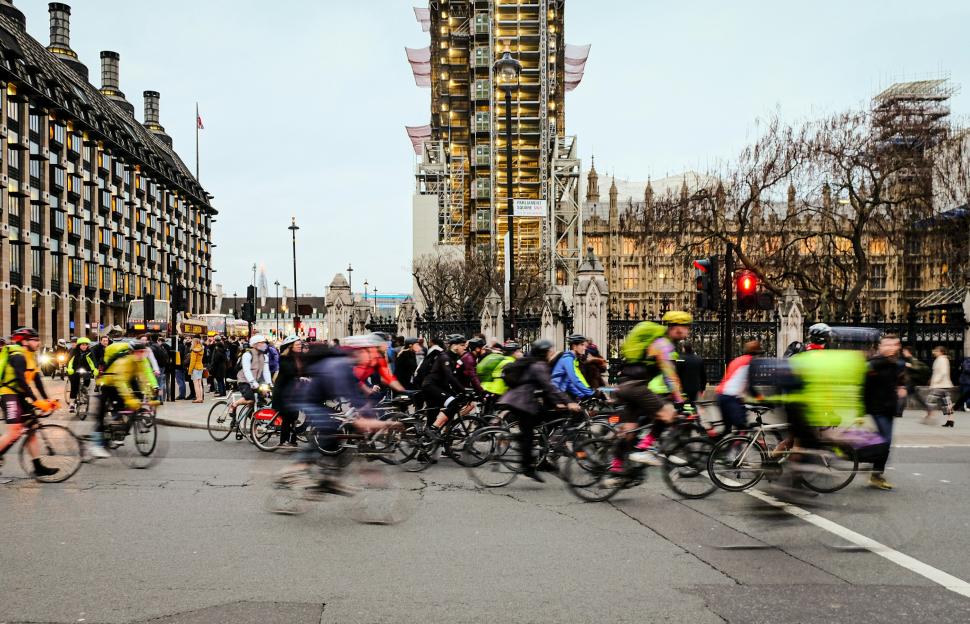
London has become a “Wild West” thanks to cyclists riding on pavements at speeds of “up to 70 miles per hour” and exhibiting an “arrogant culture of non-compliance”, the House of Lords was told this week, with one former Conservative minister asserting that, as a pedestrian in central London, “you take your life in your hands every day”.
Baroness Lucy Neville-Rolfe’s ominous claim came during a debate in parliament’s upper chamber this week on the Labour government’s Crime and Policing Bill, which could lead to cyclists facing similar punishments to drivers if their kill or injure by dangerous or careless riding, as part of a new ‘dangerous cycling’ law.
According to Baroness Neville-Rolfe, a life peer who held several ministerial roles under various Conservative prime ministers between 2014 and 2024, thanks to dangerous cyclists, London has been turned into a “Wild West”.
“As a pedestrian, particularly in central London, you take your life in your hands every day,” she said, adding that both her and her husband had been struck by cyclists in the capital.
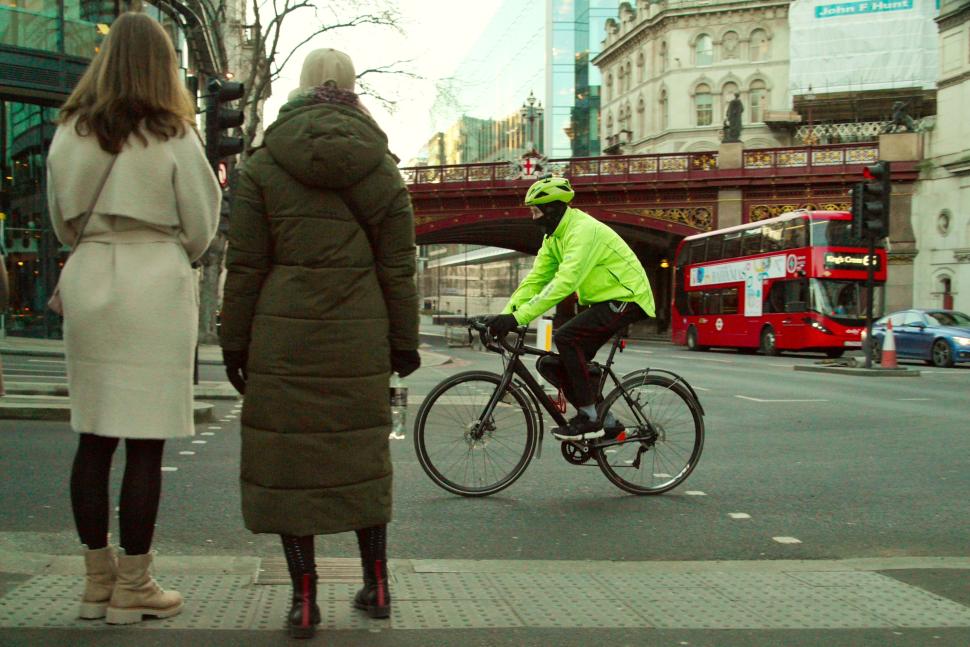 Cyclist in London with pedestrians in foreground (credit: Simon MacMichael)
The 72-year-old also accused some cyclists of displaying “an arrogant culture of non-compliance” with the law, while criticising the proliferation of illegal e-motorbikes, often incorrectly labelled as e-bikes, in recent years.
“Scooters and cycles regularly ride on pavements and, because of electrification, they can go at high speeds, up to 70 miles per hour, according to the Sunday Telegraph,” she said.
“They cannot be heard and they steal up behind you, or approach at speed, making the pavement potentially as dangerous as the road.”
The Sunday Telegraph article referenced by Baroness Lucy Neville-Rolfe was published last weekend, reporting that Transport for London and a number of local authorities in the capital have contacted the government to raise awareness about both the legal and safety implications of illegally converting e-bikes”.
This illegal practice, the letter said, “has resulted in reports of these ‘e-bikes’ travelling at 70mph in the City of London” and the deaths of four people from lithium-ion battery fires, with transport chiefs noting that “these converted vehicles are no longer e-bikes but legally become motorbikes”.
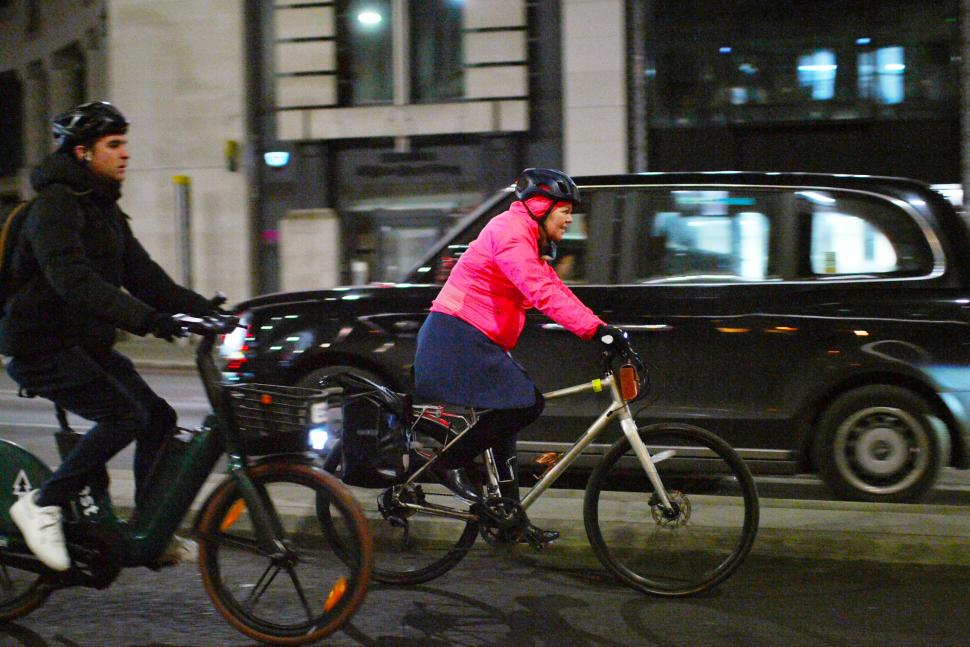 Cyclists in London male and female in cycle lane (credit: Simon MacMichael)
Meanwhile, Tory peer David Maclean, Lord Blencathra, also argued during the debate that the “threat” posed by cyclists in the capital had shifted from “Lycra louts” to illegal e-bike users.
“In the past, it was my experience that it was a tiny minority of Lycra louts, the ones with their heads down between the handlebars and their backsides up in the air, belting through lights,” Maclean said.
“I submit that I am certain that the majority of e-bike riders are breaking the law one way or another, either by excessive speed or by riding through lights or on the pavement.”
Maclean also criticised the “problem of thousands of e-bikes –mainly Lime – lying scattered over our pavements”.
He claimed that companies are “deliberately selling massive off-road bikes, which people then use on our streets” and that “thousands of people” are cycling on pavements, “with grossly inadequate enforcement to stop it”.
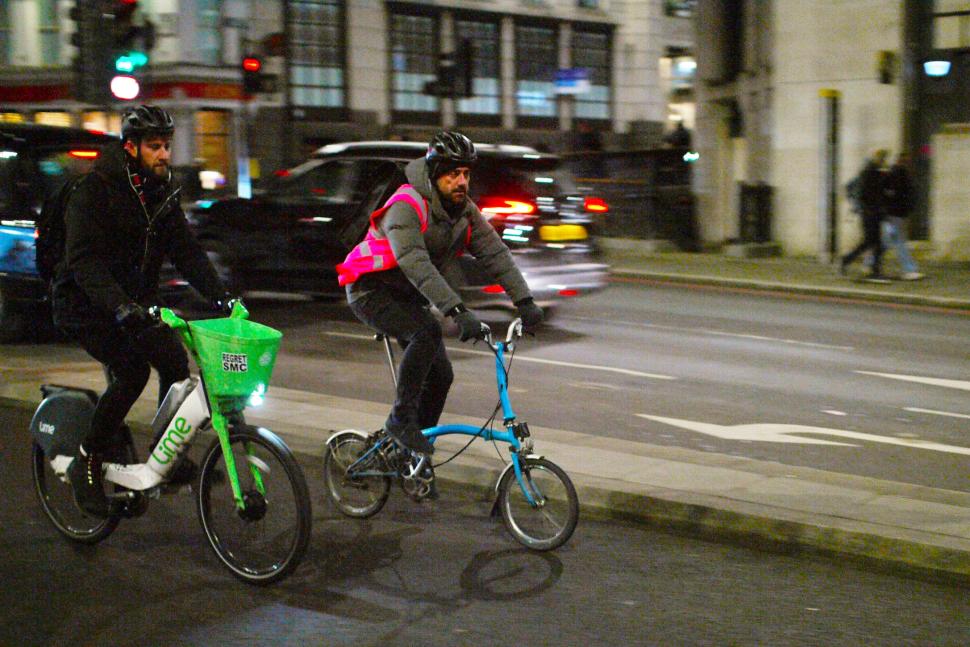 Cyclists in London Brompton and Lime hire bike (credit: Simon MacMichael)
Away from the focus on illegal e-motorbikes, Lord Hogan-Howe, the former head of the Metropolitan Police, led the criticism of ‘dangerous’ cyclists, who he claims are not held accountable for putting people “at risk”.
“Every day, particularly in our large towns and cities such as London, we see cyclists ignoring traffic regulations and putting people at risk, particularly pedestrians who have a disability or a lack of mobility, even when those same people are using pedestrian crossings,” Lord Hogan-Howe, who was Met Commissioner between 2011 and 2017, told the Lords.
“At night many cyclists are not displaying lights, wear dark clothing and ride dark cycles, and pedestrians and other road users just cannot see them.
“I do not believe that cyclists are a group of people who are more criminal than the rest of society or than any other road users. However, they are less accountable than people who drive buses and cars, and general deterrence theory does not work for them.
“They have no licence or registration mark. This means that not only does the technology not work against them, but they cannot be identified for other road users, and they have no identification mark to offer for an investigator to identify them after they have behaved badly.”
> Speed gun deployed to fine cyclists riding faster than 12mph in London park
This isn’t the first time Lord Hogan-Howe has called for cyclists to carry some form of identification. In November 2023, the crossbench peer claimed that “dangerous” cyclists are “entirely unaccountable” and should be made to install number plates on their bikes.
And last year, he called on the government to “ensure that pedal cyclists abide by the criminal law and are held accountable where they breach that law”.
Speaking in the Lords this week, Hogan-Howe argued that this lack of identification or registration system means that there is little deterrence to stop cyclists from riding dangerously, while calling for law-breaking cyclists to be issued penalty points on their driving licences.
“The best example I have found is in the City of London Police, where Sergeant Stu Ford is leading his small team of cyclists in combating road cyclists,” he said.
“On the morning when I went with them, we walked just a few yards out of the police station to set up a morning check in the City. There were cyclists ignoring pedestrian crossings and red lights, and moving dangerously through pedestrians, despite the fact that they were outside a police station and there were six or seven uniformed officers on cycles, on the road and on the pavement.”
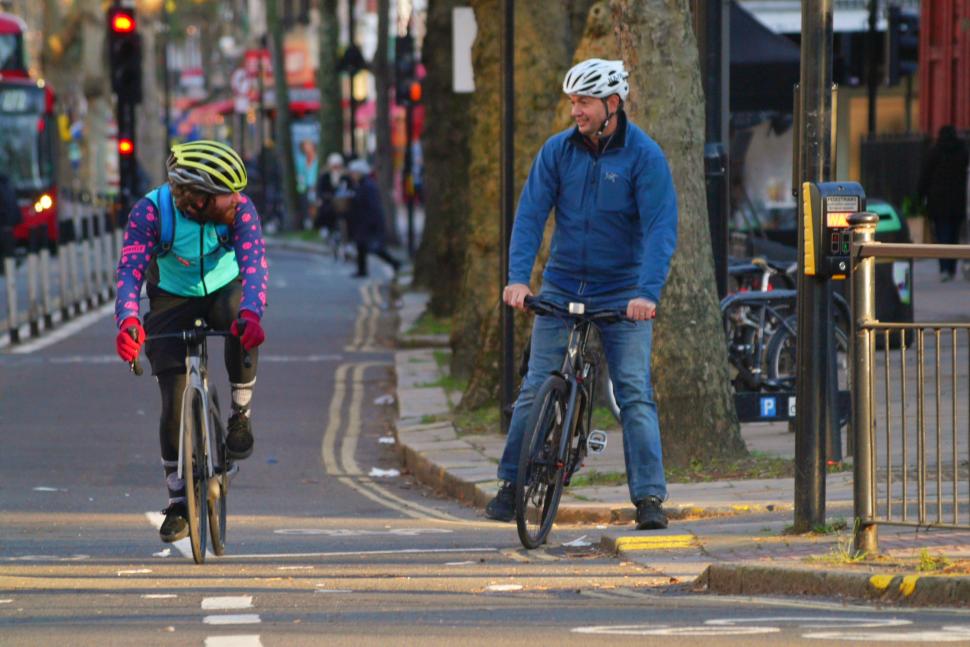 Cyclists in London talking in cycle lane (credit: Simon MacMichael)
Following Hogan-Howe’s remarks, Labour peer David Hanson, a minister of state for the Home Office, claimed that he recently almost collided with a cyclist on a zebra crossing – with the cyclist pulled over by police just down the road.
“It seems an awful long time since my cycling proficiency test. We can debate whether standards have slipped in the 50-plus years since I took my test, but I think it is a common experience of all noble Lords who have spoken that a small minority of cyclists’ reckless actions potentially put people at risk,” Lord Hanson said.
“As a temporary resident of London during the week, I regularly see cyclists on pavements and going through red lights. I can report that, on crossing a zebra crossing one evening, I myself was almost hit by a cyclist, who was then pulled over by a police car not 100 metres later, much to my satisfaction. So it is possible for enforcement to happen.
“It is right that strict legislation is already in place for cyclists, and the police do have the power to prosecute if these laws are broken. Cyclists have a duty to behave in a safe and responsible way that is reflected in the Highway Code.”