
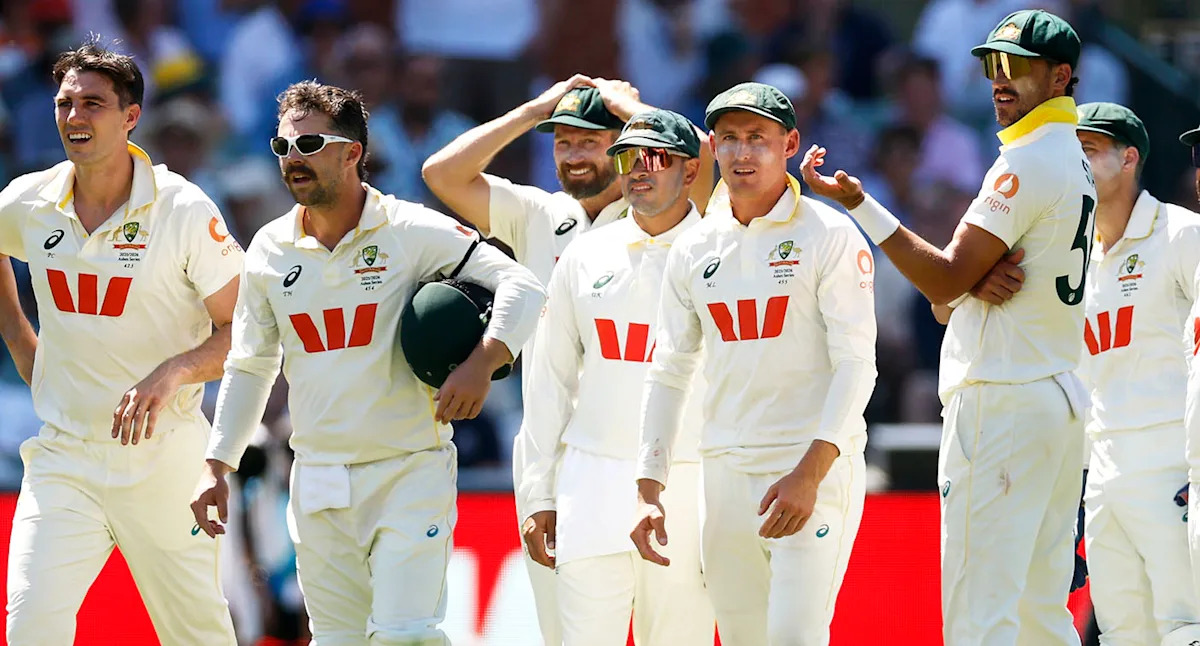
Snicko looks set to remain for the fourth Ashes Test after England and Australia reportedly held talks about replacing the under-fire technology with UltraEdge in the middle of the series. Fresh drama erupted on the second day’s play at the Adelaide Oval in the third Test when the Aussies thought they were dudded by the technology.
Jamie Smith appeared to glove the ball before it hit his helmet and ballooned to Usman Khawaja in the slips, but Snicko didn’t show anything after the on-field umpires sent it upstairs. Australia dismissed Smith not long after, but this time it was the England batter who felt he was hard done-by.
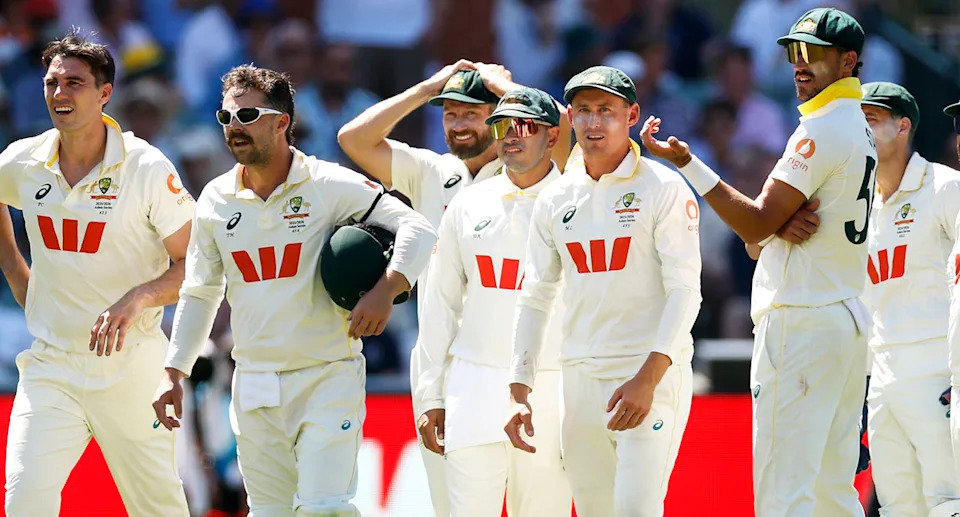
Mitchell Starc (R) and the Aussies were gobsmacked over the fresh DRS drama. (Photo by Darrian Traynor/Getty Images)
Smith threw his arms up in disbelief when Snicko showed a spike as the ball was passing the bat, and the wicket-keeper had to depart caught-behind. It followed the controversy that unfolded on Wednesday when Alex Carey was given a reprieve when the Snicko operator made an error that resulted in a spike being registered well before the ball was near the bat. Carey should have been out on 72, but the technology blunder helped him go on to make 106.
Mitchell Starc wants Snicko ‘sacked’, but tech will remain
On Thursday after the first incident with Smith, Aussie bowler Mitchell Starc was picked up on the stump microphone saying: “Snicko needs to be sacked. That’s the worst technology there is. They make a mistake the other day and they make another mistake today.”
On Friday, The Guardian reported that the England and Wales Cricket Board has held discussions with Cricket Australia about using UltraEdge moving forward instead of Snicko. Australia and New Zealand are the only Test-playing countries that still uses Snicko, despite it being an arguably inferior product to the more expensive UltraEdge.
According to The Guardian, broadcaster Channel 7 has a contract with Hawk-Eye Innovations – the company behind the UltraEdge technology. UltraEdge is used in the BBL, but Snicko is being used in the Test series.
Channel 7 and Fox Cricket would have to agree to make the mid-series change, which has reportedly been discussed between Australia and England officials for the Boxing Day Test. The stumbling block is Cricket Australia and Fox would have to come to a financial settlement with BBG Sports – the operators of Snicko.
On Friday, leading reporter Tom Morris revealed there won’t be a change for Boxing Day. “It’s pretty clear there is a desire for the ICC to take control – there won’t be any change in systems mid-series,” Morris wrote on social media.
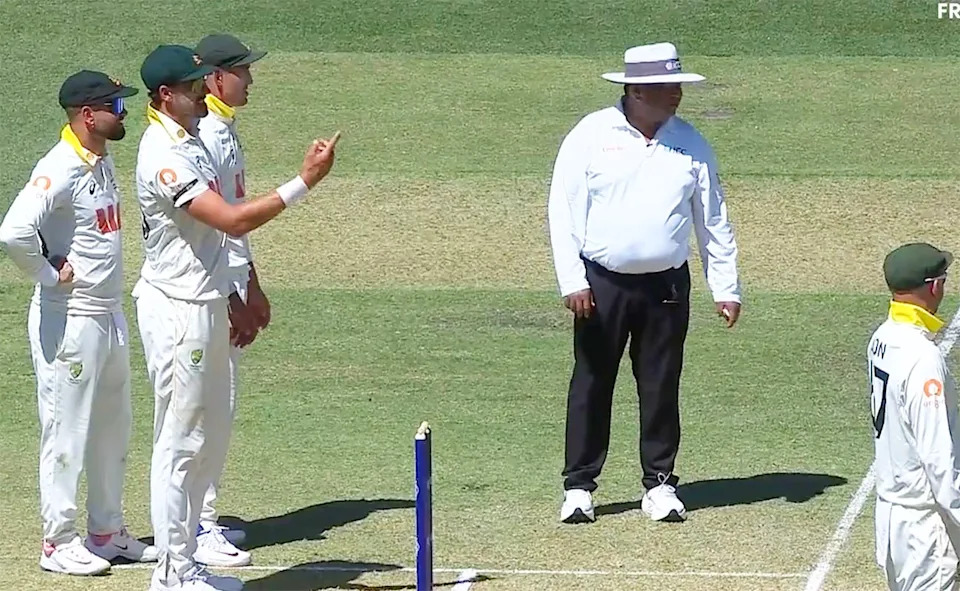
Mitchell Starc was picked up on the stump mics calling for Snicko to be ‘sacked’. Image: Channel 7
RELATED:
Cricket players’ boss says ‘careers on the line’
Also on Friday, Australian Cricketers’ Association (ACA) boss Paul Marsh slammed the situation and questioned why it’s the home broadcaster who decides and has to pay for the technology used, rather than the ICC. UltraEdge is more accurate, but more expensive.
Marsh said the ICC or home-nation boards should pay for the best technology available, with “careers on the line” for the players when wrong decisions are made. “It doesn’t actually make any sense that it’s on the broadcasters to carry the cost of this,” he told AAP. “Their interests aren’t aligned, they’re different, they’re about producing the broadcast for people watching.
“The game is the one that should be making sure that the right technology is making the right decisions. It’s nonsensical that it doesn’t sit with the ICC or the home boards.
“People are seeing there is an issue here that needs to be looked at. We have got other parts of the world that are doing it differently and better so it’s not like there’s not a model out there to have a look at.”
Simon Taufel and Ricky Ponting blast farcical situation
Meanwhile, former top umpire Simon Taufel has called out the ICC for a key change they made to the decision-making process. The on-field umpires used to give a ‘soft signal’ of out or not out when sending decisions to the third umpire, but that process has been changed.
Speaking to Channel 7 on Thursday, Taufel said it’s led to a situation where technology is being relied on too heavily rather than to support the human umpires. In both instances with Smith on Thursday, the umpires sent the decision upstairs without making a call because they asked for the catch to be checked.
“I was so disappointed to see when the ICC removed the umpire’s soft signal on-field,” Taufel said. “I love to see umpires making decisions. You know yourself on the field, sometimes you just get a feel for the decision. You get a gut feel whether it’s carried or it hasn’t carried. It’s a great starting point for the game to progress from, if technology doesn’t help us.
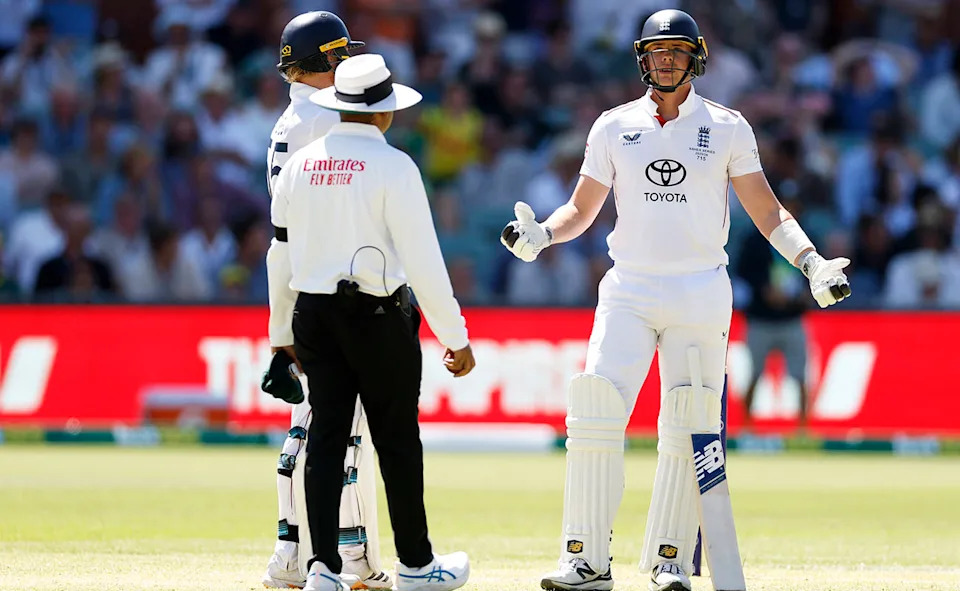
Jamie Smith was fuming when finally dismissed. (Photo by Darrian Traynor/Getty Images)
“Technology is there to support, technology is the not there to replace. And what happens when we don’t have the vision? What happens when we don’t have the edge detection technology? We can’t play the game backwards, we’ve got nowhere else to go back to. There has got to be that redundancy in the process.
“But when technology and the replays don’t give us the answer, there’s nowhere to go back to. So we’ve gone back 20 years.”
Ricky Ponting declared the technology being used in Australia is “simply not as good as technology that’s used in other countries”. He added: “You talk to the umpires, they’ll tell you the same thing. They can’t trust it.