
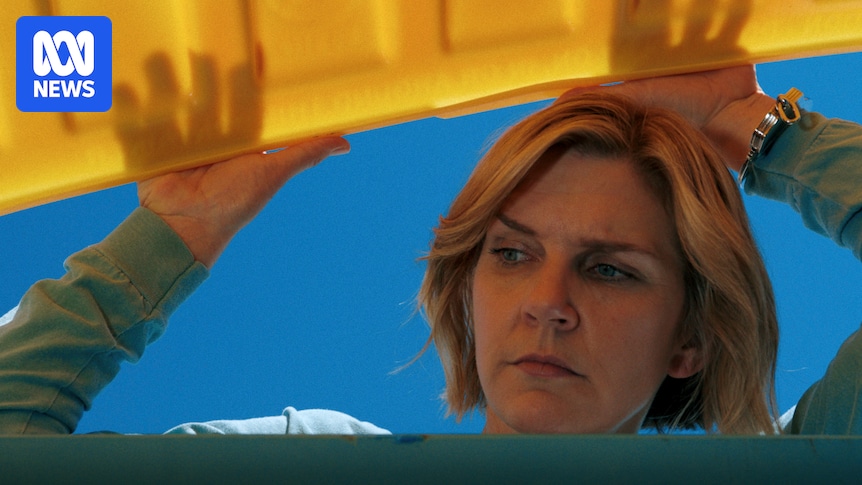
Right up until its series premiere in October, people didn’t know what Apple TV’s latest show Pluribus was about.
They knew it starred Rhea Seehorn (Better Call Saul); they knew it was the brain child of television royalty Vince Gilligan; they knew it had something to do with cheery yet eerie smiling petri dishes.
Loading Instagram content
But the narrative of the series, which was green-lit for two seasons before it even went to air, was a mystery.
In a TV landscape where new original shows often have to scream to be acknowledged, Pluribus went quiet.
It hinged most of its hopes on the promise that Gilligan — the man behind two of the most critically acclaimed shows of the 21st century, Breaking Bad and Better Call Saul — could pull off a hat trick.
It’s been 30 years since Gilligan cut his teeth as a writer on long-running sci-fi series X-Files, and he’s stoked to be back in the genre.
“There was a certain level of expectation, I think, people had for me to do something else in the Breaking Bad universe,” Gilligan tells ABC News.
“I haven’t written a flat-out hero since Scully and Mulder.”
As it nears the end of its first season, Pluribus has swept up multiple award nominations. Shortly after airing its seventh episode AppleTV announced Pluribus was the streamers most watched show ever.
It’s a flashing neon sign that confidently says: Gilligan has done it again.
The truth is out there
Pluribus starts out as hard sci-fi, as a beamed RNA sequence sees humanity transformed into one amorphous, permanently happy hive mind.
Famine, war and disease are all a thing of the past as almost every human on Earth becomes one.
But beyond the high concept, the show settles into the grounded, human characters that live in its ultra-saturated Albuquerque, New Mexico world.
Namely one character; Carol Sturka (Seehorn), a disgruntled, dissatisfied, closeted romantasy author dying to write about more than throbbing male muscles. Carol is one of the few people immune to the pull of the hive mind and she’s determined to get to the bottom of the phenomenon.
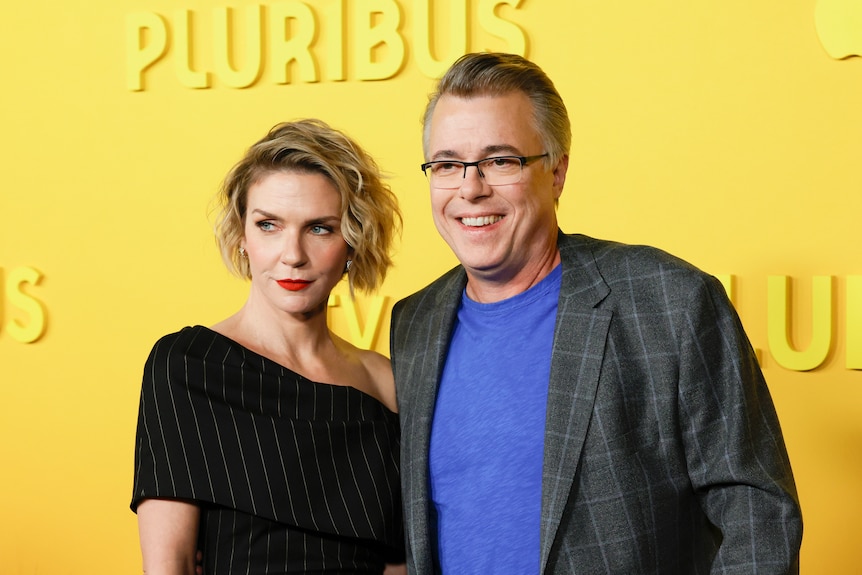
Pluribus star Rhea Seehorn and show creator Vince Gilligan previously worked together on Better Call Saul. (Getty: Frazer Harrison)
Seehorn’s performance has been lauded far and wide, which is no surprise to Gillian; she’s the whole reason he wanted to make the show.
“I realised I want to work with Rhea Seehorn again. So the character went from male to female,” Gilligan says.
“I had this idea about someone who wasn’t even that happy a person, but everybody loved them, and everybody would do anything for them. When you have an idea like that, you kind of have to explain it in science fiction terms.
“It doesn’t avail itself of a real world explanation.”
A world divided
Carol isn’t the only one to resist the conglomerate’s pull. But the handful of other survivors aren’t as interested in fighting back against their placid conquerors. Some are even waiting for the hive mind to let them join, the allure of being perfectly content with family being too strong.

In Pluribus, Carol must uncover the hive mind’s intentions before they learn how to intergrate her into the group. (Supplied: Apple TV+)
While Gilligan insists Pluribus is not an exercise in virtue-signalling, he says the heart of the show lies in Carol’s fight to force the other-non hive-minded characters to realise what they are dismissing.
“I’m kind of intrigued about the difference between individuality and conformity,” he says.
“That stuff interests me, the idea of being happy, and how important is that to us?”
Vince Gilligan on the future of TV
The writer was also inspired by the US’s fierce current political landscape and showing people that a world where all of humanity is in agreement isn’t as rosy as it seems.
“I think everybody hates that we live in a country that feels like there’s two sides, two armed camps. It feels like we’re on the edge of civil war some days, and I hate that,” he says.
“I don’t think anybody wants to live like this. They want to figure out a way to get back to a culture, a civilisation where people can disagree, the world of Pluribus where everybody agrees, that doesn’t sound so good either.
“But can we find a place where people disagree but they’re cool about it?”
The AI of it all
Watching Carol grow more and more frustrated at her fellow resisters’ acceptance of the hive mind as it uses its power to cater to their every whim, gives off the same vibe as trying to convince a friend it’s not worth asking ChatGPT to tell them what kind of sandwich to eat.
Gilligan, who has been very open on his view of AI in film and TV, says that it was just a happy accident.
“I really wasn’t thinking about AI when I came up with Pluribus, partly because I came up with it almost 10 years ago, but if people have that takeaway, more power to them,” he laughs.
“Anything I can do to make people realise that humans telling stories about other humans to humans is our greatest achievement.”
“That’s one of our highest achievements, the stories we tell one another, they have literally changed the world. The idea of robots or computers telling stories to human beings, it horrifies me.”
Pluribus is streaming on Apple TV now.