
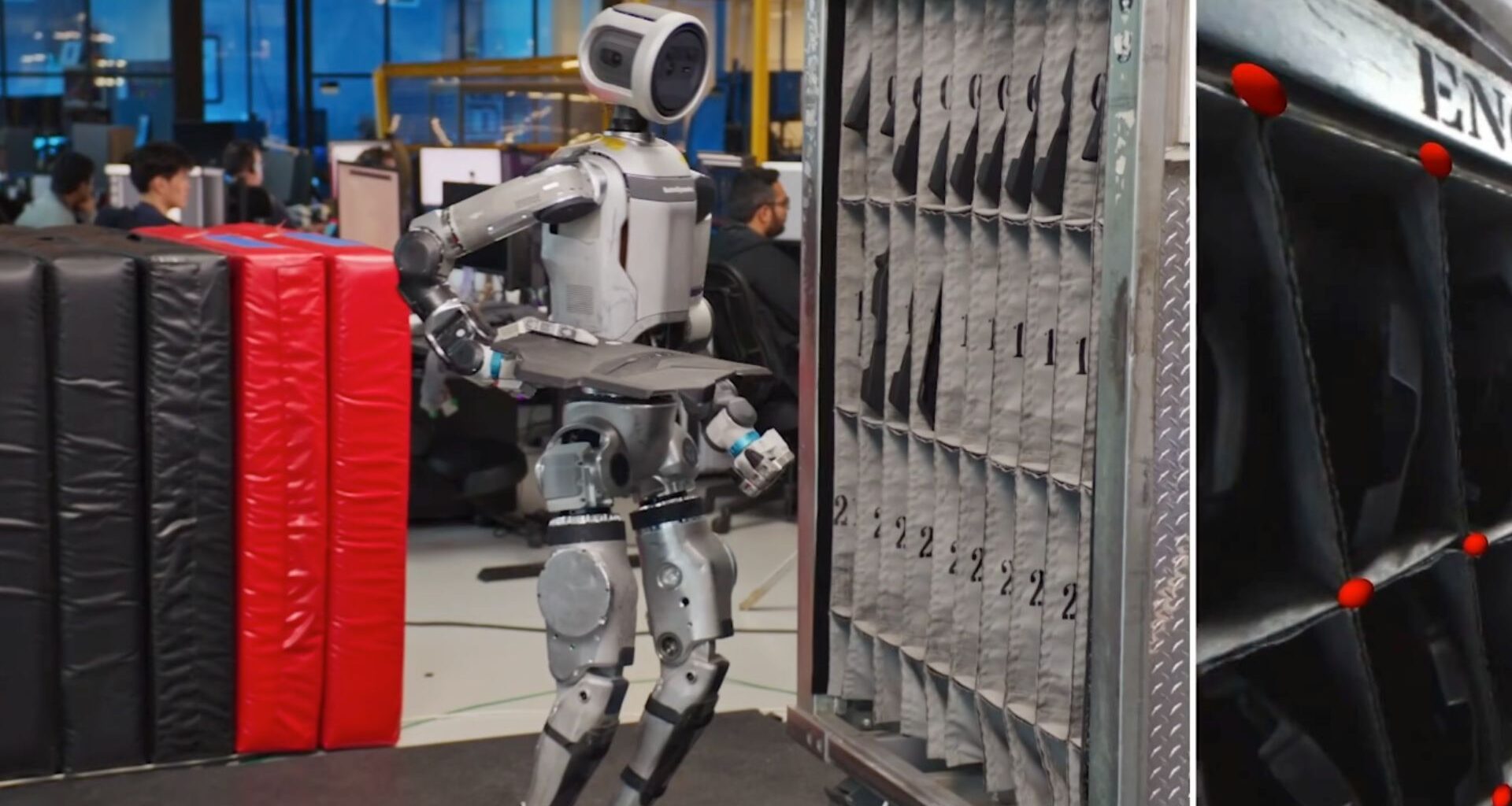
Robotics player Boston Dynamics has offered its clearest look yet at how software will power its next-generation humanoid robot, the Atlas.
In a 40-minute technical briefing posted on the company’s YouTube channel, senior leaders detail the company’s approach to building intelligence for real-world factory work.
The discussion focused on what Boston Dynamics calls the “humanoid mission in manufacturing,” outlining plans to equip Atlas with a flexible, general-purpose control system suited to complex industrial settings.
Rather than relying on hand-coded movements, the company is embracing learning-based methods, enabling the robot to acquire skills through demonstrations, feedback, and refinement—an approach designed to handle the unpredictability of modern production floors.
Last week, Boston Dynamics explained Atlas’s ground recovery, revealing why the humanoid rises with contorted movements rather than standing like a human.
Training the Atlas brain
The value of humanoid robots in industrial settings has long been questioned, particularly when simpler machines such as robotic arms or wheeled systems can perform many factory tasks.
Boston Dynamics argues the challenge is not capability, but economics. In highly flexible manufacturing environments, such as automotive plants producing multiple vehicle models with thousands of part variations, traditional automation becomes prohibitively slow and costly.
Designing and integrating a custom machine for a single task can take a year and cost more than a million dollars, making large-scale automation of every task impractical, Humanoids Daily reports.
To escape what it describes as the limits of “hard automation,” the company is betting on a reprogrammable, general-purpose humanoid that can be redeployed in days rather than engineered over years.
This strategy aligns with its goal of deploying robots at production scale rather than as isolated demonstrations. Achieving that level of adaptability requires a shift away from hand-coded motion planning toward learning-based methods, where robots improve through training, feedback, and correction.
Boston Dynamics has outlined three parallel approaches to building Atlas’s intelligence. One relies on teleoperation, where human operators guide the robot through tasks using virtual reality, producing highly accurate but difficult-to-scale training data.
A second approach uses reinforcement learning in simulation, allowing Atlas to practice millions of movements virtually, particularly for dynamic or high-precision actions. The third, longer-term path focuses on observation, training robots to learn physical intuition and task understanding by watching humans perform activities, potentially through large video datasets.
Beyond end-to-end AI
Boston Dynamics is taking a hybrid approach to robot intelligence rather than relying on a single, end-to-end AI model. The company has ruled out a pure “pixels-to-torques” system, in which a single neural network would directly convert camera data into motor commands. Instead, its Atlas humanoid is built around a layered control structure inspired by human cognition and motor control.
In this framework, a high-level decision system processes visual information and generates abstract movement goals, such as where to step or how to position a hand.
These instructions are then handled by a separate, fast-acting control layer responsible for balance, coordination, and physical constraints. By separating decision-making from motor execution, the robot avoids having to relearn basic physics, such as gravity and momentum, at the AI level, improving stability and efficiency. Similar architectures are being explored across the humanoid robotics sector.
Beyond software design, Boston Dynamics emphasized the strategic role of Hyundai Motor Group. The partnership extends beyond deploying robots onto factory floors, with both companies working to redesign automotive plants around humanoid systems.
Hyundai contributes large-scale manufacturing environments and long-term infrastructure investment, while Boston Dynamics concentrates on solving complex manipulation tasks required in vehicle assembly, reports Humanoids Daily.
The presentation ended with a clear signal of the company’s priorities: as the all-electric Atlas hardware matures, the focus is shifting toward building the intelligence behind it.
Boston Dynamics is actively seeking machine learning talent, underscoring that software development will define the next phase of humanoid deployment.