
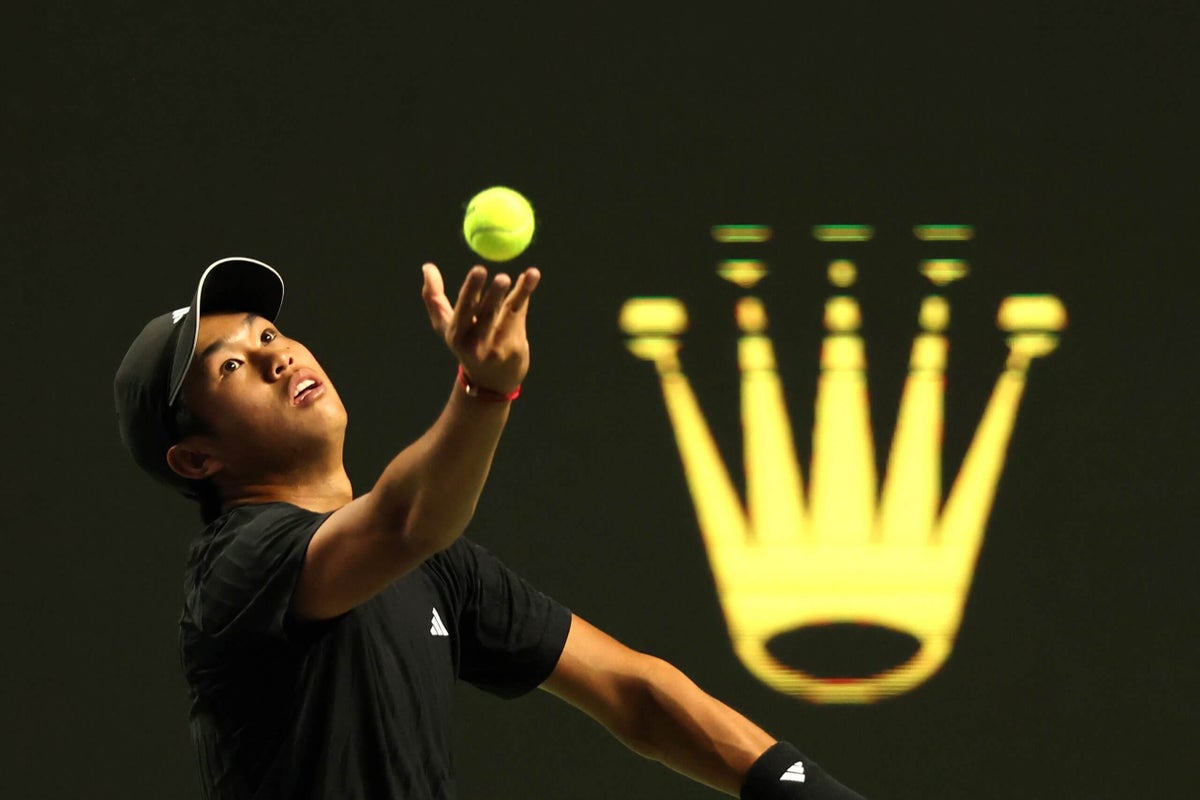
The Next Gen ATP Finals in Jeddah, Saudi Arabia started with an upset Wednesday, as Rafael Jodar of Spain beat overwhelming favorite Learner Tien of the U.S. in their opening round-robin match. But after a slow start, the American recovered to qualify for the final by winning his next three matches, setting up a clash with the best player of the week, Alexander Blockx of Belgium.
Tien, who lost in last year’s final to João Fonseca, entered as world No. 28 after a successful first full season on the ATP Tour. The other seven players in the field, drawn from the best men’s players aged 20 and under, are clustered between world No. 116 and world No. 187.
Blockx, who is No. 116, is yet to lose a match in Jeddah and has impressed throughout with his ferocious serving and dexterous court coverage; Tien does the latter better than just about anyone, but has found it difficult to escape pressure all week, amplified by the first-to-four-game sets and sudden-death deuce system at the tournament.
Two of the strongest eligible entrants, Jakub Menšík of Czechia and Fonseca of Brazil, who like Tien this year became mainstays on the regular tour, withdrew ahead of the event due to injury. Menšík and Fonseca finished first and second in the ‘Race to Jeddah,’ which counts ranking points won by season. That meant that Jodar, who finished No. 9 in the race, was eligible to play; No. 10, Rei Sakamoto of Japan, then also withdrew through injury, giving a spot to Justin Engel of Germany, who is the youngest player in the field at 18.
Jodar finished the year strongly by winning two consecutive ATP Challenger Tour titles, the rung below the main tour. Just below Tien in the race were Blockx, who made the second round of the Cincinnati Masters this summer, and Martin Landaluce, who won a Challenger Tour title in September by beating rising Belgian Raphaël Collignon in the final.
Dino Prižmić, the Croatian who memorably went toe-to-toe with Novak Djokovic at the 2024 Australian Open, qualified for the event alongside Nishesh Basavareddy of the U.S., who took a set off Djokovic at this year’s Australian Open and recently added Gilles Cervara, Daniil Medvedev’s former coach, to his team. The final qualifier, Nicolai Budkov Kjær of Norway won four Challenger Tour titles this season.
Here’s everything to know about the event.
How does the Next Gen ATP Finals draw work?
The eight players who qualified were split into four pairs for the draw. The first pair is No. 1 and No. 2, the second is No. 3 and No. 4, and so on.
These seedings follow the players’ rankings in the ‘ATP Race to Jeddah,’ the table which only counts ranking points earned in 2025.
The No. 1 seed (Learner Tien) and No. 2 seed (Alexander Blockx) were drawn into the Blue Group and the Red Group respectively. The remaining three pairs were then allocated a spot at random, pair-by-pair.
What is the format for the Next Gen ATP Finals?
The ATP Next Gen Finals begins Wednesday December 17, with four matches per day in the group stages: two in the Jeddah afternoon from 11 a.m. GMT / 6 a.m. ET and two in the Jeddah evening from 4 p.m. GMT / 11 a.m. ET.
The final is Sunday, December 21 and the two semifinals will be played Saturday, December 20.
Each player plays three round-robin matches, before the top two in each group contest the semifinals, with 1st in the Blue Group playing 2nd in the Red Group and visa versa.
Each match is best of five sets, but the first player to win four games wins the set, rather than the usual six, and a tiebreak is played at 3-3 instead of 6-6. The tiebreaks are first to seven points with a two-point winning margin — 7-4, 7-5, 8-6, 9-7, etc.
The event also uses ‘No-Ad’ scoring. At 40-40, the server chooses to serve to the deuce court or the ad court and the two players play a deciding point. There were previously no lets, a feature of American college tennis in which a serve that hits the net but lands in the correct service box counts as a live ball, but that has been removed for 2025.
The shot clock between points, which has been a contentious issue on the ATP Tour, is also different to the main tour. If a point is fewer than three shots, the usual 25-second time between points is reduced to 15 seconds, with eight seconds allowed between the first and second serve at all times.
Who won last year’s tournament?
Fonseca defeated Tien 2-4, 4-3, 4-0, 4-2 to win the 2024 event. It was the first edition for which only players 20-and-under were eligible, with the ‘Next Gen’ having included players aged 21 and under prior to that.
How much prize money is there?
Each of the eight players gets $154,000 (£114,740) just for participating. A round-robin match win is worth $37,500 (£27,940); a semifinal win earns $113,500 (£86,425) and victory in the final is worth $157,250 (£117,155). If the eventual champion goes undefeated, they will take home $539,750 (£402,130).