

A new era is starting in the NHL. Connor McDavid, Nathan MacKinnon and Leon Draisaitl are still a tier above the rest, but the next wave of star centers is starting to share the spotlight.
The growth of Connor Bedard, Macklin Celebrini and Leo Carlsson over the last year has been one of the NHL’s brightest spots. But these players aren’t at their peak just yet — they’re only just scratching the surface. So their development over the next year is something to get excited about.
That’s why they lead our list of things to get hyped about around in the NHL in 2026.
The next wave keeps coming
Top draft picks such as McDavid, MacKinnon and Jack Eichel have set the bar high for players drafted first and second overall. So when someone such as Celebrini emerges as an immediate star, it’s a big deal.
Celebrini made an instant impact in San Jose last season; his transition game, dangerous passing and primary scoring-chance contributions quickly put his elite skill set on display. And this season he has kicked it up a notch, which has helped the Sharks hang in the playoff picture.
Celebrini is dancing around the ice nightly and has the vision and patience to slow the game down. With 54 points, Celebrini ranks third in scoring, behind McDavid and MacKinnon. The big question is whether he can keep this up across a full season — at this rate, he is on pace for 123 points.
Macklin Celebrini are you kidding?! pic.twitter.com/kQdsDCyTMl
— Sportsnet (@Sportsnet) December 19, 2025
Not everyone comes in with that kind of impact status — not immediately, at least. Players such as Nico Hischier, Jack Hughes and even Aleksander Barkov needed a little seasoning. But when that impact status eventually hits, it’s a game changer.
That glow-up is what Bedard is experiencing this season with the Chicago Blackhawks, and increased speed is a key part of it: He’s up to 76 20-plus mph speed bursts in 31 games, according to NHL Edge data, compared with a total of 90 in 82 games last year. That speed is helping him create more off the rush and drive to the scoring areas, which has contributed to his climb up the scoring charts with 19 goals in 31 games (which had him tied for fourth at the time of his injury on Dec. 12).
Depending on when Bedard returns, he could still be looking at a 40-goal season if he can keep up this pace, which is exciting enough. Still, the injury could be what keeps him off Team Canada. That could lead to a spite-fueled return that only adds spice to his rise this season.
As for Carlsson, some funky in-and-out deployment in Year 1 and Greg Cronin’s north-south coaching style slowed him down. But this season, his 200-foot game has solidified his stock as a difference-maker for the Anaheim Ducks. Carlsson isn’t a high-octane scorer like Bedard or Celebrini (yet, at least), but his scoring-chance creation makes the Ducks a better offensive threat. And he helps limit the damage in matchup minutes; his puck retrievals support that, along with his ability to extend offensive-zone opportunities. Carlsson’s all-situations play is putting him on a Barkov-like trajectory.
🚨 LEO 🚨
He is UNREAL!!
We lead 2-1! #FlyTogether pic.twitter.com/LSMjK7gDyH
— Anaheim Ducks (@AnaheimDucks) November 9, 2025
These three have all taken “the leap” this season, which is when their skill set aligns with their overall physical growth and everything clicks to bring players to an outright new level. As Dom Luszczyszyn and Sean Gentille wrote earlier this season, the average “leap” age for the 29 players in Tiers 1 and 2 is 22. These three are ahead of the curve and could keep pushing the boundaries thanks to their elite ceilings.
Schaefer becoming The Guy on Long Island
So the 2023 and 2024 No. 1 picks are putting on a show this season. But how about the defender who went No. 1 in 2025?
Matthew Schaefer is everything the New York Islanders craved on the back end — he’s a true quarterback who can play with pace on both ends of the ice. His ability to carry the puck up the ice with control is a standout. So is his speed and poise around the offensive zone and at the blue line. He has the wheels to defend in transition and is already growing into a matchup role.
MATTHEW SCHAEFER HAS HIS FIRST CAREER POINT 👏 pic.twitter.com/MNRx6x7rsD
— Sportsnet (@Sportsnet) October 9, 2025
And after absorbing a lot of minutes early on, he proved he was ready for more at this level. It took Schaefer a few games to adjust to playing against top competition (starting Nov. 8), but since then, he has shown he is up to the task. Over the last 22 games, he has a 49 percent expected goals rate and has helped the Islanders outscore opponents 17-9 at five-on-five.
A defenseman getting drafted first overall was rare enough; only four others have been picked that early in the salary-cap era — Owen Power (2021), Rasmus Dahlin (2018), Aaron Ekblad (2014) and Erik Johnson (2006). But what Schaefer is doing as an 18-year-old defenseman is legitimately incredible. His two-way development has put him head and shoulders above what other defenders did at this early phase in their careers.
Schaefer is growing into a difference-maker on the fly, so there is a ton to look forward to over the next year — how he fares as the playoff race tightens, a potential postseason debut and the start of his sophomore season after his first real NHL offseason.
The Avalanche’s dominance
The Colorado Avalanche took over first place in the standings on Nov. 1 and haven’t looked back. By Dec. 1, Colorado had a six-point lead on second place (Dallas) and an eight-point lead on first place in the East (Tampa Bay). A few days later, on Dec. 4, the team earned its second regulation loss in 27 games.
The Avalanche have been dominant on both ends of the ice. Scott Wedgewood and Mackenzie Blackwood have combined to allow only 1.85 goals against per 60. And the team’s offense has been outright overwhelming: Colorado is scoring at a pace of 3.62 goals per 60. That rate doesn’t just lead the league — it’s currently ahead of every regular-season team in the analytics era (since 2007-08). Across a full regular season, the number to beat is the 2021-22 Florida Panthers’ 3.36 goals per 60.
Between the Avs’ high-octane scoring and stingy goaltending, it makes for a plus-61 goal differential. And that’s something Colorado is just running away with relative to the rest of the league. It’s 25 goals ahead of the next best team, the Dallas Stars.
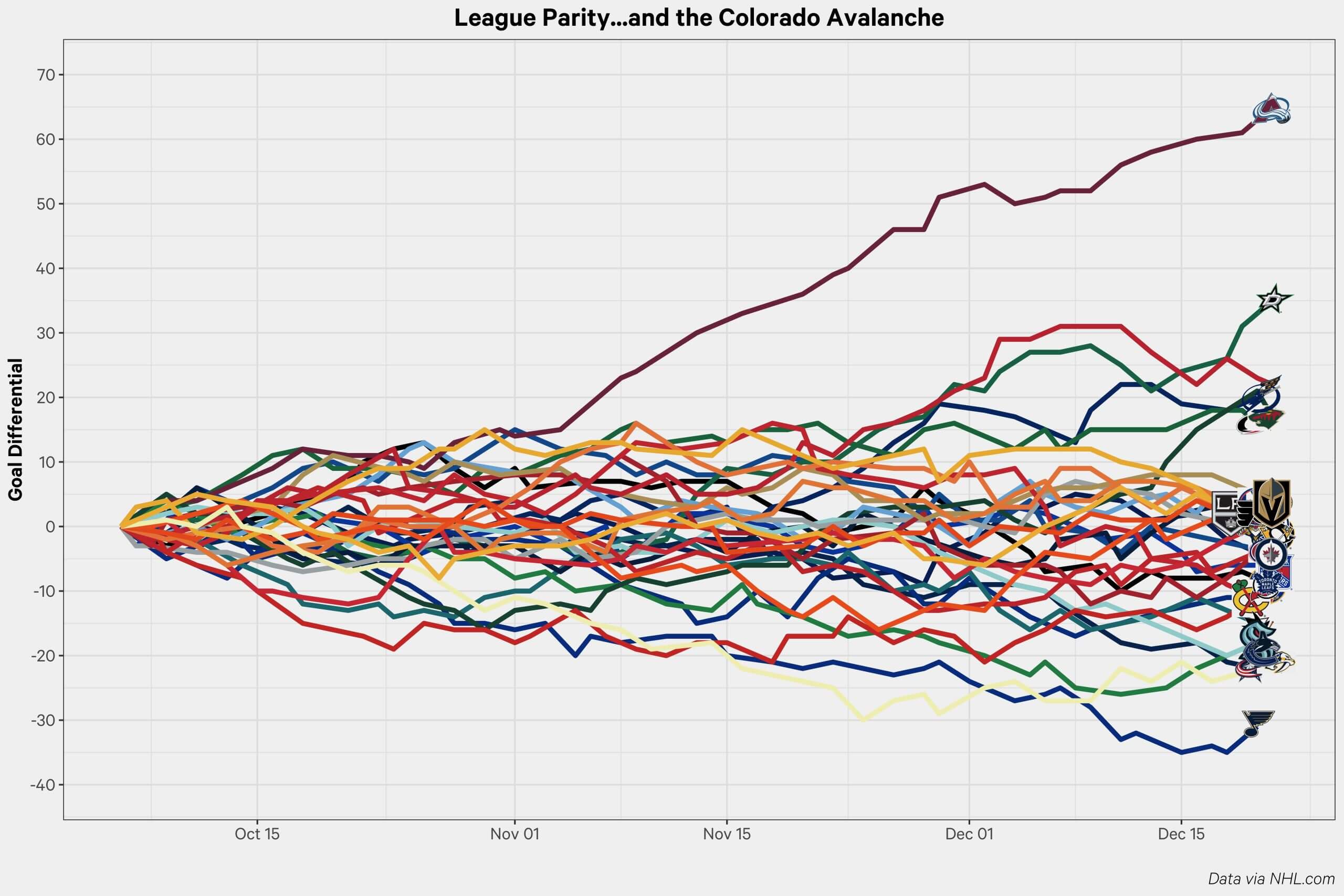
Viz by Prashanth Iyer
For context, some playoff teams can’t even match that number across a full regular season. Only two teams ended the 2024-25 season above that mark: the Winnipeg Jets (plus-86) and Tampa Bay Lightning (plus-75). Three teams did in 2023-24 (the Panthers’ plus-68, Stars’ plus-64 and Hurricanes’ plus-63).
So, how high can the Avalanche push it across 82 games? Luszczyszyn’s model projects a plus-105 goal differential.
The 1976-77 Canadiens hold the league record for best goal differential at plus-216. A plus-105 wouldn’t even crack the top 25 in NHL history. But it would stack up highly in the salary-cap era. The 2022-23 Bruins lead there with a plus-127 (16th all-time). A plus-105 would come in third, between the 2005-06 Senators and 2018-19 Lightning.
So whether the Avs can push the boundaries of the regular season and keep up this pace adds an exciting element to the second half.
The Quinnesota Wild era
The Minnesota Wild have generated a reputation for being … well, mild.
In recent years, the team has generally done enough to reach the playoffs but hasn’t made a strong enough impact when it counts. Management hasn’t done enough to change that, with low-key trades and quieter offseasons.
That is, until this year.
It started in early fall when the Wild signed Kirill Kaprizov to a record-setting eight-year, $136 million extension. And then the team made a franchise-altering trade a couple of weeks ago to bring in Quinn Hughes.
The Wild “sacked up” to bring one of the best defensemen in the world, which has quickly changed their entire outlook. In Hughes, Minnesota has added a true game breaker, whose dynamic all-around skill set has already elevated this team. He has already revitalized an under-performing power play and stepped into pivotal even-strength minutes alongside Brock Faber.
QUINN comes up HUGHES with his first @mnwild goal! 😉 pic.twitter.com/ZA2skxWJnm
— NHL (@NHL) December 15, 2025
Generally, Jonas Brodin shoulders the heaviest matchup burden for the Wild. On Saturday, it was Hughes going head-to-head with McDavid. In their 12-minute matchup, the Wild had a 17-13 edge in shot attempts and a 75 percent xG rate and outscored Edmonton 1-0. If the Wild keep sending Hughes over the boards for the toughest matchups, it could unlock another element of his game as well — since the Canucks generally didn’t task him with that workload.
The Hughes factor is obviously massive for this season, but there is even more to watch for over the next year since he is eligible for an extension July 1. And barring another trade before September, the Wild are the only team that can offer him eight years before the new CBA kicks in. It’s not the same as the original Quinn Hughes sweepstakes, which ended earlier than expected with the trade to the Wild, but there is still a lot of intrigue here.
The Central Division race
For the last two years, it’s been the Jets, Avalanche and Stars jostling for positioning. In 2024, the Avs took out the Jets before falling to the Stars in Round 2. Last year, sealed by a Game 7 Mikko Rantanen hat trick, the Stars eliminated the Avalanche. Then they knocked out the Jets to be the last Central team standing.
This season’s divisional battle is tracking to look different, with the Jets’ playoff chances dwindling by the day. The Avalanche look like a playoff lock. The second-place Stars are the only team in the league within 10 points of Colorado. And the Wild have jumped to third place in the league, after a November turnaround and the addition of Hughes.
Colorado always looks in the regular season like a contender to beat, but it hasn’t had the same playoff success in recent years. Since winning the Stanley Cup in 2022, this team hasn’t gone on a deep run, with two Round 1 exits and one in Round 2. So the Avalanche have something to prove.
So do the Wild, who haven’t made it out of the first round in 10 years. But Minnesota also hasn’t had this star-studded a core, either, what with Kaprizov, Hughes, Matt Boldy, Faber and Joel Eriksson-Ek. Add in their elite goalie duo, and the Wild could disrupt a Stanley Cup favorite.
The bar is a lot higher in Dallas after three straight Western Conference final losses. With Glen Gulutzan behind the bench, this team is looking to take the next step. The Stars have one of the deepest lineups in the league, which helped this group navigate key injuries so far this season.
At this rate, at least one of these teams will unfortunately be sent home in Round 1 — and whoever is left standing will have to fight through another tight Round 2 battle.
Eastern Conference playoff race
Six Western Conference teams have an 80 percent or higher chance of reaching the playoffs. The East is a lot more open.
Only 12 points separate first from last in the Eastern Conference, so there is a lot of room for movement over the next few months of action.
Order could be restored soon enough. The Panthers are already trending up after going 7-2-1 in their last 10 and are one point outside a wild-card seed. The Pittsburgh Penguins are coming back to earth, too, after shaking things up through the first couple of months. A healthy New Jersey Devils team, with both Jack Hughes and Brett Pesce back, could climb the standings, too.
But it may not be that simple, considering how many surprises there have been on both sides of the spectrum. The New York Rangers don’t have the scoring talent to make a consistent impact. The Toronto Maple Leafs’ offense has been completely stifled, and a change in the power-play coach may not be enough to get Auston Matthews or the rest of the team back on track.
On the flip side, the Detroit Red Wings are finally proving they belong in the playoff picture. The retooling Islanders are still in the thick of the race. And the Buffalo Sabres may finally be ready to make some noise after some front-office changes; the team is currently riding a six-game winning streak and looks re-energized.
So now it’s a test to see which of those surprise teams has enough substance to stay in the race down the stretch. And it’ll be interesting to see if there are any post-Olympic turnarounds — think about how the Canadiens and Blues powered up the standings after the 4 Nations last season. Maybe some new playoff threats will emerge, or struggling contenders will get back on track. Either way, it should be entertaining.
The NHL’s return to the Olympics
There have been some tastes of best-on-best international hockey between the World Cup of Hockey in 2016 and the 4 Nations Face-Off last season. But nothing compares to the prestige of an Olympic tournament.
The NHL’s road back for the first time since 2014 obviously hasn’t been without a lot of twists and turns — from the rink-size saga to the delayed rush to the finish. So as long as there is a proper rink, this is something to get hyped about. A handful of players, such as Sidney Crosby, will have the chance to return for what is likely one last ride. Others will have the opportunity to shine on a global stage for the first time.
Say Brandon Hagel makes it for Canada — if his NHL playoffs and 4 Nations experience is any indication, he could make himself even more of a household name. So could Dylan Larkin on Team USA, after his star-powered 4 Nations showing. Larkin has only five games of NHL playoff experience, so his ability to shine in that kind of environment was even more impressive. If Celebrini makes the cut, it’s a chance to show he truly has the chops to hang with the best.
Players outside of the USA and Canada have a real opportunity to make an impact, too. If Moritz Seider helps Team Germany contain Team Canada’s top line, or Switzerland’s Hischier and Jonas Siegenthaler team up to slow down Team USA, it will highlight the strengths in their games without the support of an NHL-caliber roster around them.
Data via Evolving-Hockey, Dom Luszczyszyn, Prashanth Iyer, HockeyStatCards, All Three Zones and Natural Stat Trick. This story relies on shot-based metrics; here is a primer on these numbers.