
A newly published study reveals that moist tropical forests in Australia are now a net carbon emitter, making this the first documented case of tropical forest woody biomass making the flip from sink to source.Researchers analyzed nearly five decades of data and found that around the year 2000, these forests stopped absorbing more carbon than they emitted and went into a reversal.They identified tree deaths as the core problem, showing that these doubled compared to earlier decades, with new growth unable to keep pace.Climate change and cyclones are to blame, as rainforest species evolved for warm, wet conditions, but are now facing temperature extremes and extended droughts that damage their tissues and stunt growth.
See All Key Ideas
When it comes to capturing carbon, trees have always been our go-to. But a sinister switch is underway. A study published in the journal Nature reveals that moist tropical forests in Australia are now emitting more carbon than they capture.
Researchers examined nearly five decades of forest monitoring data from the far northeast of Queensland state. Between 1971 and 2019, they tracked roughly 11,000 tree stems across 20 rainforest plots, measuring changes in the carbon locked away in trunks and branches.
Around the year 2000, the study reports, the rate at which these forests absorbed carbon slowed and reversed, making them net emitters instead. It’s the first documented case of tropical forest woody biomass making this flip.
“We analysed this long-term data and found a clear signal: woody biomass switched from being a carbon sink to a carbon source about 25 years ago,” the authors of the paper write in The Conversation.
The core problem? Tree deaths have doubled compared to earlier decades, and new growth isn’t keeping pace.
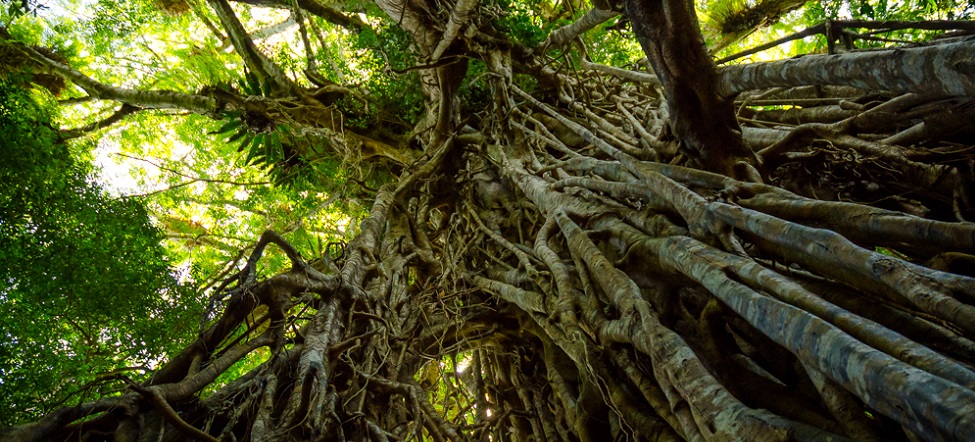 A famous strangler fig (Cathedral Fig) in Queensland, Australia. Image by James Niland / Flickr – Creative Commons
Before 2000, the forests pulled in approximately 0.62 metric tons of carbon per hectare each year. By the most recent decade studied, they were hemorrhaging 0.93 tons per hectare annually.
What’s killing the trees? Climate change tops the list. These rainforest species evolved for warm, wet conditions, but they’re now facing temperature extremes and extended droughts that damage their tissues and stunt growth.
The research team analyzed which climate variables hit hardest. Temperature spikes proved most destructive. When they compared recent conditions to those between 1981-2010, average temperatures had climbed by 0.83° Celsius (1.49° Fahrenheit).
The most extreme heat events had intensified by 50-80% of what climate models project for 2050, meaning these forests are already experiencing mid-century warming.
“The change our study describes is largely due to increased tree mortality driven by climate change, including increasingly extreme temperatures, atmospheric dryness and drought,” said lead author Hannah Carle, who conducted the work as part of her Ph.D. at Australian National University and is now at Western Sydney University.
Cyclones are also to blame. The analysis showed these storms elevate tree death rates by roughly one-fifth above normal and suppress growth for about six years after each event. More than half the monitored trees endured at least one cyclone during the study period.
“We also found that cyclones suppress the carbon sink capacity of woody biomass in these forests,” Carle said. “This is cause for concern with cyclones projected to become increasingly severe under climate change, and to impact areas further south, affecting additional stretches of forest to a potentially greater extent.”
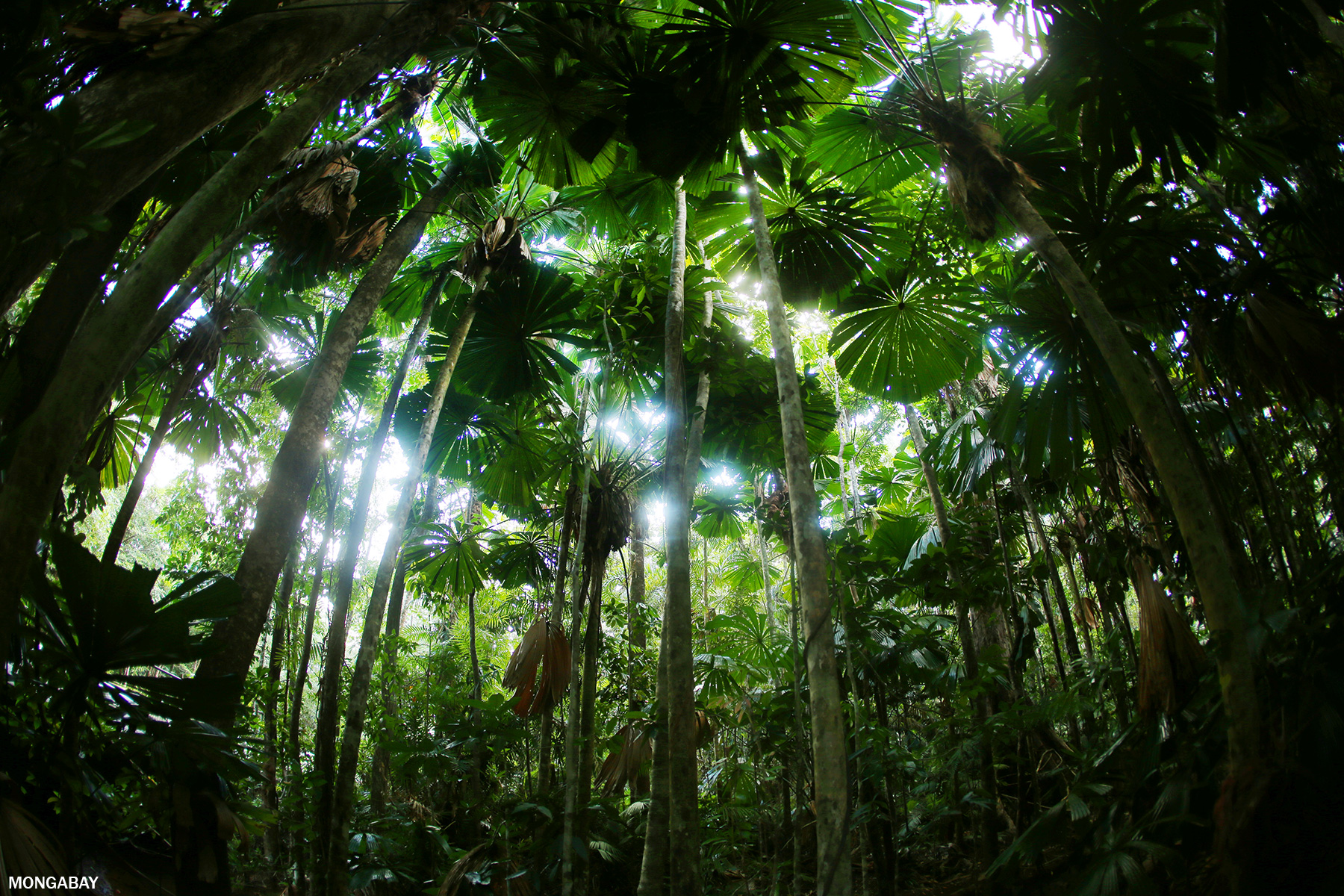 Fan palms in Australia’s Daintree rainforest in Far North Queensland. Photo by Rhett A. Butler.
More carbon could benefit plants, in theory. In fact, satellite imagery reveals forest canopies have grown about 20% greener since the 1980s, suggesting photosynthesis has ramped up. Yet that additional carbon captured from the air isn’t accumulating in wood. Heat, water scarcity and nutrient constraints are likely throttling growth even as atmospheric CO₂ rises.
“Higher carbon dioxide levels should make it easier for plants to scavenge carbon dioxide from the air, leading to more tree growth and greater carbon sink capacity,” Carle said. “Regrettably, the associated increase in carbon losses to the atmosphere has not been offset by increased tree growth.”
The carbon residence time, how long carbon stays stored in living trees, has also plummeted. Prior to 1990, carbon remained locked in these forests for an average of 85 years. That’s dropped to just 46 years, below Amazon and African forest averages.
Though this is the first time the woody biomass of a tropical forest has been shown to switch from carbon sink to source, some research has also shown the Amazon Basin to be a net greenhouse gas emitter and found the Brazilian Amazon to be a carbon source, primarily due to fires burning trees.
Despite these changes, rainforests remain carbon powerhouses, holding approximately 209 metric tons of carbon per hectare. They also harbor exceptional biodiversity and sustain cultures and livelihoods.
 The Mary River turtle (Elusor macrurus) is an endangered species that lives in the waters of tropical forests in Queensland, Australia. Photo courtesy of the Mary River Turtle Conservation Program.
“Tropical forests are among the most carbon-rich ecosystems on the planet. We rely on them more than most people realize,” Carle said. “Forests help to curb the worst effects of climate change by absorbing some of the carbon dioxide released from burning fossil fuels. But our work shows this is under threat.”
The researchers acknowledge their analysis covers only aboveground woody biomass. Roots, soils and canopy dynamics weren’t included. Future studies measuring total ecosystem carbon exchange will provide a more complete picture.
Whether other tropical forests worldwide will follow Australia’s trajectory remains unclear. South American rainforests show weakening carbon uptake, while African forests don’t. Australia’s tropical forests span roughly 1 million hectares (2.5 million acres) and experience harsher conditions than most tropical systems. They may serve as early warnings for potential changes in larger forest complexes across the Amazon, Africa and Asia.
Scott Denning, an atmospheric science professor at Colorado State University in the U.S., who wasn’t involved in the research, noted that plants globally have grown faster than they’ve died for decades, providing crucial emissions reductions. “Now we’re seeing the limits of that process,” he said. “It means society will have to work harder to eliminate fossil fuels from the world economy since we won’t be able to rely on tropical forests to clean up after ourselves.”
Brazil’s Amazon is now a carbon source, unprecedented study reveals
Citations:
Carle, H., Bauman, D., Evans, M. N., Coughlin, I., Binks, O., Ford, A., … Meir, P. (2025). Aboveground biomass in Australian tropical forests now a net carbon source. Nature, 646(8085), 611-618. doi:10.1038/s41586-025-09497-8
Bauman, D., Fortunel, C., Delhaye, G., Malhi, Y., Cernusak, L. A., Bentley, L. P., … McMahon, S. M. (2022). Tropical tree mortality has increased with rising atmospheric water stress. Nature, 608(7923), 528-533. doi:10.1038/s41586-022-04737-7
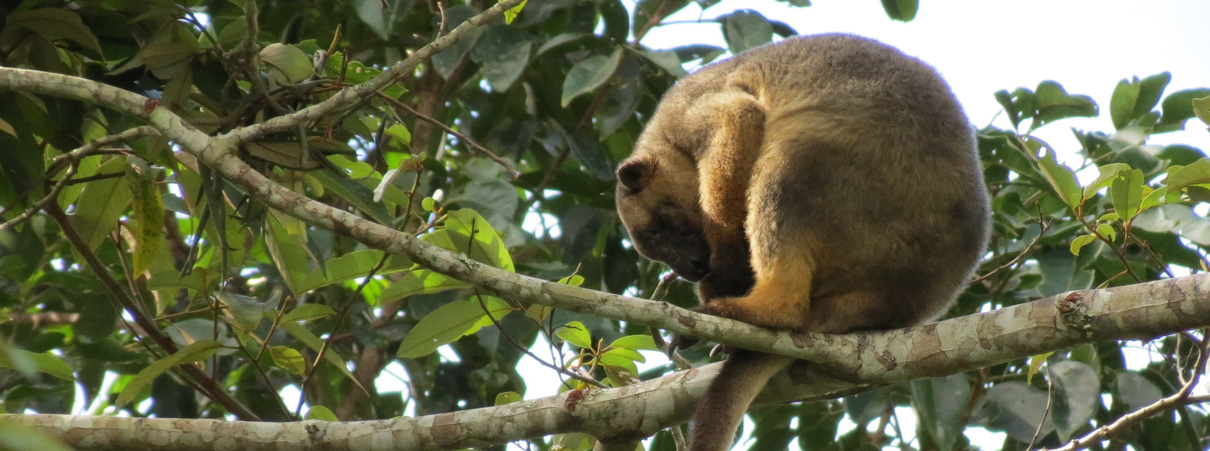
Banner image of a Lumholtz-tree-kangaroo, a species that lives in tropical forests of North Queensland, Autralia by Rhett A. Butler.
FEEDBACK: Use this form to send a message to the author of this post. If you want to post a public comment, you can do that at the bottom of the page.
