
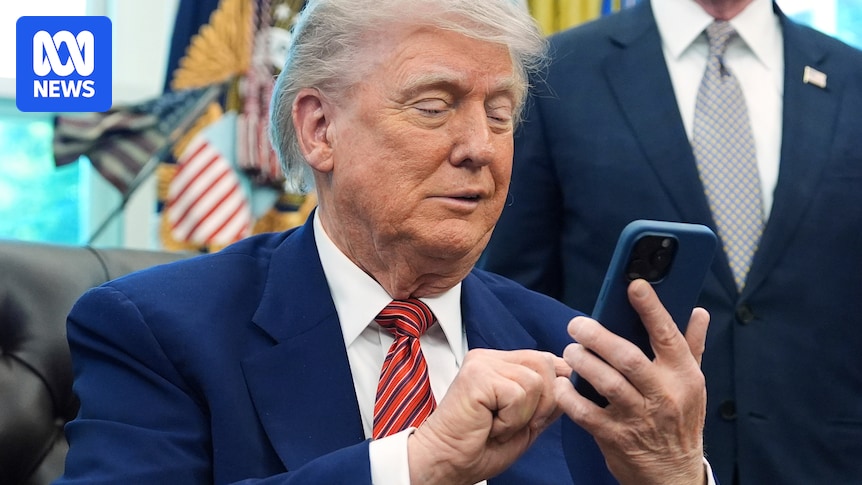
Donald Trump says he wants the United States to lead the world in the “6G race” and has given his government one year to find out how to begin making it happen.
The US president has authorised national radio frequencies used by federal agencies to be vacated so private companies can start planning and testing a future rollout of 6G wireless networks.
“The next generation of mobile communications networks (6G) will be foundational to the national security, foreign policy, and economic prosperity of the United States,” Mr Trump said in a statement released on Friday, local time.
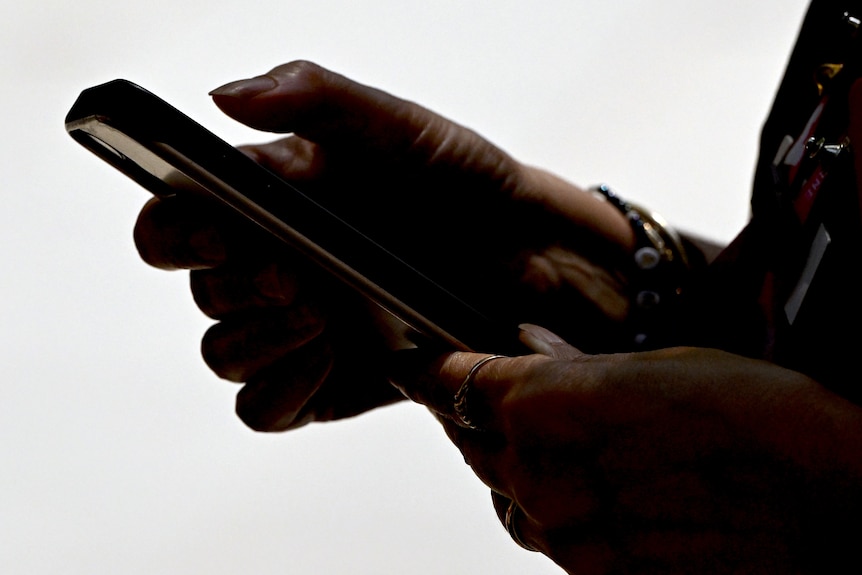
6G connectivity would be central to national security, foreign policy, and economic prosperity, according to Donald Trump. (AAP Image: Joel Carrett)
“This technology will play a pivotal role in the development and adoption of emerging technologies like artificial intelligence, robotics, and implantable technologies.
“6G will also provide faster, more resilient, and more secure communication networks that can be utilized for national security and public safety purposes.
“It is the policy of the United States to lead the world in 6G development.”
So, what is known about 6G and when could it become a reality? Here’s what we know.
‘The next generation of mobile computing’
Jay Guo, a distinguished professor from the University of Technology Sydney, says 6G is the world’s next generation of communications and will be underpinned by three key differences compared to 5G:
An integration of terrestrial and non-terrestrial networks: A combination of existing mobile networks that provide coverage across land, with the use of satellites and drones to expand communications access to the air and space.Network sensing: New technology to identify and warn of environmental factors in an area, such as predicting likely rainfall totals or the chance of a flood.AI Native: Using artificial intelligence to underpin 6G networks.
“Australia definitely needs [6G] for coverage purposes because we can’t roll out the [existing] terrestrial networks to cover 100 per cent of the land,” Professor Guo told the ABC.
TIME magazine names 2025 Person of the Year
Dr Ming Ding, from the CSIRO’s Data 61 Privacy Technology Group, said 6G could provide new platforms for communications innovation.
“6G might include new and higher radio frequencies, new protocols, higher data rates, integrated sensing, more modular infrastructure, AI-supported network optimisation and integration of terrestrial and non-terrestrial networks,” he told the ABC in an email.
“Applications could include: Unmanned Aerial Vehicle (UAV) mobility, Holographic presence, Autonomous driving, Digital twins, Smart grid, Industry 5.0 (humans and machines working together), intelligent healthcare and extended reality. Many of these applications are already being impacted by 5G.”
How will the US roll out 6G?
In his statement, Mr Trump said his administration had been studying federal radio frequencies throughout 2025 to determine which would be best for 6G development without posing a risk to national security.
The president ordered Assistant Secretary of Commerce for Communications and Information Arielle Roth to oversee multiple government departments to study the frequencies, estimate the costs of moving federal agencies’ work to other frequencies and assess any potential risk to national security.
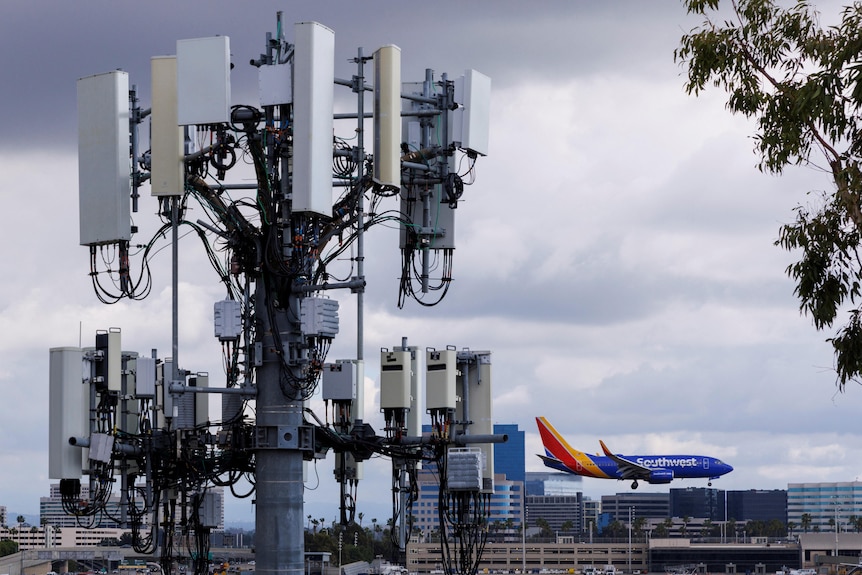
US government agencies will begin vacating specific radio frequencies to free up space for technology companies to begin testing 6G connectivity. (Reuters: Mike Blake)
Mr Trump has given Ms Roth until December 19, 2026 to report her findings.
The president also ordered US Secretary of State Marco Rubio to create “a coalition of industry and foreign partners that supports the United States’ positions” on 6G.
What Australians think about AI
“Certain steps are necessary to achieve the goal of this policy,” Mr Trump said in his statement.
“Including steadfastly advancing American interests in the international standards bodies that will play a crucial role in 6G development, and identifying a significant volume of radiofrequency spectrum that can be harmonized for 6G networks internationally.”
Professor Guo said he did not believe it was realistic that the US would have access to a functioning 6G network within 12 months.
“This mobile telecommunications technologies follow a global standard. The standardisation activity just started this year. It will take at least four years to complete,” he said.
“Without standards, no one can actually or precisely say they’ve got 6G because they don’t know … It’s just impossible.”
Technology commentator Trevor Long, from the EFTM.com website, agreed and said the US typically overstated its progress.
“America is quite often pretending to be first on things when they’re not,” he told the ABC.
“Even with 4G and 5G, American mobile telcos would put a little 5G or 4G symbol on people’s phones, even though they weren’t effectively using what was globally known was the standard for those generations.”
What is Australia’s 6G stance?
In February 2024, the Australian government announced the nation had joined multiple other countries in a joint 6G research-sharing and development agreement.
The agreement included the governments of the US, Canada, Czech Republic, Finland, France, Japan, the Republic of Korea, Sweden and the United Kingdom.
Is 2025 ending with an AI bubble?
“Collaboration and unity are key to resolving pressing challenges in the development of 6G,” a joint statement said.
“We hereby declare our intention to adopt relevant policies to this end in our countries, to encourage the adoption of such policies in third countries, and to advance research and development and standardization of 6G networks.”
The agreement also said the countries would prioritise the building of 6G technologies that protected national security and privacy and were environmentally sustainable and affordable.
The partnership came after Australia joined Canada, Japan, the UK and US in 2023 to create the Global Coalition on Telecommunications to share information about improved technologies.
In November, Australia was accused by Chinese state media of “stigmatising narratives about China” and its 6G development.
The rebuke came after former government cyber adviser Alastair MacGibbon told the Australian Financial Review that collaboration with Beijing on 6G could risk “extraordinary and irreversible national security risks”.

The United States and China are the world’s two leading nations for AI and telecommunications technology innovation. (News Video)
Professor Guo said China and the US were leading the world for technological advancements in AI and 6G networks, but there could be risks if Australia needed to rely solely on them for its own national coverage.
“All the [current Australian telecommunication] networks are under our government rules … But if we start using satellite communications provided by foreign companies, it becomes a different game altogether,” he said.
Prime Minister Anthony Albanese told reporters in November that the federal government would assess impacts to national security with any potential 6G rollout.
When could Australia get 6G?
There is currently no 6G network connection anywhere in Australia.
Australia’s major telecommunications companies Telstra, Optus and Vodafone provide access to 5G coverage to customers living in most capital and major cities.
The telcos’ 4G coverage also extends to large parts of rural and regional Australia.
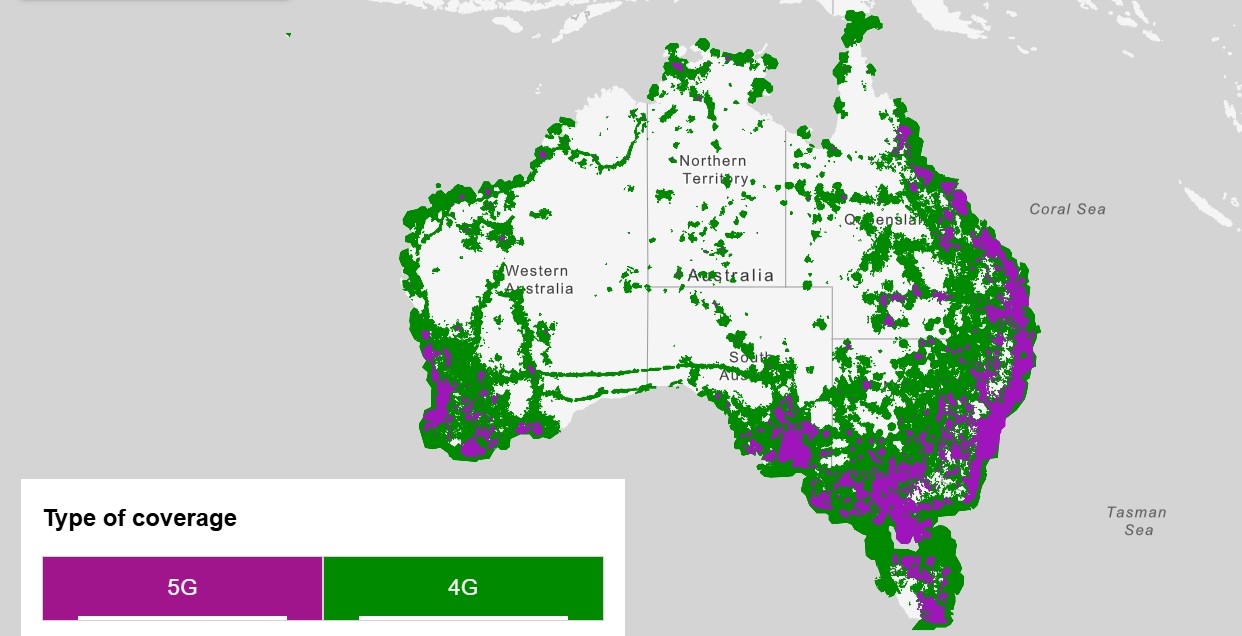
Australia’s largest telco, Telstra, provides 4G and 5G coverage for customers living in most capital and major cities across the country. (Supplied: Telstra)
The country’s first high-speed mobile network, 3G, was disconnected nationwide late last year after a gradual decline and telcos’ move to 4G connectivity.
Professor Guo estimated Australia would not have 6G coverage at least until 2030.
He said the rollout would be impacted by a need in metropolitan areas for “much higher” data rates to service customers, and comprehensive satellite coverage for rural and regional areas.
Mr Long said the history of 5G development had shown that it could still be years before Australians were able to access 6G coverage on their devices.
“We talked about 5G for years. We had tests of 5G in labs and in some towns for years before it was signed off as a global standard and then it hit mobile phones,” he said.
“I would argue Australia is a big driver of the change.
“Telstra, for example … are a world leader, mainly because of the size of Australia and the uniqueness of our country, and therefore the mobile networks.”

High costs and lengthy development periods could mean 6G will not be accessible in Australia until at least 2030. (Adobe stock)
The 6G network could boost Australia’s overall connectivity by replacing the existing 4G and 5G networks, according to Australian Telecommunications Alliance CEO Luke Coleman.
“Today, Australia has 4G and 5G networks, and telcos are now rolling out ‘5G Standalone’ — a newer version of 5G that isn’t bolted-on to 4G technology,” he told the ABC in an email.
“5G standalone offers lower latencies, faster data speeds, and the ability to connect vast numbers of devices. Next we’ll see 5G-Advanced, which will bring us a step closer to 6G.”
Mr Coleman said the timeline for Australia to adopt and develop 6G could be significantly impacted by the affordability of telcos accessing “spectrum” — the nation’s public radio frequency airwaves that underpins Australians’ data usage.
“The ACMA, which is responsible for spectrum management, recently valued the renewal fees for telcos’ existing spectrum licences at $7.3 billion, up from the previously indicated range of $5.0 to $6.2 billion,” he said.
“These higher prices will inevitably have significant negative consequences for Australians. Every dollar spent on spectrum is a dollar that can’t be invested in mobile coverage and capacity.
“Higher spectrum costs reduce the pool of capital available to support investment commitments. An increase of this magnitude will inevitably constrain the funds available to invest in 5G Advanced, and in future, 6G.”