
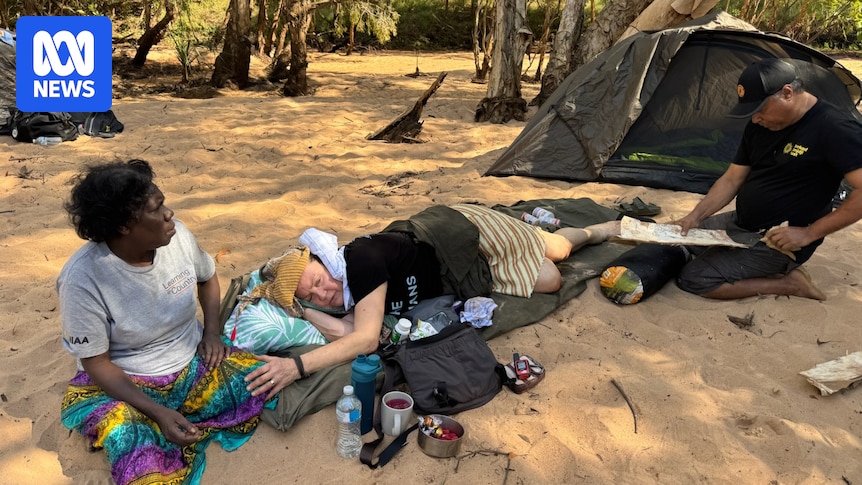
It was just after dawn on a cool, dry season morning in remote West Arnhem Land when Margie Moroney heard a crack.
At first, she thought it was the sound of a branch snapping.
But when she looked down, Ms Moroney saw that her foot was hanging at a right angle to her shin.
With no mobile phone coverage and no chance of anyone hearing her call out, Ms Moroney decided to crawl 500 metres back to the campsite she was sharing with her colleagues.
“I just thought: ‘I cannot stand to lie here with my brain going round and round for an hour and a half,'” she said.
“I thought: ‘Well, I’ll see if I can crawl.'”
Margie Moroney was forced to crawl back to her camp after breaking her ankle in three places. (Supplied: Margie Moroney)
A board member of the Nawarddeken Academy and the Karrkad Kanjdji Trust (KKT), Ms Moroney lives in Sydney but often travels to remote parts of the Northern Territory for work.
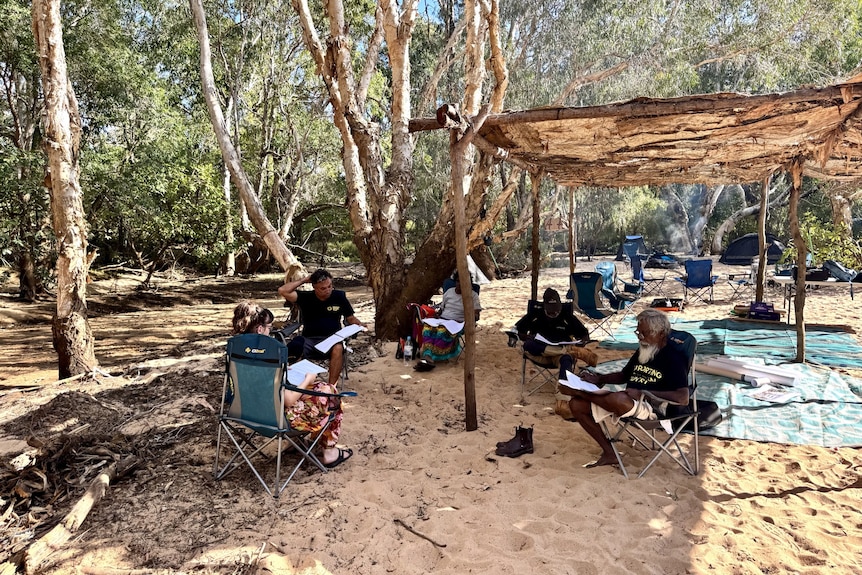
On June 3 this year, she was visiting the small homeland of Mamadawerre, 100 kilometres north-east of Gunbalanya, for five days of meetings.
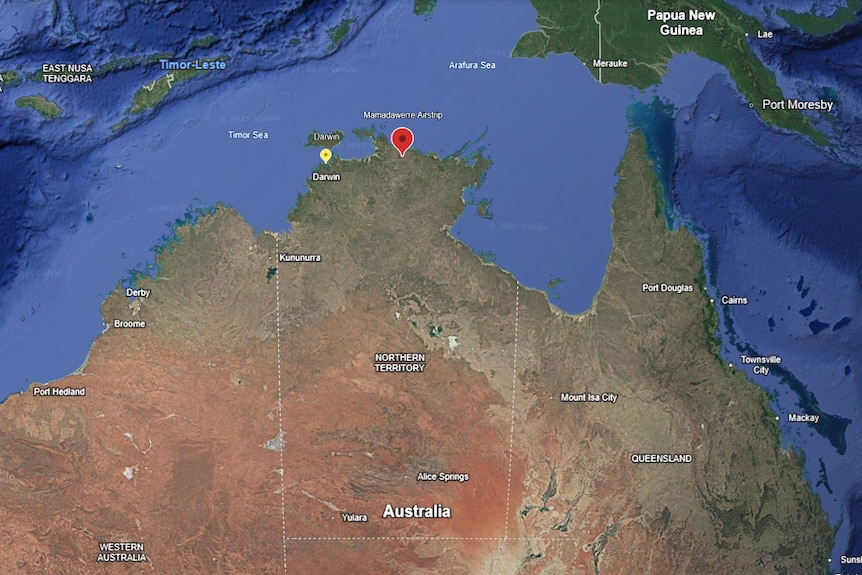
The Mamadawerre homeland, marked in red, is 400 kilometres east of Darwin in West Arnhem Land. (Supplied: CareFlight)
She told her colleagues she was going for a short walk to stretch her legs before the day’s meetings began.
Ten minutes later, she slipped on a patch of mud in the otherwise dry creek bed.
Holding her foot in the air and dragging her bloodied knees over the ground, it took Ms Moroney about 25 minutes to reach the camp.
“I knew if I looked ahead, I’d lose heart, so I just looked down … at each hand and thought: ‘I’ll just keep going until I can’t go any further,'” she said.
“My knees were pretty shredded.”
Paperbark ‘handy stuff’
Fellow board member Fred Hunter, a Kakadu National Park ranger for 38 years, was able to treat Ms Moroney while they waited for assistance to arrive.
“There was nothing there that I could think of to use as a splint because I could see her ankle was — to me — it was snapped in half,” Mr Hunter said.
Loading…
“The best thing I could see were the paperbark trees everywhere there, [so] I cut a nice square piece and wrapped it around her foot and used a bandage to hold it.
“I do a lot of ground ovens, and I cook with paperbark. It’s very handy stuff.”
Ms Moroney’s colleagues then used a swag as a makeshift stretcher and transported her to the homeland, but it was still a few hours with only paracetamol for pain relief before a CareFlight crew was able to reach them.
A challenging landing
Fixed-wing pilot Myles Lauer said it was the first time CareFlight had landed at Mamadawerre, and there were several hazards they had to consider, including the length of the airstrip and the terrain.
“There’s a little bit of the escarpment area towards the south of it, and quite tall trees at both ends,” he said.
“Animals are definitely another big aviation risk. There can be people driving across [the airstrip] as well.”
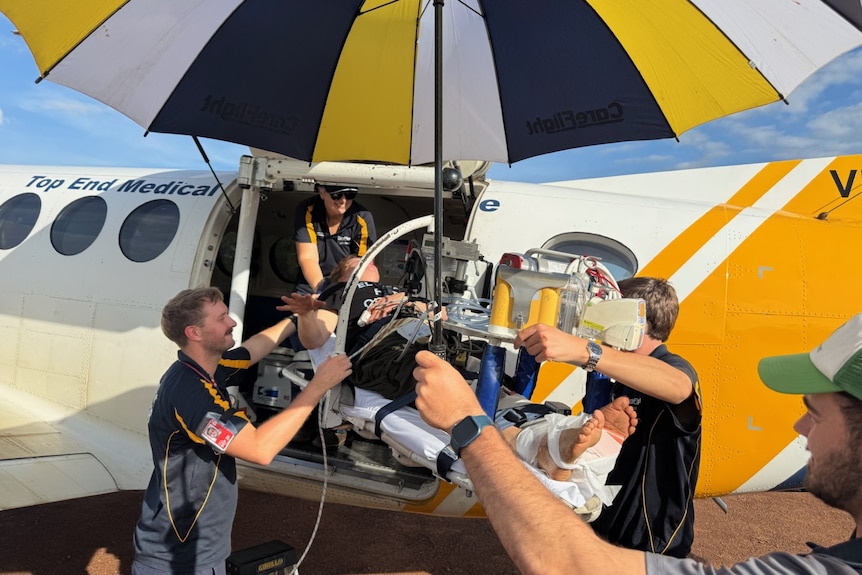
The CareFlight plane was greeted by the whole Mamadawerre community. (Supplied: CareFlight)
When CareFlight arrived that afternoon, the whole community was there to welcome them.
“Everyone was out there watching us land and wanted to help carry equipment in,” flight nurse Nadine Tipping said.
“Everyone had done such an amazing job of cleaning [Ms Moroney] up a bit and preparing [her]. And the splint — we’re still amazed by using the paperbark as a splint.”
Ms Moroney was flown to Darwin, where she learned she had a triple fracture in her ankle, plus torn ligaments and tendons.
She spent almost two weeks in Royal Darwin Hospital before returning to Sydney for surgery and rehabilitation.
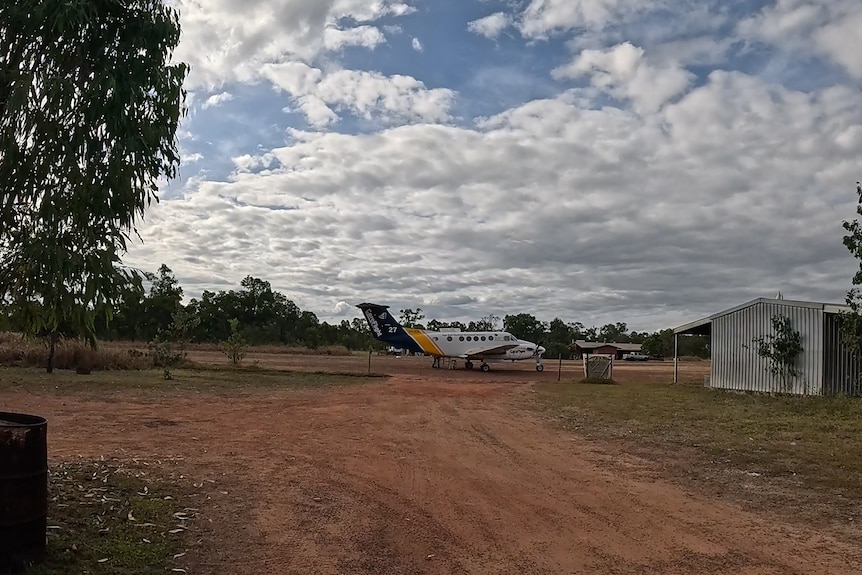
It was the first time CareFlight had landed in Mamadawerre and it came with a number of unique challenges. (Supplied: CareFlight)
Mr Hunter retraced Ms Moroney’s crawl the following day and said it was an impressive effort.
“She crawled a fair way, at least 500 metres with her foot up in the air, on her knees,” he said.
“It was just lucky that there was no buffaloes or pigs around.”
Safe handsLying with a spine injury in the remote Australian bush, Craig feared the worst
Several months on, Ms Moroney is still recovering from her ordeal, but says that although her injury occurred in a challenging location, she was always in safe hands.
“I could not have been with better people — the Traditional Owners, the rangers, the teachers and my KKT colleagues were all phenomenal, and I will never forget my relief when that CareFlight team walked into the room,” she said.
“Where would we be without CareFlight? I would have had to endure a 12-hour drive over rocky creek crossings.
“It’s just an absolute necessity. Particularly where we work — it’s so remote, there are no clinics. It’s critical.”