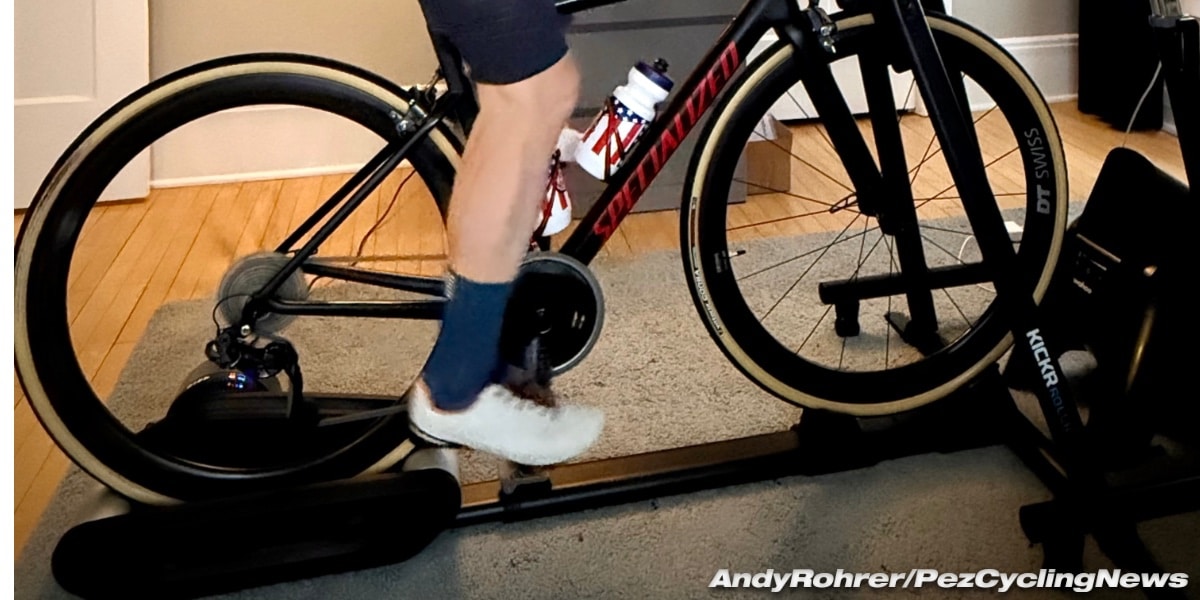
Here at PEZ, we’ve tracked the Wahoo revolution since our first KICKR review back in 2014. Since then, Wahoo has built a full-blown family of indoor options. You’ve got the “pro-level” KICKR BIKE PRO and the “pain cave” staple like the KICKR CORE 2. But Wahoo realized not everyone wants to pull their rear wheel off or drop $4k on a dedicated trainer bike. Enter the KICKR ROLLR.
First introduced back in 2022, it’s now updated with onboard power estimation (and the firmware is backward-compatible for first generation owners). Wahoo has delivered an economical entry to smart training…let’s get reviewing riding!
KICKR ROLLR — $699.99
With updated firmware, the Wahoo KICKR ROLLR is now an indoor smart trainer that cleverly merges the natural, unconstrained ride feel of traditional rollers with the controlled resistance and smart connectivity of a modern direct-drive trainer. Wahoo have moved the trainer closer in capability to its pricier KICKR siblings with native onboard power broadcasting that enables high-quality structured indoor training, and even indoor racing à la Zwift, on virtual training platforms.
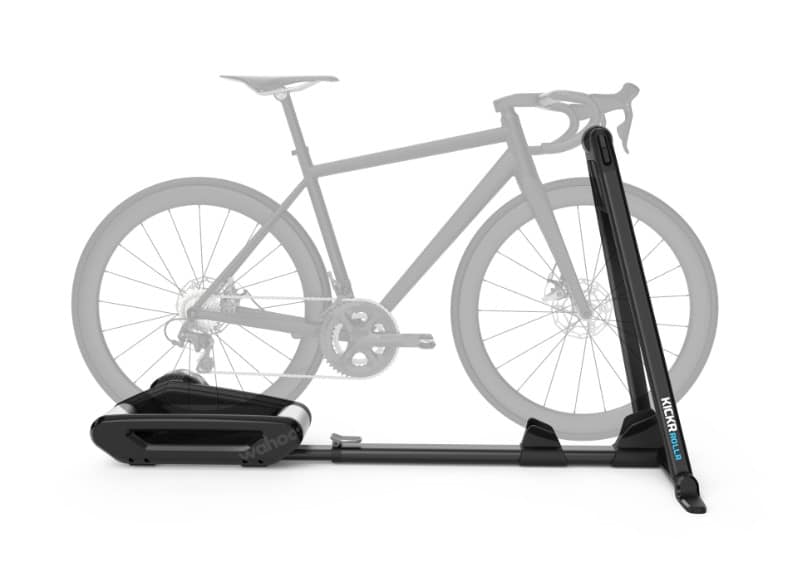 Image credit: Wahoo Fitness
Key Features

Dual-Roller Design: A 10.5 lb flywheel provides weighted inertia to replicate real-road feel, while the rear wheel moves naturally beneath you.
Safety Tire Gripper: A quick-adjust clamp secures the front wheel for stability during high-wattage efforts.
Broad Compatibility: Fits 700c tires up to 45mm; wheelbases from 950mm to 1100mm. Wahoo sez: “The smoother the tire, the better.”
Smart Specs: Simulates grades up to 10% and handles up to 1,500 Watts.
What changed?
The big news is the Power Meter Connect firmware update. Previously, the ROLLR required an external power meter to function as a “smart” trainer. Now, the unit provides native onboard power estimation. It transforms the ROLLR into a standalone tool for Zwift or structured training without needing extra sensors on your bike.
Andy sez: Like all of the trainer offerings in the KICKR family, this is a high quality unit. The KICKR ROLLR is not cheap, and it is not cheaply made. With the updated software, Wahoo has further lowered the cost of entry into the smart trainer segment. By providing native power estimation, Wahoo enables riders who do not have a power meter to jump right into virtual training platforms without buying a power meter.
Unboxing and assembly
Setting up the KICKR ROLLER is refreshingly straightforward. You do not need to be a university trained mechanical engineer to get on the rivet here.
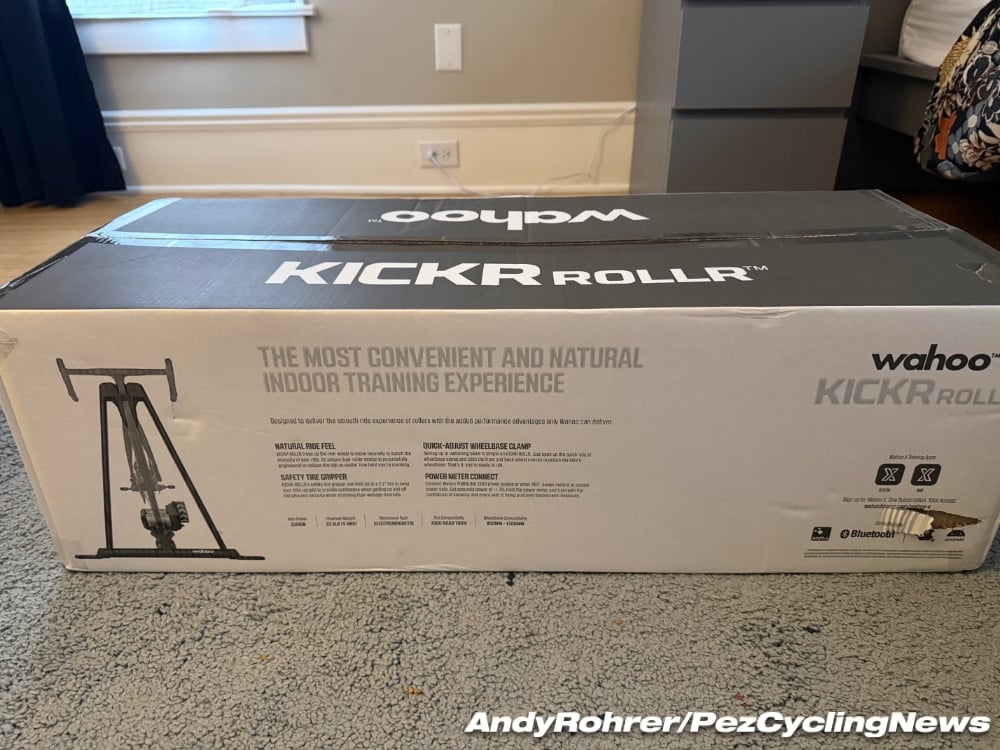
The box was slightly damaged from shipping. Note the tears in the outer box from where the delivery driver dropped the awkwardly sized 60 pound (27kg) box. But, no worries…
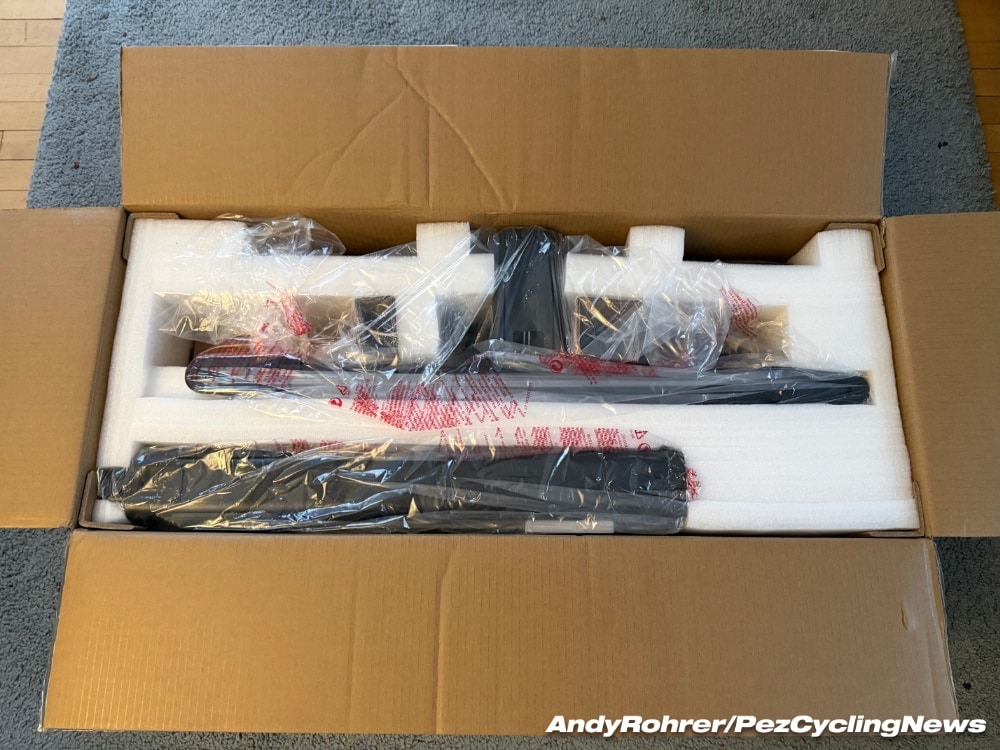
Opened up, the box reveals a well packaged (and protected) unit. The packaging protected and stabilized the trainer with well-engineered packaging. If Wahoo put this much though into packaging, it’s fair to assume they did their homework engineering the unit as well…
The whole assembly consists of six major parts.
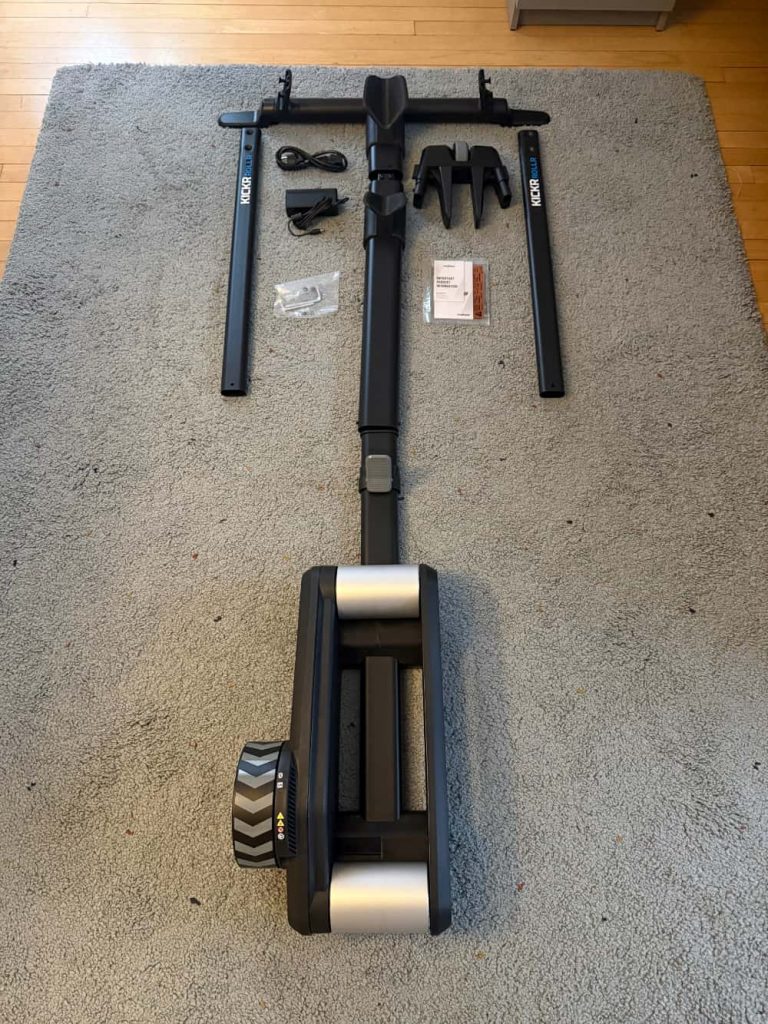

When you unpack the unit, the bolts are partially screwed into their respective positions, so you will not be hunting through bags of bolts. Very thoughtful, and very easy!
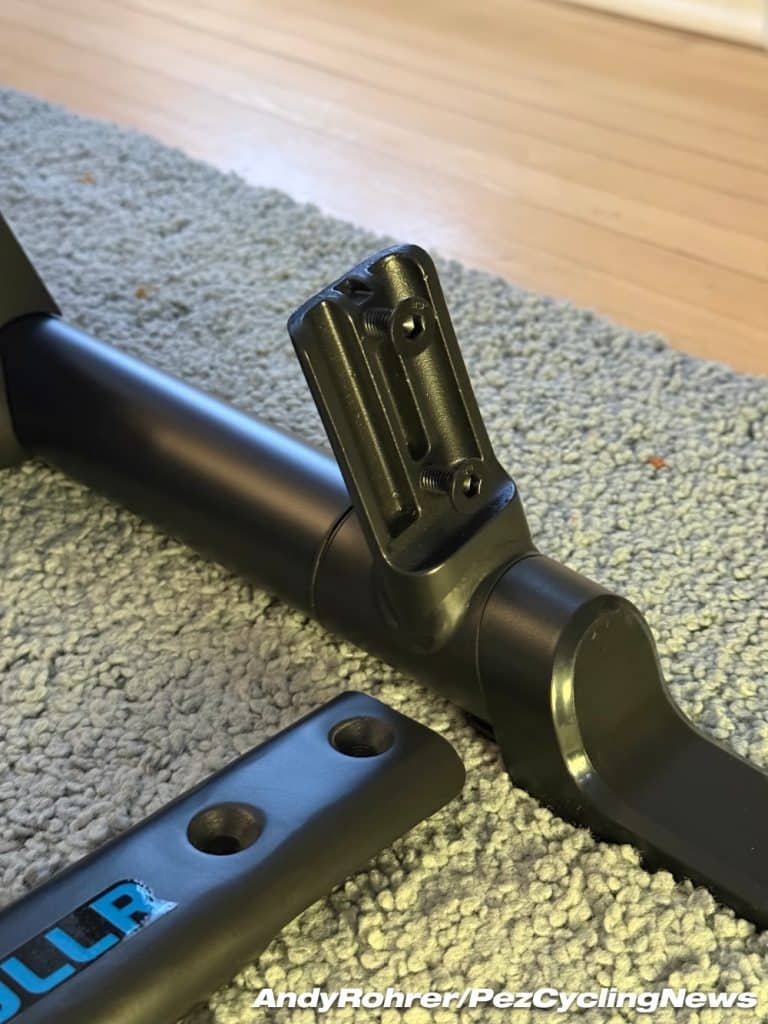
One notable difference from the original ROLLR is that A-frame is now a three part assembly. Previously, the entire front portion of the frame was a single unit. The design change makes for more compact packaging. I found the assembly process for the A-frame a bit finicky, because I just started putting the parts together. I should have read the assembly instructions first, it went much smoother once I did. with the A-frame assembled, the longitudinal bar that joins the A-frame to the roller and flywheel unit is easily maneuvered into place to finish the assembly.
Mounting the bike
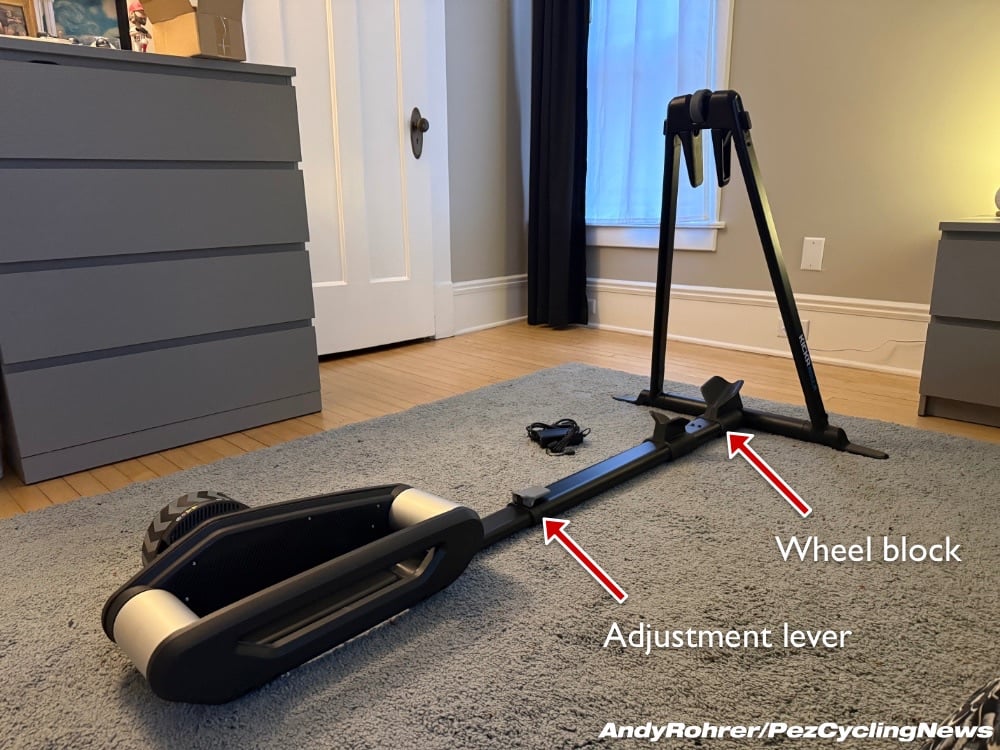
This is arguably the easiest step of the KICKR ROLLR smart trainer assembly process. The complete assembly of the trainer took less than 30 minutes to this point. Putting the bike on took another minute. In the photo above I’ve pointed out a couple of items for reference, and yes, it is really this easy.
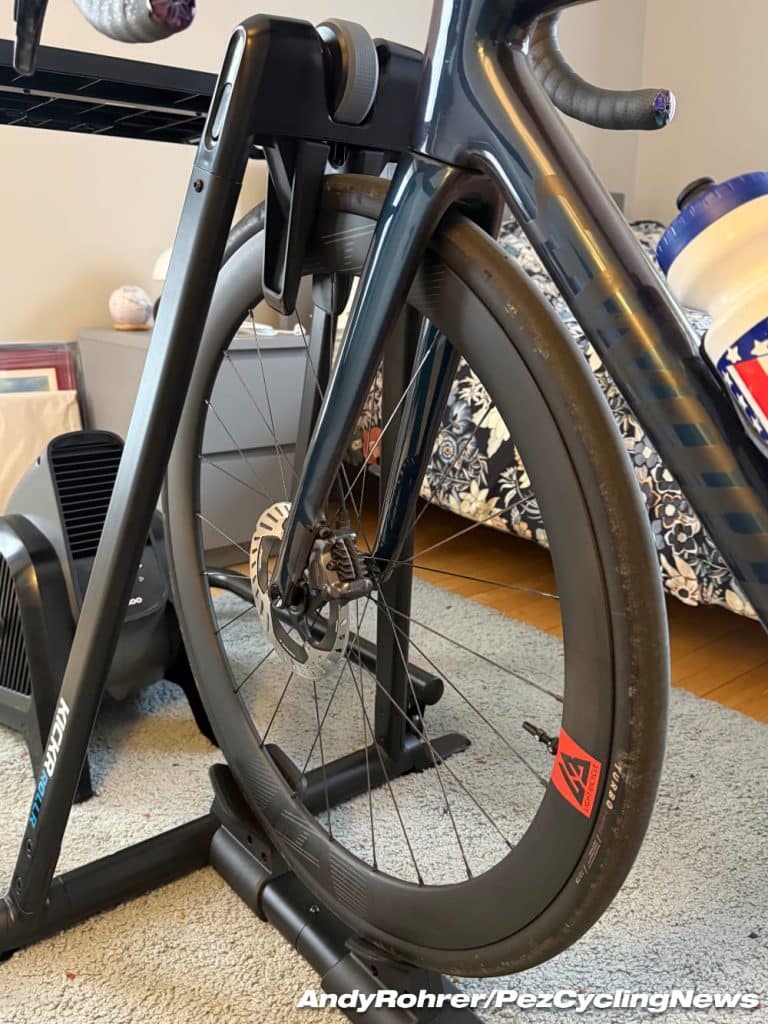
I placed the front wheel in the integrated wheel block, maneuvering the top of the wheel to sit between the jaws of the wheel gripper at the top of the A-frame. Then, I sat the rear wheel on the rollers (more on that in a moment) and I secured the front wheel, by closing the jaws. So, how do you know when it’s tight enough?
Wahoo sez: “Adjust…to your desired tightness – a looser fit allows more lateral play while riding, while a tighter fit provides greater stability.”
More on that later. Now for the rear wheel.
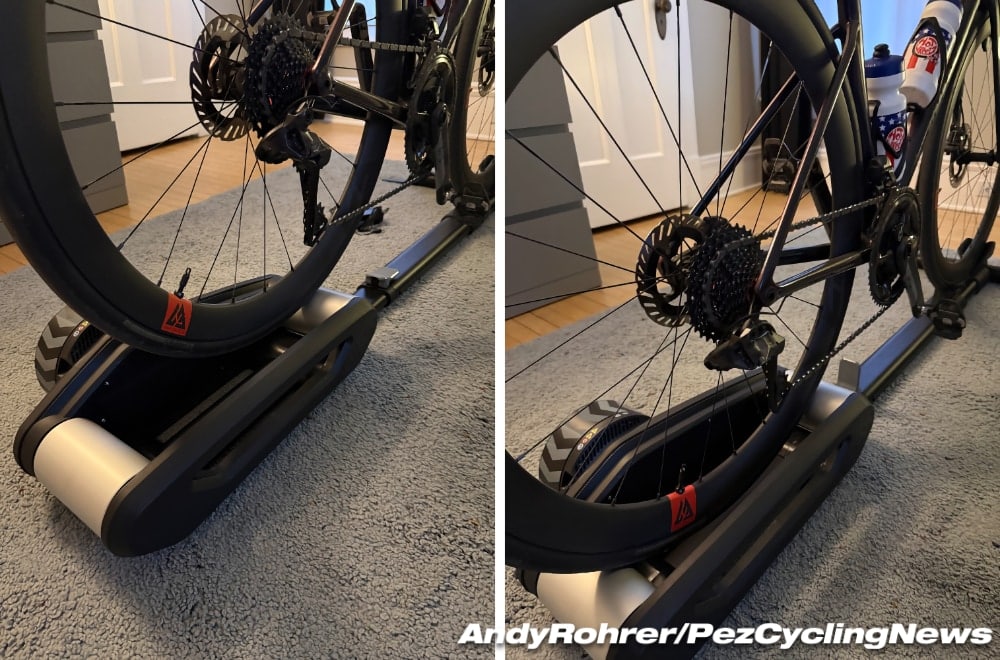
As you can see, when I first placed the rear wheel in the roller assembly, it was resting on top of the front roller. I lifted the adjustment lever, really a locking lever, and slid the roller assembly forward. Once the wheel sat between the rollers contacting both, I just closed the lever and I was ready to go.
Power up!
The first generation WAHOO KICKR ROLLR did not have native on board power. To access smart training features, like resistance and use the ROLLR with online platforms, you needed a separate power meter. WAHOO of course name checks Speedplay pedals, but any ANT+ capable power meter will work. My SRAM AXS Power Meter Spider carrying 48-35 chainrings was just fine.
The newest KICKR ROLLR smart trainer is suddenly a more compelling indoor training proposition because it can estimate power out of the box, no power meter required. WAHOO achieved this using a firmware update, v 1.1.31 for the techie inclined. Thoughtfully, Wahoo made the firmware compatible with the first generation ROLLR. It is not unheard of, unlocking new capability through software updates that’s backward compatible. But, it is not common either. Kudos to WAHOO for recognizing that the hardware was capable of accepting this upgrade, and making it available to existing owners of the first generation ROLLR.
Get connected
You will have two ways to connect the KICKR ROLLR once you’ve plugged it into the wall. First, you can use an on-bike power meter to send power and cadence data to a connected device (Garmin, Wahoo, etc.) or an app (Rouvy, Zwift, etc.) which then communicates with the ROLLR to apply dynamic resistance. The second option is to use the ROLLR itself to estimate power values and communicate directly with a connected device using the FE-C protocol or to an app.
The limitations of the second method are hinted when Wahoo Sez: “This setting is meant for personal training and entertainment purposes, and will not be comparable to other sources equipped with a power meter…Due to the accuracy limitations of Onboard power, the acceptability of using virtual power in racing in the app is at the discretion of a given event’s race directors.”
In the interest of keeping you interested, I am not doing the litany getting the device connected. Suffice it to say, the process is easier, and shorter, than assembly. For reference, connecting your on-bike power meter is covered here, while connecting to the onboard power meter is covered here.
Riding the ROLLR
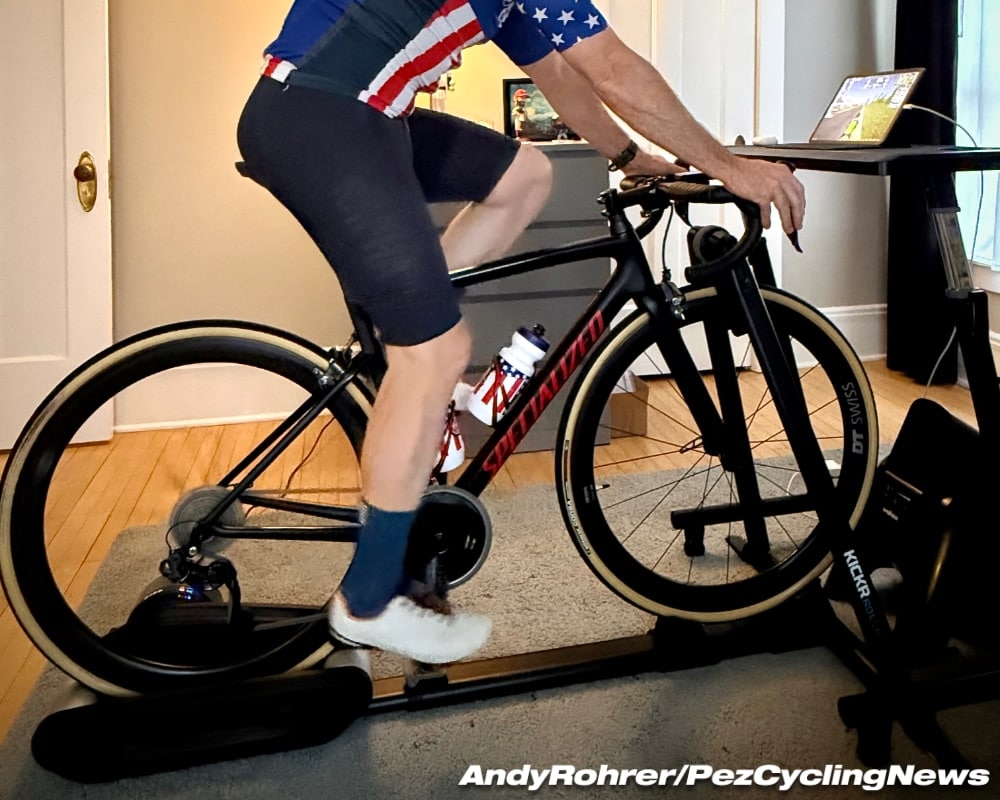
Where this all matters is riding the ROLLR. It is functionally no different in terms of feel as described by Chuck when he tested the original ROLLR.
In function
Right from the start, the KICKR ROLLR smart trainer needs to be understood for what it is capable of and what it cannot do. It offers an entry level, and dead simple option for smart indoor training. It is simpler to put into operation than a direct drive trainer and measurably more economical than investing in an n+1 “stationary” indoor bike. I say entry level, because what it can’t do natively with the onboard power estimation (per Wahoo) is give a precision power based experience.
But, the ROLLR is quiet. Direct drive trainers have gotten quieter over the last decade or so. The ROLLR is not silent, but it is quiet even compared to the most modern and quietest direct drive trainers. Not quite the quiet swish of 320tpi tubeless tires and a freshly waxed chain, but it isn’t obnoxious either.
Limitations
As stated above, Wahoo acknowledges the “accuracy limitations of Onboard power.” These limitations are enough to see Zwift—where a whole system for virtual competition exists, and which is serious enough that they require real world validation in some cases—typically will not allow ROLLR mounted athletes compete. Translate that to training. Though Wahoo praises accuracy, the accuracy band for the ROLLR is significantly wider than physical power meters that use strain gauges and accelerometers to give incredibly precise measurements. The reality is that the ROLLR with power estimation is just not going to deliver the sort of precision that dedicated power meter hardware does.
The primary challenge to using the ROLLR is the roller/tire interface. When I snapped a 600W+ sprint, I did experience some slippage between the tire and the roller. It’s not a mechanical flaw; it’s just physics. Like a hard acceleration on loose gravel, the tire can slip before the roller recaptures it. Punchy power deliveries challenged the ROLLR. So did sustained, high power efforts (like on a Zwift or Rouvy ramp climb) out of the saddle.
Frankly, Wahoo’s claims of a 1500W have me skeptical. A precise record of a hard punchy sprint just couldn’t be achieved, standing or seated. Maybe if you’re Tadej Pogačar or Mathieu van del Poel doing a measured spin up to 1500W you can achieve it. This isn’t a trainer for track sprinters, but for everyone else? It’s plenty.
This is not intended as a harsh critique – but an honest characterization of the reality of the roller/tire interface and the challenges of estimating power from the roller and flywheel mechanism. Though it is far more accurate than the estimations offered by a popular online training diary while pedaling your favorite segment, it is unable to deliver the precision of a physical power meter with strain gauges and accelerometers.
The bottom line
You might think a “power estimate” makes this a secondary tool. On the contrary, I find it incredibly useful. Winter base miles are turning out to be very enjoyable on the KICKR ROLLR smart trainer. The natural movement and quiet operation make long sessions feel less like a “torture fest” and more like a bike ride.
The KICKR ROLLR is the perfect ticket for building volume. I can assure you, my readiness to line up for the Melting Mann short course (39 miles) on March 28, 2026, will be due to the ROLLR. Come on out once winter is over, let’s go racing!
•• Buy the Wahoo Kickr Rollr with this link and Pez earns a small commission to help keep the site running.
Like PEZ? Why not subscribe to our weekly newsletter to receive updates and reminders on what’s cool in road cycling?