
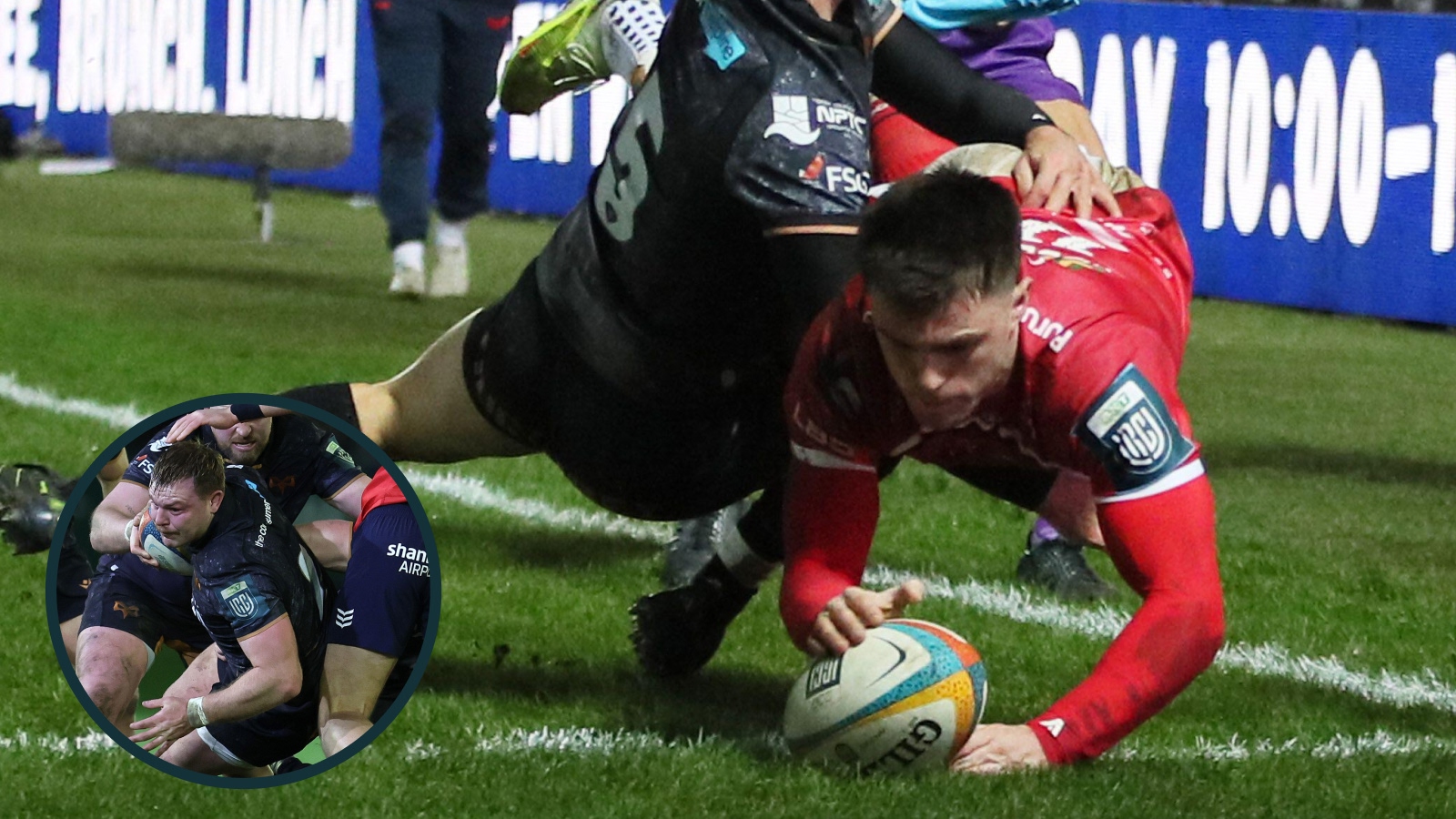
Following a 26-19 victory for the Ospreys over the Scarlets in the United Rugby Championship (URC), here’s our five takeaways from Friday’s Boxing Day game at Parc Y Scarlets.
The top line
This bottom-of-the-table Welsh derby battle between the two regions whose heads are most on the cost-cutting WRU’s chopping block was a physically gruelling spectacle, but the eventual outcome – a bonus point Ospreys win – was a fair reflection of what unfolded.
Scarlets thought they were ahead less than four minutes in, but Jake Ball’s try was scrubbed out for double movement after TMO review. They threatened again soon after, but Gareth Davies’ kick and chase ended with the ball beating him over the dead-ball line.
With Dewi Lake having issues at the lineout and Keiran Williams carded for a deliberate knock on, the scene appeared set for Scarlets to get a reward for their dominance. However, the man-down Ospreys took a 24th-minute lead they were never to lose with Owen Watkin’s converted try under the posts after a huge Ross Moriarty carry.
An error from Ellis Mee then got Ospreys sniffing again in the hosts’ 22 and, after a penalty awarded after Williams came back from the bin put them into touch at the corner, Lake was driven over by a 29th-minute maul.
Suddenly down by 14 points, the peeved Scarlets struck back with a 36th-minute try from Joe Roberts, but they couldn’t be happy at trailing at the break 7-14 to an opposition that has put in more than three times the number of tackles.
The second-half action was of the suffocating variety, with little creative play materialising and the standard of box kicking repeatedly poor. It was somehow apt that it was a stray box kick that handed Ospreys the possession to ignite the country-attack from halfway that ended with Kieran Hardy scoring the converted try that pushed the margin to 21-7.
Keelan Giles’ yellow card for a deliberate knock-on soon after kept things interesting, though, as Roberts got in at the corner on 69 minutes for his second try to cut the margin to nine points.
Scarlets’ hopes of a successful comeback, however, were scrubbed out by Max Douglas’ yellow card and Iestyn Hopkins ‘ 77th-minute unconverted try from a Dan Edwards crosskick to clinch the four-try bonus point.
The hosts did snatch a losing bonus point with Jarrod Taylor’s converted try, but that consolation wasn’t enough to prevent them from being left rooted at the bottom of the URC table.
Opinion: Welsh rugby does not need to rediscover its past, rather it needs to design its future
Injury-causing stadium furniture
There has been plenty of chat in football about pitch perimeters following the tragic death in September of ex-Arsenal academy player Billy Vigar. He suffered a traumatic brain injury when he crashed into a wall at Wingate & Finchley while playing for Chichester.
Scarlets’ derby versus the Ospreys produced a reminder that this type of safety discussion is also needed in rugby. Parc Y Scarlets is a modern stadium with plenty of room, but the behind-goal advertising hoardings were placed very close to the dead-ball line and it was there that home scrum-half Davies had a painful collision after just seven minutes.
Chasing Mee’s kick, Davies kicked on himself only to be beaten by the ball that bounced over the dead-ball line. Davies had unsuccessfully attempted to dive onto the ball after edging his race with Ospreys’ Harri Deaves and his momentum took him headfirst into the metal advertising hoarding.
It was a wincing collision, and while Davies played on with a headband following treatment, it was a reminder of the dangerous hiding in plain sight around sports pitches.
Bad enough that injuries happen on the field of play – blood was spilt when Ospreys duo Watkin and Moriarty clashed heads when double-tackling Eddie James soon after play restarted following the Davies incident – but every precaution must be taken to ensure that off-pitch furniture isn’t a fault for an injury.
Want more from Planet Rugby? Add us as a preferred source on Google to your favourites list for world-class coverage you can trust.
Life in vet’ Moriarty
Ospreys couldn’t have been as brutal and unwatchable as they were last Saturday at home to Munster. Following the confirmation that Lake and Jac Morgan were joining Gloucester for the 2026/27 season in England, Mark Jones’ side played as if it had its heart ripped out.
A fiery response was demanded, and having to go up the road to neighbours, who are felt to have a better chance of WRU survival, turned out to be the perfect fixture to rouse them. What they demonstrated at Parc Y Scarlets, which was badly missing at Bridgend last weekend, was grit to stick at it when things don’t go your way.
Ospreys were second best during the early part of this derby, and the accumulation of a yellow card was a real backs-to-the-wall situation where they demonstrated their mettle.
The 31-year-old Moriarty has not worn a Wales shirt since 2022, but the veteran was as hard as nails here, especially in a first half where he suffered a clash of heads. He didn’t carry much, but when he did, such as in the lead-up to his team’s opening try, it was inspiringly effective.
More to the point, in a match where Ospreys had to put in upwards of 210 tackles to Scarlets’ 88, Moriarty was robustly involved. His 15 tackles were a figure a mile shy of the 27 credited to the chart-topping Deaves, but his engine illustrated he still has plenty to offer to the Welsh game following his summer return from Brive.
URC round eight: Predictions, teams, kick-off times, how to watch and referee appointments
Improved Plumtree discipline
Coming into this derby, Taine Plumtree had gained a reputation for indiscipline that he needed to shake, and this fixture was ultimately a step forward in that regard despite his team’s loss.
The pre-game stats glaringly showed that the New Zealander, a son of the recently departed Sharks coach John, had encountered repeated yellow card trouble this season.
Four sin-binnings in seven games was the damning evidence, with two of those yellows coming last month on Wales duty, where his banishment left his team a man down and getting badly taken advantage of by the All Blacks and the Springboks.
A rib injury meant this derby was the 25-year-old’s first club appearance since his indiscipline versus South Africa, and the lay-off appeared to be time well spent.
Not once did the flanker incur the wrath of referee Ben Whitehouse and he also showed up well in play, especially in the carry, where he was ranked his team’s second-busiest player behind Fletcher Anderson.
If some of his teammates performed as defiantly as he did – check out the 75th-minute lineout steal in his own five-metre line to delay Ospreys getting their four-try bonus point – a different result could have materialised.
Another Rogers blank
Having remarkably scored a hat-trick last month for Wales against the All Blacks, there was always going to be a focus on what Scarlets’ Tom Rogers manages to do next.
The Boxing Day derby was his third appearance since a hamstring injury ended his supreme effort in that double scores 26-52 loss to New Zealand, but he struggled to convincingly find a way across the gain line in a fixture where space out wide down his flank was at a premium.
His first break ended with a kick ahead that was easily marked by the Ospreys on 13 minutes, but he popped up on the opposite side of the field later in the half to catch-pass in the creation of the try for fellow winger Roberts.
That was unselfish, intelligent play by the 27-year-old, and he kept that attitude up despite not getting rewarded himself. Instead, he exited on 72 minutes, by which stage Roberts had added his second try.
For Rogers, that was his third Scarlets blank since his heroics versus the All Blacks, and the sooner he gets back scoring, the better for everyone in Wales looking towards the Six Nations.
READ MORE: State of the Nation: ‘Honeymoon over’ for Steve Tandy as Wales ‘review is akin to an obituary’