
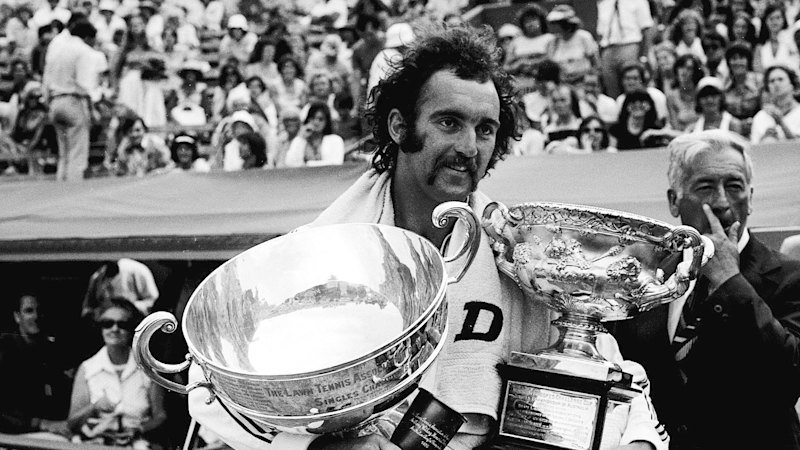
“Back then, every young kid wanted to go to the Olympics. But tennis wasn’t in the Olympics so it was the Davis Cup for me.”
Much to his annoyance, and sadness, Edmondson’s name is dredged up every summer as still the last Australian man to hoist the Open trophy.
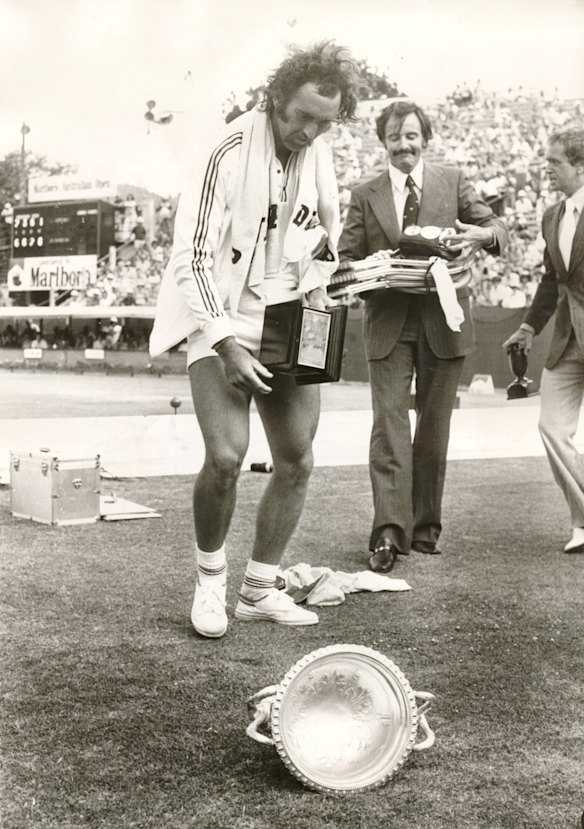
The trophy juggle becomes too much for the victorious Edmondson.Credit:
Getting their hands on the Norman Brookes Challenge Cup has proven too elusive for greats like two-time AO finalist Pat Cash, dual US Open winner Pat Rafter and his fellow former world No. 1 and 2005 Australian Open runner-up Lleyton Hewitt.
Carrying the hopes of a nation has also been too much of a burden for Wimbledon finalists Mark Philippoussis and Nick Kyrgios, boy wonder Bernard Tomic and, until this summer at least, world No.7 Alex de Minaur.
Maybe that’s why the humble Edmondson, who these days has swapped his tennis racquet for golf clubs and plays off a most respectable 10 handicap at Bayview on Sydney’s northern beaches, admits to revelling in his role as an unexpected giant killer 50 years ago.
“I’d only been in two or three grand slam tournaments altogether,” he said, happily recalling a great escape against Austrian Peter Feigl in the first round.
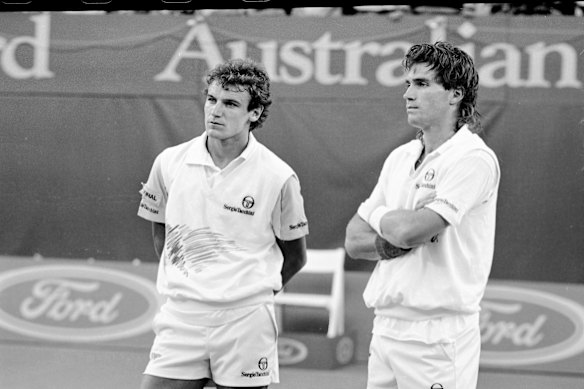
Winner Mats Wilander (left) and the beaten Pat Cash following the Swede’s Australian Open win in 1988. Credit: The Age
“I had a great advantage after I won the first round, which I was possibly lucky after I was down a break in the fourth set and won against a guy who thought he had a good draw.
“But I also thought I had a good draw compared to all the other good players in the tournament.
“Everybody I played after that was pretty much a top-30, top-25 player, so I was certainly the underdog.
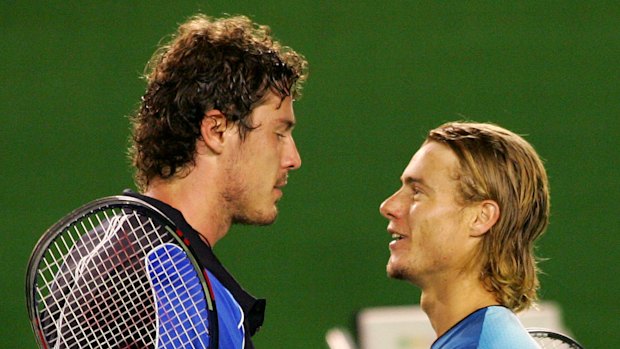
Marat Safin (left) is congratulated by Lleyton Hewitt after winning the 2005 Australian Open final.Credit: AP
“I had nothing to lose and everything to gain, so I just went out and played.
“I’d been serving very well, so I just went out and tried to win my serve and see what happens, and I was lucky enough to get a few breaks of serve and keep going.”
But Edmondson still wasn’t convinced he could contend, even after taking out fifth seed Phil Dent in the second round.
“I’m not sure Phil wasn’t maybe injured, so I just went out after that first match knowing the other guys were definitely better than me, and I’ll just give it my best,” he said.
‘Well, it was a surprise that I beat Rosewall and Newcombe.’
Mark Edmondson
“But we’re also playing out on the back courts, which might have upset the fifth seed.
“It took me ’til the quarters ’til I got to play on the centre court, so those guys are not as used to the outside courts as the lesser players like myself.
“And if you get a few bounces that aren’t as good – because the courts aren’t in as good condition as the centre court – that only helps the lesser player because we’re used to playing on the crappy court out the back.”
Despite Edmondson playing down his life-changing triumph, even claiming it was “simpler” winning the Australian Open back then because three of the four slams were played on grass, his victory was anything but a fluke.
The only other players in the past 65 years to roll the top two seeds en route to the AO title are Rod Laver, who defeated Roy Emerson and Neale Fraser in 1960, and Stan Wawrinka, the conqueror of Novak Djokovic and Rafael Nadal in 2014.
“I reflect on an unbelievable week. It was surprising to everybody except me,” said Edmondson, who slayed four seeds in all and is expected to present the trophy to next month’s Open men’s champion at Melbourne Park.
“Well, it was a surprise that I beat Rosewall and Newcombe, but I’d been playing well for over six months.”
Indeed, Edmondson had reigned at the Tasmanian Open a month before, was runner-up in the Queensland Open and won six tournaments back-to-back in singles and doubles in Europe in the lead-up.
“Then it all just came together that week,” he said.
“All I wanted to do was be able to play tennis good enough to travel the world and pay for it.”
Despite injuries curtailing his career and leaving Edmondson wondering if there might have been more, he is content with his accomplishments.
He reached No. 15 in the world in singles after also making the 1982 Wimbledon semi-finals and also hit No. 3 in the world in doubles – behind only arguably the all-time greatest pairing of John McEnroe and Peter Fleming.
The unfairly unsung “Edo” also played a pivotal role partnering Paul McNamee in helping Australia to a famous Davis Cup final victory over Sweden in 1983.
“If I was doing what I did in my career now, I’d be very, very rich as opposed to having other jobs,” he said.
“But we played at a different time.”
AAP
News, results and expert analysis from the weekend of sport are sent every Monday. Sign up for our Sport newsletter.