

In a remarkable leap forward for robotics, a team of Chinese scientists has managed to teach tiny clusters of human brain cells — known as organoids — to control robots. These miniature “brains,” while nowhere near as complex as a human one, are learning to interact with machines in entirely new ways.
You may have heard the term “wetware.” It’s the biological counterpart to software and hardware, referring to systems that blend living cells with technology. Once just a theoretical idea, wetware is quickly becoming a reality, thanks to advances in bioengineering. Brain organoids — tiny three-dimensional bundles of neurons grown from human stem cells — are at the center of this revolution.
Other groundbreaking efforts are already underway, such as Johns Hopkins University’s Organoid Intelligence initiative, Indiana University’s Brainoware computer, and FinalSpark’s neuroplatform. But researchers at Tianjin University and the Southern University of Science and Technology (SUSTech) have taken things a step further: they’re using brain organoids to actually control robots.
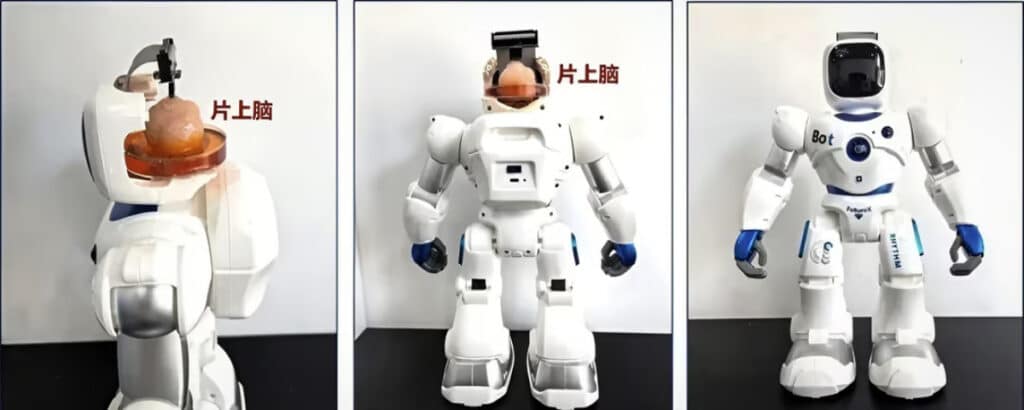
Illustration of what a brain organoid integrated into a robot could look like. However, the current system is much smaller, and requires a lot of equipment to keep the organoid alive. © Tianjin University
Teaching living brain tissue to pilot machines
Their project, named MetaBOC, acts as a bridge between bio-computers — devices containing “brains on a chip” — and traditional electronic systems. Through this software interface, organoids receive sensor data as electrical signals, interpret it, and gradually learn to perform tasks. MetaBOC even integrates artificial intelligence to help the biological and digital systems communicate and learn together.
Just like training an AI model, scientists can first teach these living mini-brains to control robots in virtual simulations, reducing risks before moving to real-world tests. To enable richer neural activity, the researchers use spherical, 3D organoids cultivated with low-intensity focused ultrasound stimulation.
And it’s working: robots guided by the MetaBOC system have already demonstrated the ability to avoid obstacles and grasp objects — early signs that biological computing could play a powerful role in the future of robotics.
If successful, this hybrid of biology and technology could redefine what it means to “think,” blurring the line between organic intelligence and artificial design.

Edward Back
Journalist
My passion for programming began with my very first computer, an Amstrad CPC 6128. I started coding in Basic, then moved on to Turbo Pascal on a 286, eventually exploring more modern languages including web development. I’m also deeply interested in science, which led me to attend a math-focused preparatory program. Later, I studied psychology with a focus on the cognitive aspects of artificial intelligence.