
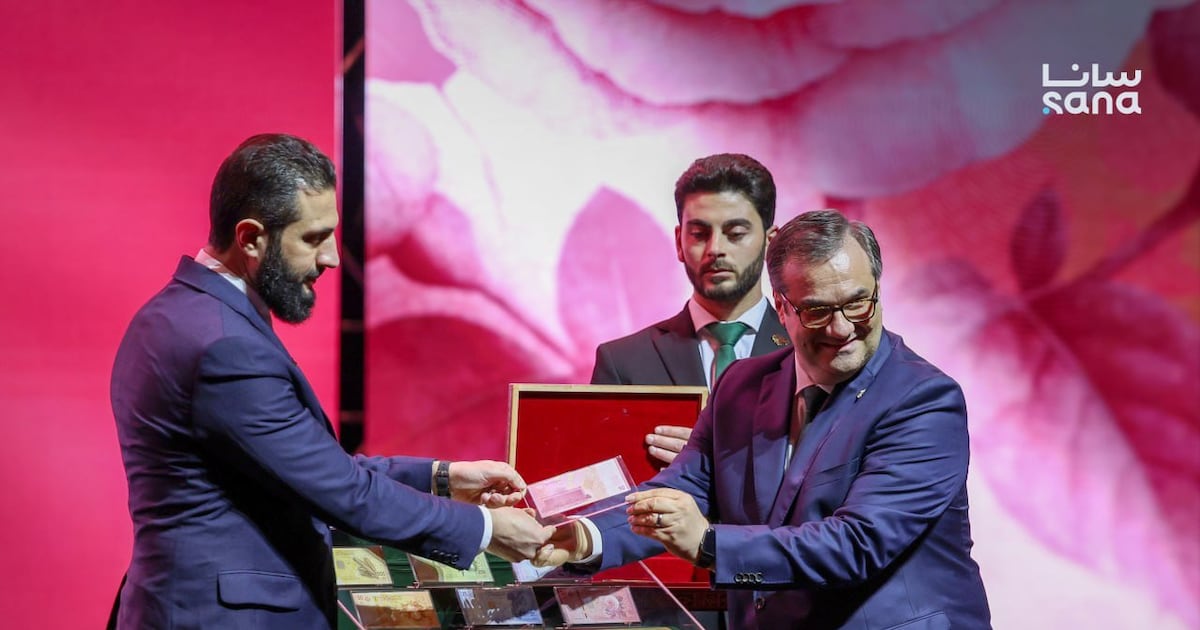
Syrian President Ahmad Al Shara and central bank governor Abdulkader Husrieh on Monday unveiled the country’s new currency, which will be introduced gradually from January 1.
The move is intended to strengthen the Syrian pound after its purchasing power collapsed to record lows during the civil war that ended last December, when rebels toppled president Bashar Al Assad’s regime.
Speaking at the unveiling in Damascus, Mr Al Shara said the design of the new banknotes, which feature images only of animals and plants, “is an expression of the new national identity and a move away from the veneration of individuals”.
“The currency change event marks the end of a previous, unlamented phase, and the beginning of a new phase that the Syrian people and the peoples of the region who are hopeful about the modern Syrian reality aspire to,” he said, according to state news agency Sana.
Images of the new notes projected on a screen showed a 25-pound note with mulberries, a 50-pound note with oranges, a 200-pound note with olives, and a 500-pound note with ears of wheat.
Mr Al Shara said there were “many concepts that need to be clarified during the currency exchange phase”.
“The first is that changing the zeros and removing two zeros from the old currency to the new currency does not mean improving the economy, but rather it is easier to deal with the currency,” he said.
“Improving the economy depends on increasing production rates and reducing unemployment rates in Syria, and one of the basics of achieving economic growth is improving the banking situation because banks are like arteries for the economy.”
Mr Husrieh said last week that the new currency would be introduced gradually from the start of the new year, and that the exchange of old notes for new ones would be “smooth and organised”, with guidelines to be announced later.
Mr Al Shara described the changeover as “sensitive and delicate”, saying the most important consideration was “to avoid panic among the people and not to rush to throw away the old currency and replace it with the new one”.
“Everyone who has old currency will have it replaced with the new one, so there is no need to insist on changing it because that may harm the exchange rate of the Syrian pound,” he said.
“We need a calm approach to currency replacement, and the central bank has made it clear that this will be done according to a specific timetable.”
Mr Husrieh said the currency change would not affect the exchange rate and was intended to encourage people to rely on the Syrian pound in daily transactions.
He said the exchange should last 90 days, but might be extended if needed. “This will help stabilise prices, and we confirm that pricing during this phase will be in both the old and new currencies,” Sana quoted him as saying.
“There will be a media campaign to accompany the currency change and explain the details in the coming days.”
The Programme
Saturday, October 26: ‘The Time That Remains’ (2009) by Elia Suleiman
Saturday, November 2: ‘Beginners’ (2010) by Mike Mills
Saturday, November 16: ‘Finding Vivian Maier’ (2013) by John Maloof and Charlie Siskel
Tuesday, November 26: ‘All the President’s Men’ (1976) by Alan J Pakula
Saturday, December 7: ‘Timbuktu’ (2014) by Abderrahmane Sissako
Saturday, December 21: ‘Rams’ (2015) by Grimur Hakonarson
Lexus LX700h specs
Engine: 3.4-litre twin-turbo V6 plus supplementary electric motor
Power: 464hp at 5,200rpm
Torque: 790Nm from 2,000-3,600rpm
Transmission: 10-speed auto
Fuel consumption: 11.7L/100km
On sale: Now
Price: From Dh590,000
The specs
Engine: 4.0-litre V8 twin-turbocharged and three electric motors
Power: Combined output 920hp
Torque: 730Nm at 4,000-7,000rpm
Transmission: 8-speed dual-clutch automatic
Fuel consumption: 11.2L/100km
On sale: Now, deliveries expected later in 2025
Price: expected to start at Dh1,432,000