
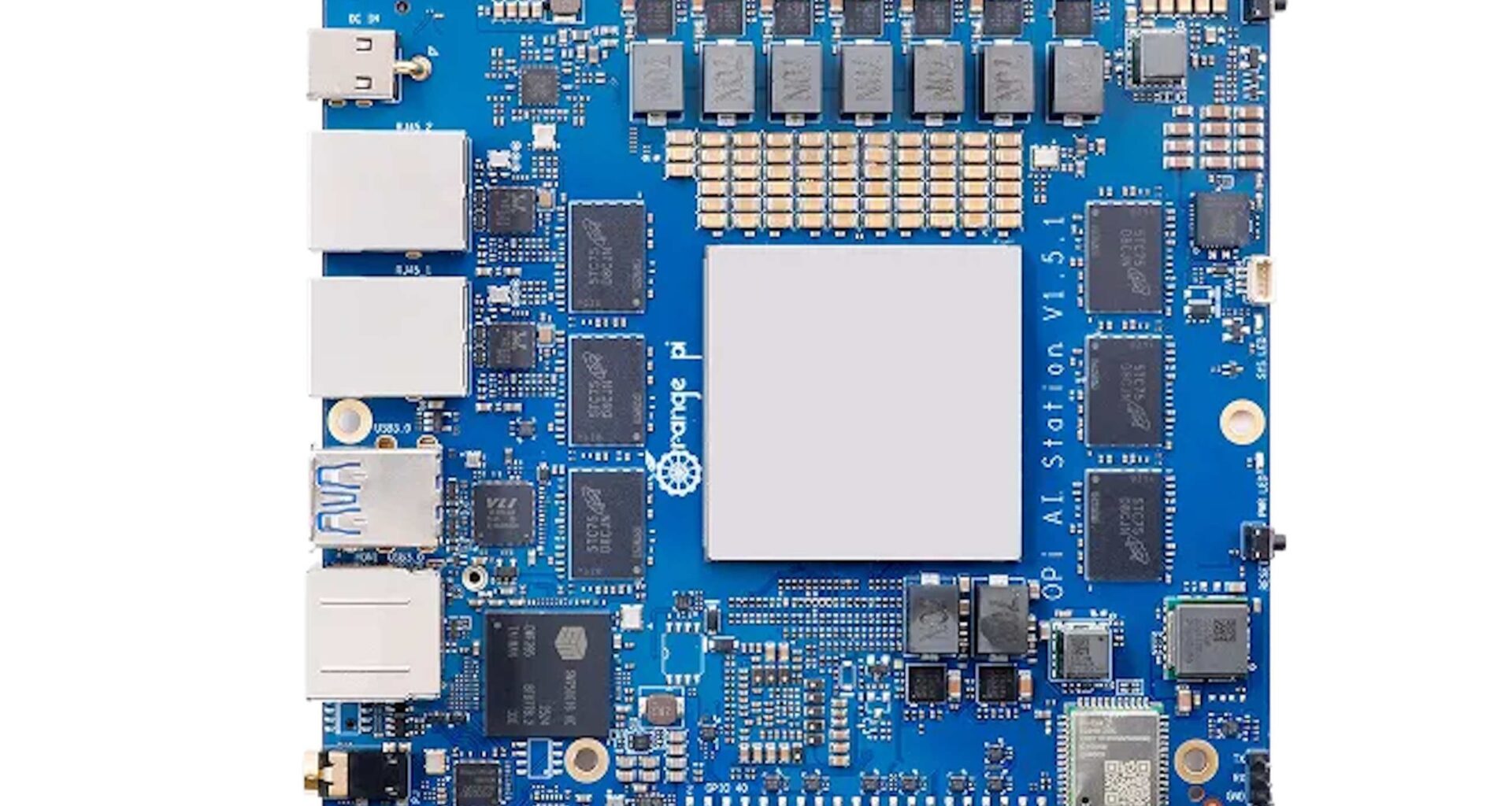
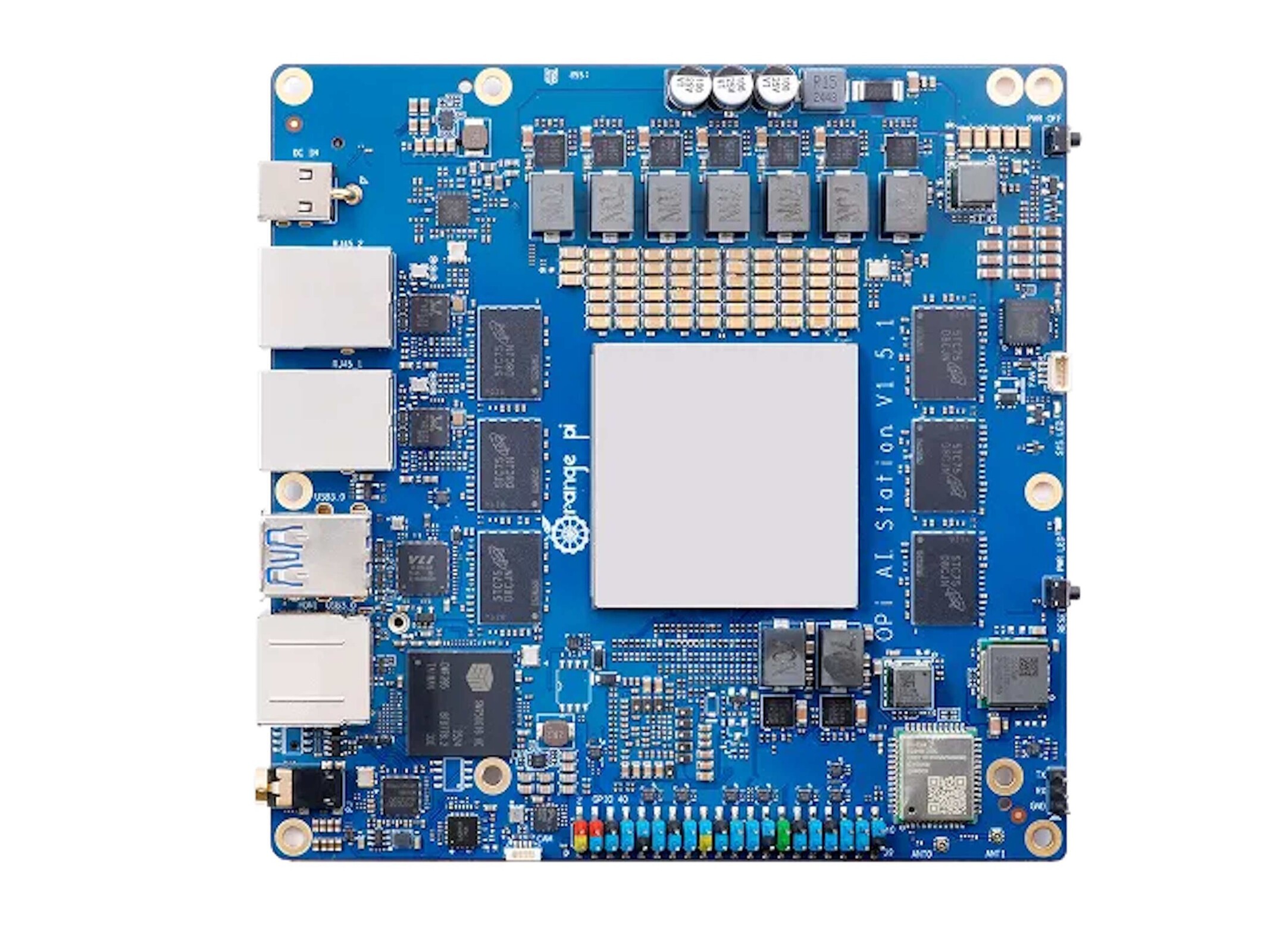
 The AI Station is an SBC for AI applications (Image source: Orange Pi)
Orange Pi has introduced the so-called AI Station, which is a new single-board computer that can even be used as a base for a mini PC. This device can run various AI applications locally and can be hooked up to external sensors as well as actuators.
The brand-new Orange Pi AI Station is a new single-board computer or rather mini PC, as the manufacturer officially calls it. In practice, this is more of an SBC that can be used as a foundation for a mini PC. The system is positioned in the DIY segment and is therefore intended as a platform for custom projects, so it’s not necessarily a device that’s immediately ready to use. The operating system is openEuler 22.03, while video output is possible via HDMI at a FHD resolution at 60 frames per second.
The new Orange Pi mini PC is based on a Huawei Ascend 310 SoC, which sports an NPU with 10 AI cores, along with 16 CPU cores clocked at 1.9 GHz and 8 vector cores. An AI performance of 176 TOPS is advertised, so this SBC is mainly designed for AI-heavy applications that can be run locally directly on the device. There’s a pretty wide range of possible use cases here, such as live image analysis to monitor crowds and quickly identify hazardous areas.
Depending on the configuration, the LPDDR4X RAM has a capacity of 48 or 96 GB. The single-board computer further supports up to 256GB of eMMC storage, as well as SD cards and a PCIe SSD. For networking, two Gigabit Ethernet ports and WiFi are on board, and an active fan can be installed as well. Last but not least, the Orange Pi SBC has a 40-pin GPIO header, which can be used to control a motor or alarm, for instance. Orange Pi has yet to reveal exact pricing and availability details.
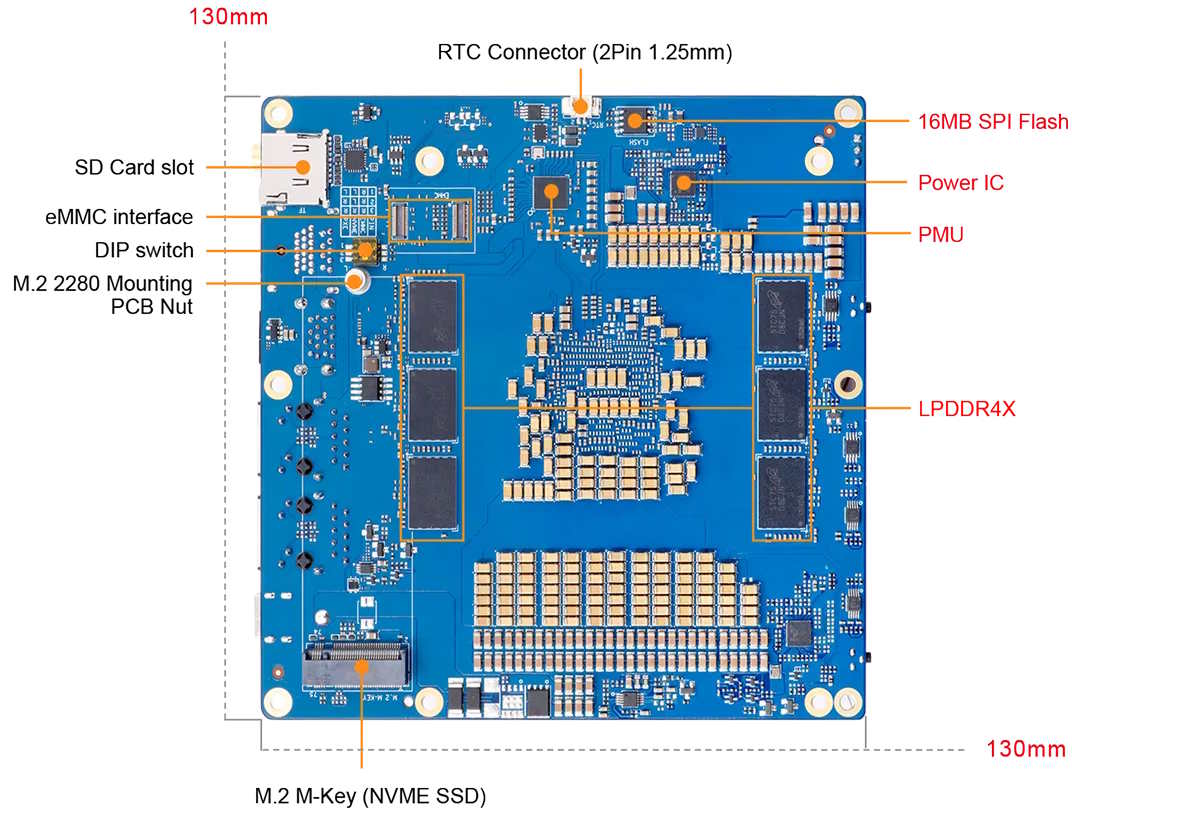 An M.2 SSD can be connected via PCIe (Image source: Orange Pi)
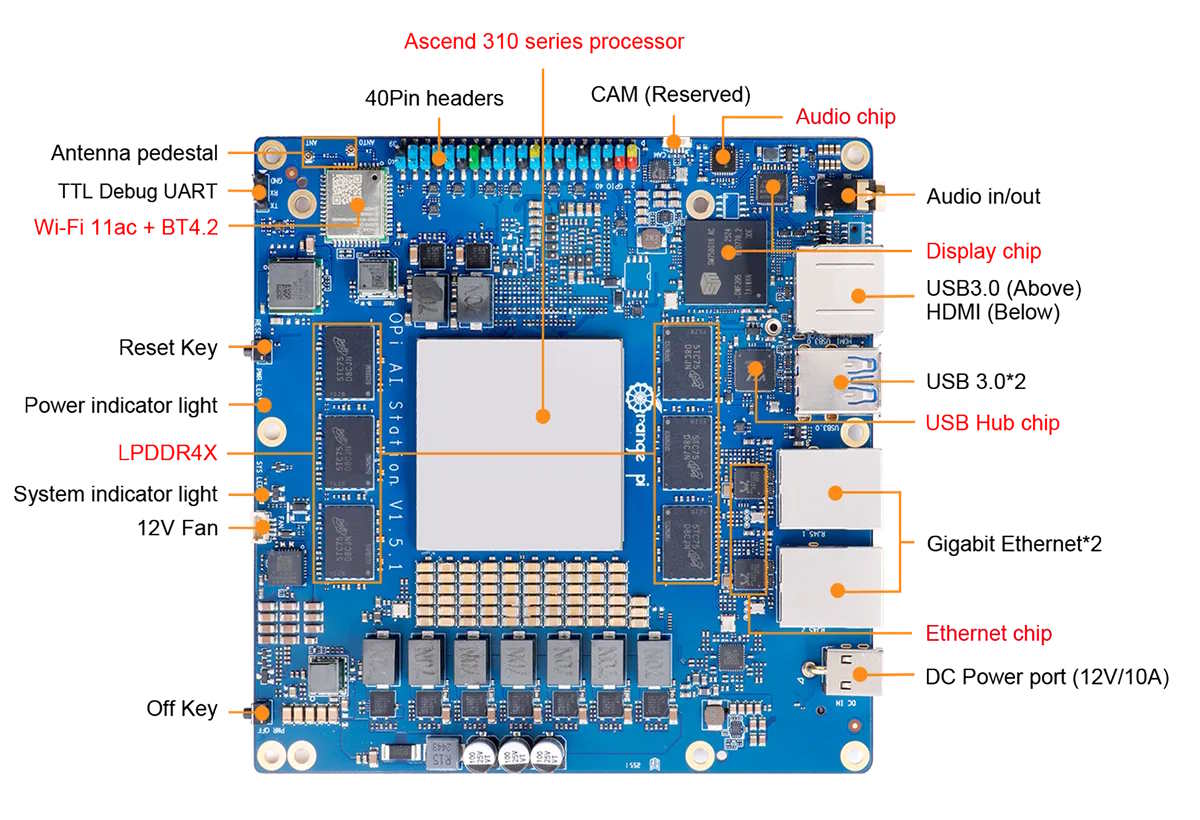 The SBC has two Gigabit Ethernet ports (Image source: Orange Pi)

I have been active as a journalist for over 10 years, most of it in the field of technology. I worked for Tom’s Hardware and ComputerBase, among others, and have been working for Notebookcheck since 2017. My current focus is particularly on mini PCs and single-board computers such as the Raspberry Pi – so in other words, compact systems with a lot of potential. In addition, I have a soft spot for all kinds of wearables, especially smartwatches. My main profession is as a laboratory engineer, which is why neither scientific contexts nor the interpretation of complex measurements are foreign to me.
 Translator: Enrico Frahn – Managing Editor Accessory Reviews, Tech Writer – 6009 articles published on Notebookcheck since 2021
My fascination for technology goes back a long way to the Pentium II era. Modding, overclocking and treasuring computer hardware has since become an integral part of my life. As a student, I further developed a keen interest in mobile technologies that can make the stressful college life so much easier. After I fell in love with the creation of digital content while working in a marketing position, I now scour the web to bring you the most exciting topics in the world of tech. Outside the office, I’m particularly passionate about motorsports and mountain biking.