
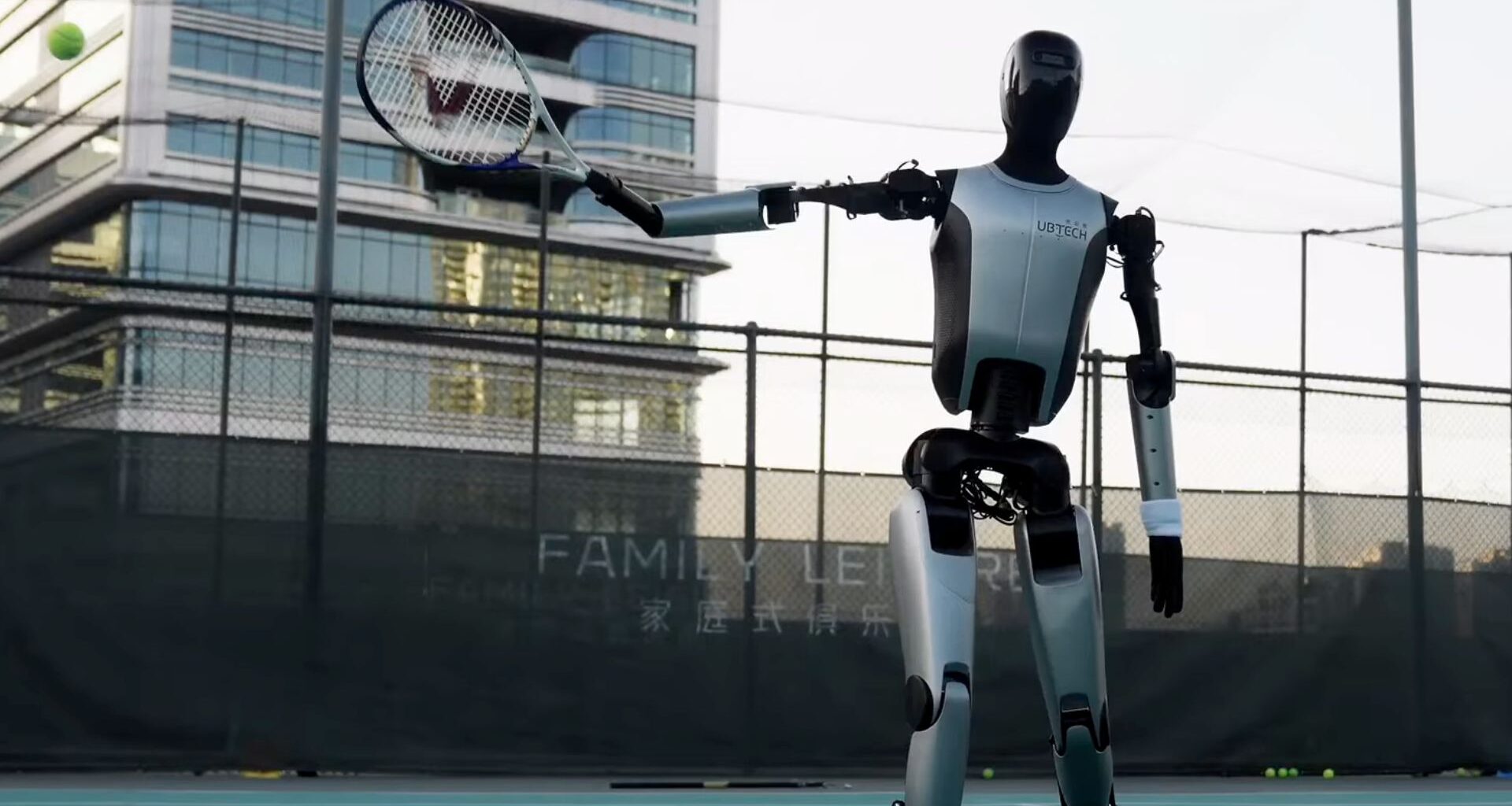
Chinese robotics firm UBTech’s Walker S2 humanoid robot is pushing beyond scripted demos, demonstrating its ability to hit a moving ball with speed and precision in real-world conditions.
What looks simple is technically demanding: tennis requires a robot to seamlessly combine perception, prediction, balance, and rapid motion.
“On this New Year’s Day, we open a new chapter with a human-robot tennis rally. Witness the powerful and precise strokes of Walker S2,” read the video description posted by the UBTech on YouTube.
Recently, UBTech announced that it has rolled out its 1,000th Walker S2 humanoid, marking a shift from prototypes to scaled deployment, with over 500 units already in real-world use.
Beyond lab demos
UBTech’s Walker S2 represents a new generation of industrial humanoid robots designed to operate continuously in real-world environments and perform complex, coordinated tasks.
UBTech has opened 2026 by taking its Walker S2 humanoid out of the lab and onto a tennis court, rallying live against a human opponent. The demo goes far beyond a visual stunt, showing the robot managing real impacts, balance shifts, and split-second decisions in an uncontrolled setting.
Tennis is especially demanding for humanoids because everything has to happen in one continuous loop. The robot must detect the ball early, predict its trajectory, position its body, stabilize its legs, and swing the racket at precisely the right moment—without stopping to reset. Even a short exchange leaves no room for delay, as the ball keeps moving regardless of processing time.
What makes the task harder is contact. When the racket meets the ball, small errors can quickly destabilize the robot. Absorbing that shock while staying upright is where many humanoids struggle. Walker S2’s performance suggests its whole-body control system is actively adapting in real time, rather than replaying pre-programmed motions, adjusting to timing variations that change with every shot.
Intelligent robotic labor
Walker S2 is equipped with a whole-body, human-like dynamic balance algorithm that allows deep squatting, forward pitching up to 125 degrees, and stable lifting of payloads up to 33 pounds (15 kilograms) within a working range of 0 to 1.8 meters. These capabilities enable the robot to perform physically demanding actions such as stoop lifting, material handling, and precise object manipulation while maintaining stability.
According to the firm’s website, perception is handled through a self-developed “human-eye” binocular stereo vision system integrated into the robot’s head. Using pure RGB cameras and deep learning–based stereo depth estimation, Walker S2 generates high-precision, real-time depth maps. This allows accurate spatial awareness, object recognition, and safe interaction with dynamic environments.
To coordinate complex activities, Walker S2 runs on UBTECH’s self-developed Co-Agent system, part of the BrainNet 2.0 dual-loop AI architecture. This system combines task-driven decision-making with real-time feedback, enabling adaptive behavior, multi-step task execution, and coordinated operation alongside other robots.
Walker S2 also features an autonomous power system that enables real-time battery monitoring and self-directed energy management. Its dual-battery architecture allows the robot to switch between single- and dual-battery modes, choosing whether to recharge or perform an automatic battery swap based on task priority. This capability supports long-duration, uninterrupted operation on factory floors and industrial sites.
According to UBTech, these systems allow Walker S2 to move beyond scripted actions, supporting continuous operation, physical interaction, and intelligent decision-making required for advanced industrial, logistics, and service applications.