
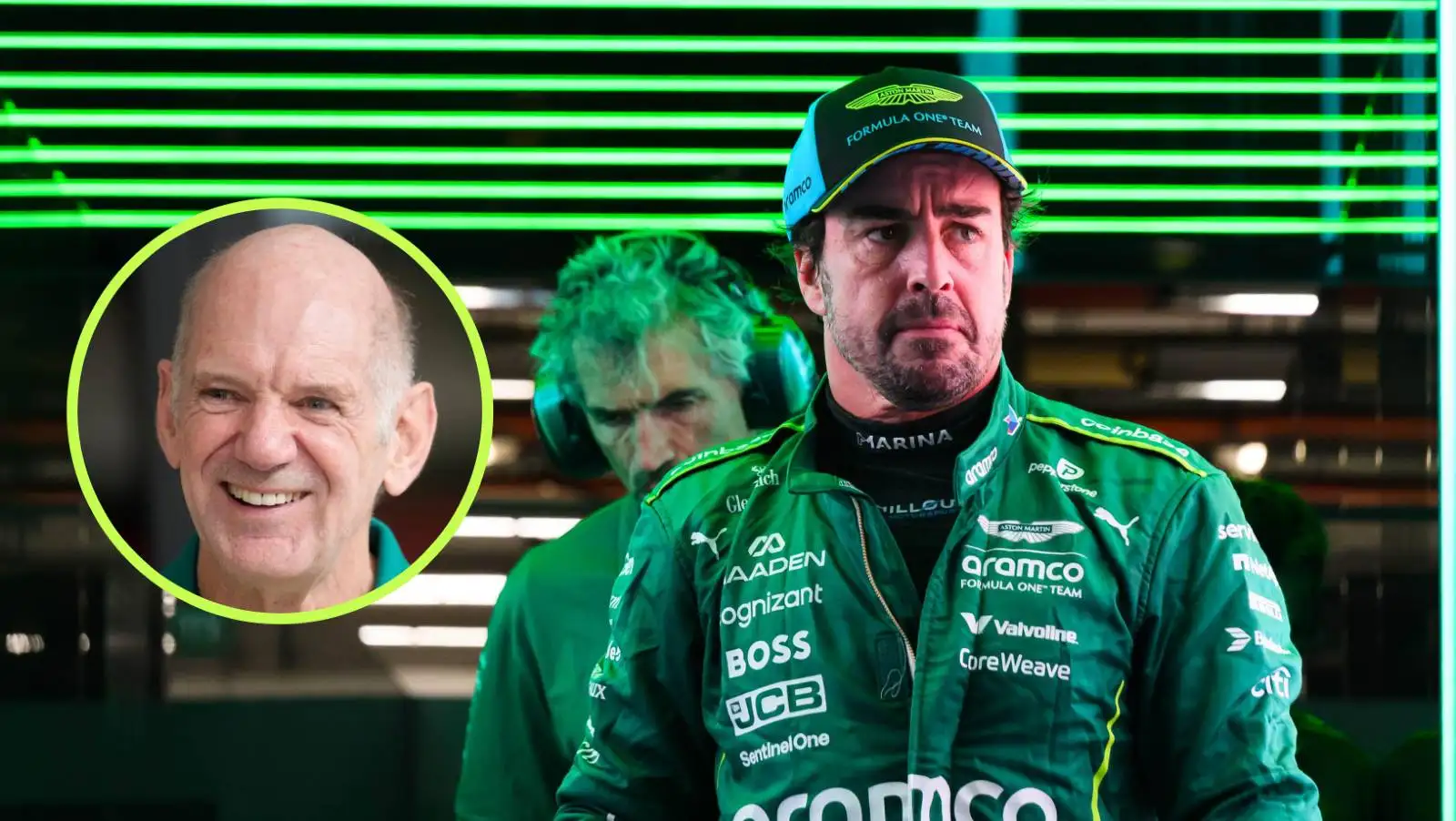
Fernando Alonso has said the F1 world is “different” now that more team leaders hail from technical, rather than business, backgrounds.
In recent years, more teams have plumped for leadership hailing from technical backgrounds, an evolution from the past when it was businessmen and more financially-focused figures in charge.
Fernando Alonso: Data-driven F1 has hastened change
Want more PlanetF1.com coverage? Add us as a preferred source on Google to your favourites list for news you can trust.
In years gone by, the established pattern for most F1 teams was that the main figurehead of leadership oversaw the team’s performance push while also being responsible for the business side of the organisation.
These included the likes of the late Eddie Jordan of his eponymous team, Ron Dennis at McLaren, Flavio Briatore at Benetton/Renault and Christian Horner at Red Bull.
But, in recent years, more and more teams have turned to technical leaders when it comes to succession decisions, perhaps forming a two-pronged leadership structure with a CEO or business-orientated partner.
For instance, at McLaren, Andrea Stella is an engineer turned team boss, working closely alongside CEO Zak Brown. At Red Bull, Laurent Mekies is an engineer turned team boss and CEO, working alongside Red Bull GmbH CEO Oliver Mintzlaff, while Mekies’ former role at Racing Bulls has been filled by Alan Permane as team boss, partnering Peter Bayer as CEO.
Other examples are Ayao Komatsu succeeding Guenther Steiner at Haas, Steve Nielsen at Alpine, Jonathan Wheatley and Mattia Binotto at Sauber, and the recent appointment of Adrian Newey as team principal at Aston Martin.
Newey is replacing Andy Cowell in that role, with Cowell moving aside after a year in charge as team boss in order to concentrate on the team’s transition to Honda power in F1 2026.
After 25 years in Formula 1, one driver who has experienced the full breadth of different types of team leadership is Fernando Alonso, whose career started with Minardi in 2001, when Australian businessman Paul Stoddart owned and ran the backmarker team.
After years with Briatore at Renault, driving for Ron Dennis at McLaren, and Stefano Domenicali at Ferrari, Alonso is now set to work with Newey after previously serving under Mike Krack and Andy Cowell during his Aston Martin tenure.
“It is different, no doubt,” Alonso told media including PlanetF1.com when asked about the impact of seeing teams moving towards technical figureheads for leadership.
“But the sport is different and the world is different.
“Everything is more about performance now, trying to make perfection every weekend. The car is run by thousands of simulations and perfect setups, and these kinds of things.
“So there is less intuition into the things we do on the weekend. Everything is driven by data and things like that.
“The teams as well, I think in the past, you had to deal with strong personalities, and each of them was different, with the likes of Luca di Montezemolo or Flavio [Briatore] or Eddie Jordan in the past, or Ron Dennis.”
More on the all-new regulations for F1 2026
F1 2026 tech analysed: The future of overtaking and biggest car advantage identified
F1 2025 vs F1 2026: Nine key questions ahead of massive regulation changes
Alonso observed that one key area for drivers may have become more difficult in the modern age.
“Maybe it’s tougher to negotiate your contracts now, it’s about numbers and data and things like that!” he joked.
“In our team, I think we are lucky because we balance the two of those things. We have great technical leaders, but, at the same time, we have a very strong commercial team.
“We have our sponsors, and we have Lawrence [Stroll] on top of that, who is still one of the old characters, and the passion of racing is still in his blood. It’s not only data, so, yeah, it’s a fun team to be at the moment.”
Aston Martin now boasts a bevy of technical talent.
Not only is the team headed up by proven winners such as Newey and Cowell, but the team has recently seen Enrico Cardile start work at its Silverstone campus.
It’s also still got Mike Krack and Bob Bell amongst its ranks following a recent technical restructuring – PlanetF1.com understands that Akio Haga and Eric Blandin are both departing following this restructuring – and Andy Stevenson remains as sporting director.
With quite a lot of change on the personnel front over the last 12 to 18 months, coinciding with the final touches of a huge amount of capital investment in the infrastructure of the Aston Martin factory, Alonso doesn’t believe there are any obvious gaps in the team’s talent.
“I think we have a strong team also here at the racetrack, some people with a lot of experience – Andy Stevenson, we have great race engineers, performance engineers, and strategy,” he said.
“Between Lance and myself, we have 35 years of experience between both of us.
“It’s not that we are lacking on the race team, experience, or a vision of what is needed to succeed. I’m not concerned about that. We just need a fast car next year.”
With Aston Martin having pulled together a very impressive roster of senior leaders to work with its state-of-the-art infrastructure, Alonso believes it’s a matter of when, and not if, his team starts delivering upon its potential.
“Factory is completed. Wind tunnel is brand new and completed, and we are using it,” the two-time F1 World Champion said.
“We have Adrian Newey, Andy Cowell, Enrico Cardile. I mean, we have great people and great talent in the factory.
“We just need to put everything in place and to make sure that all those facilities and people, that are new facilities, are new people are just few months into the system.
“Will it be enough, these few months, or do we need one full season to glue everything together? That’s the thing I don’t know.
“But Aston Martin will succeed. I think it’s for me [a] guarantee. The biggest question is when.
“That’s what we all try, to make it as soon as possible.”
Read Next: Andrew Shovlin details Mercedes’ suspension misstep after ‘confusing’ European run