
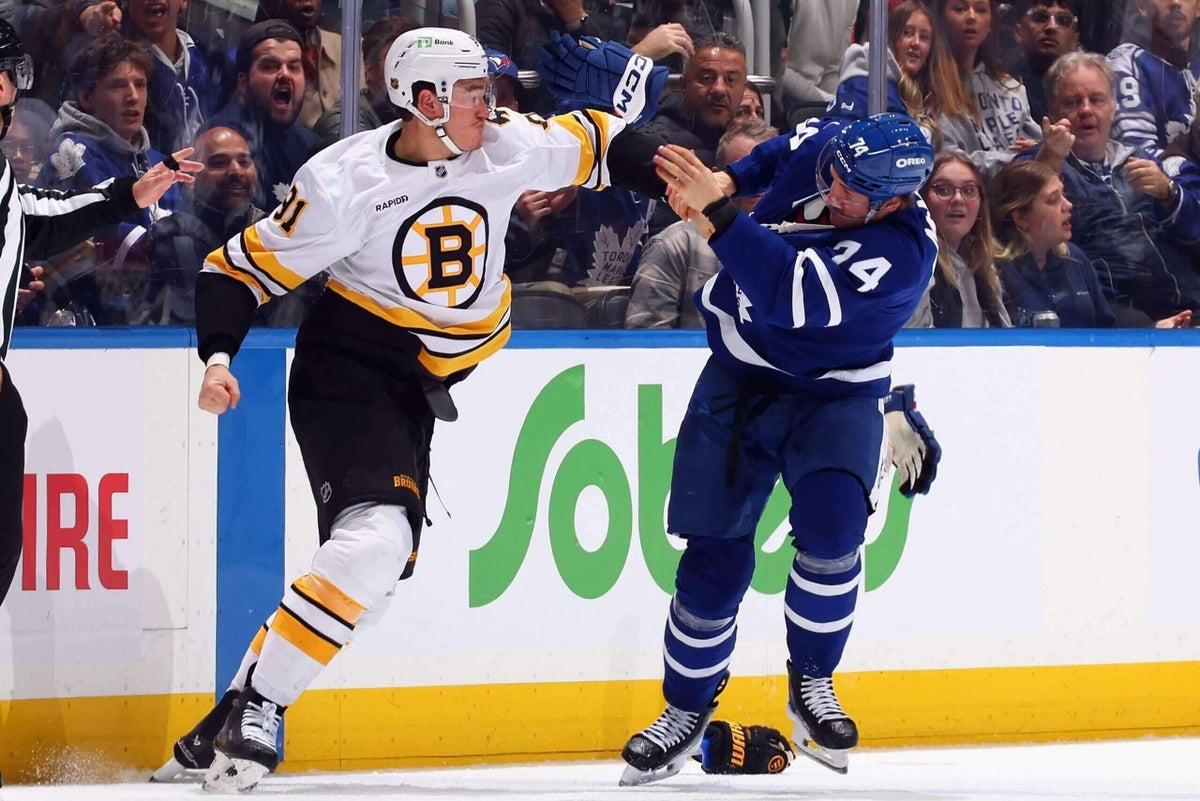
The Boston Bruins are no fun to play against. On one shift, Tanner Jeannot (five fights) and Mark Kastelic (four) dare opponents to remove their gloves. On the next shift, Alex Steeves (a team-high 17.82 hits per 60 minutes of play) burrows foes into the glass on the forecheck. Meanwhile, Nikita Zadorov (three fights) runs his motor and his mouth in hopes of finding someone foolish enough to take his body-slamming bait.
Nastiness is back on the Bruins’ menu.
This was general manager Don Sweeney’s vision and first-year coach Marco Sturm’s mandate for 2025-26. The belief was that by pulling on their boots and flexing their muscles, the Bruins would brush off last season’s fifth-worst finish and grow into a collective that would be greater than its components.
Through 42 games, this has been partly true. It is not a coincidence that Jeannot, Kastelic, Steeves and Zadorov have performed above expectations. Their physicality and eagerness to put themselves in harm’s way have made them better players and affected team play. As president Cam Neely promised, the Bruins have become a harder out.
In that way, with Sturm’s guidance, the Bruins have checked off the No. 1 priority of their on-the-fly rebuild. It’s been infectious. Aside from occasional exceptions, the Bruins have contested in every game. They do not quit. They fight, literally and figuratively.
This returns to a point that ex-coach Bruce Cassidy made about David Pastrnak. The right wing never played with Mark Recchi, the Hockey Hall of Famer who went out on top with the Bruins in 2011, but Brad Marchand and Patrice Bergeron, Pastrnak’s future linemates, used to ride with Recchi. The veteran’s tenacity left a mark on them.
In turn, they transferred Recchi’s vivacity to Pastrnak. No. 88 has since become dogged on pucks, physical when necessary and competitive in every situation.
Cassidy’s theory was that Pastrnak had absorbed some of Recchi’s energy. Assuming such marvels occur, it’s a good bet a similar degree of osmosis is occurring this season.
Fraser Minten, for example, has shared 192:28 of five-on-five time with Jeannot and Kastelic, per Natural Stat Trick. It does not matter that Minten plays a more refined game than his roughneck friends. The No. 3 center is learning how to be first on pucks and hard on opponents. The 21-year-old cannot help it, considering his proximity to Jeannot and Kastelic.
Marat Khusnutdinov, who did not look out of place centering Pastrnak and Morgan Geekie, is playing with a similar degree of urgency when it comes to hunting pucks. The 23-year-old buzzes around and through larger opponents.
Given their ages, Minten and Khusnutdinov project to be long-term support players for Pastrnak, Charlie McAvoy and Jeremy Swayman, the organization’s primary pillars. Minten made his latest mark by scoring two goals, including the overtime winner, in the Bruins’ 3-2 victory over the Vancouver Canucks on Saturday. The Vancouver native’s showing against his hometown club was a sign that perhaps he could develop into an all-situations No. 2 center.
The Bruins simply need more.
It is unrealistic to expect the Bruins to transition from a 2025 deadline teardown to a 2026 postseason participant. One offseason of roster adjustment plus a coaching change are not enough to initiate a 180-degree revival, especially when the former consisted of adding complementary players such as Jeannot, Steeves, Viktor Arvidsson, Jonathan Aspirot, Mikey Eyssimont and Sean Kuraly.
The franchise’s next step is to incorporate difference-making reinforcements.
It is all well and good that Elias Lindholm and Pavel Zacha have 26 points, tied for third-most on the roster behind Pastrnak (46) and Geekie (41). But Lindholm and Zacha have cashed in on the power play. Lindholm has 14 power-play points. Zacha has 13. At five-on-five, they have just eight apiece, which places them behind 13 of their teammates. As responsible as they are away from the puck, neither Lindholm nor Zacha qualifies as an offensive pace-pusher. Top teams do not have this measure of inefficiency on their top two lines.
On the back end, Sturm has leaned hard on McAvoy, Zadorov and Hampus Lindholm. They’ve combined to take 60 minor penalties, contributing to the Bruins’ league-high 183. The Bruins have been short-handed 163 times. The Tampa Bay Lightning are second with 138.
The Bruins have played with fire too often. When the top three defensemen haven’t been in the box, they’ve been burning calories killing penalties. At the same time, this keeps Pastrnak and Geekie, who do not kill penalties, on the bench. Discipline has been a season-long issue, perhaps because the Bruins have chased the puck more than they’ve possessed it.
Team identity, the No. 4 power play (25.8 percent) and Jeremy Swayman (12.4 goals saved above expectation according to Moneypuck, fourth-most after Logan Thompson, Ilya Sorokin and Igor Shesterkin) have gone above and beyond to keep the Bruins in the fight. But as of Sunday, their .548 points percentage was higher than only two clubs in the Eastern Conference.
The rebuild needs more time.