
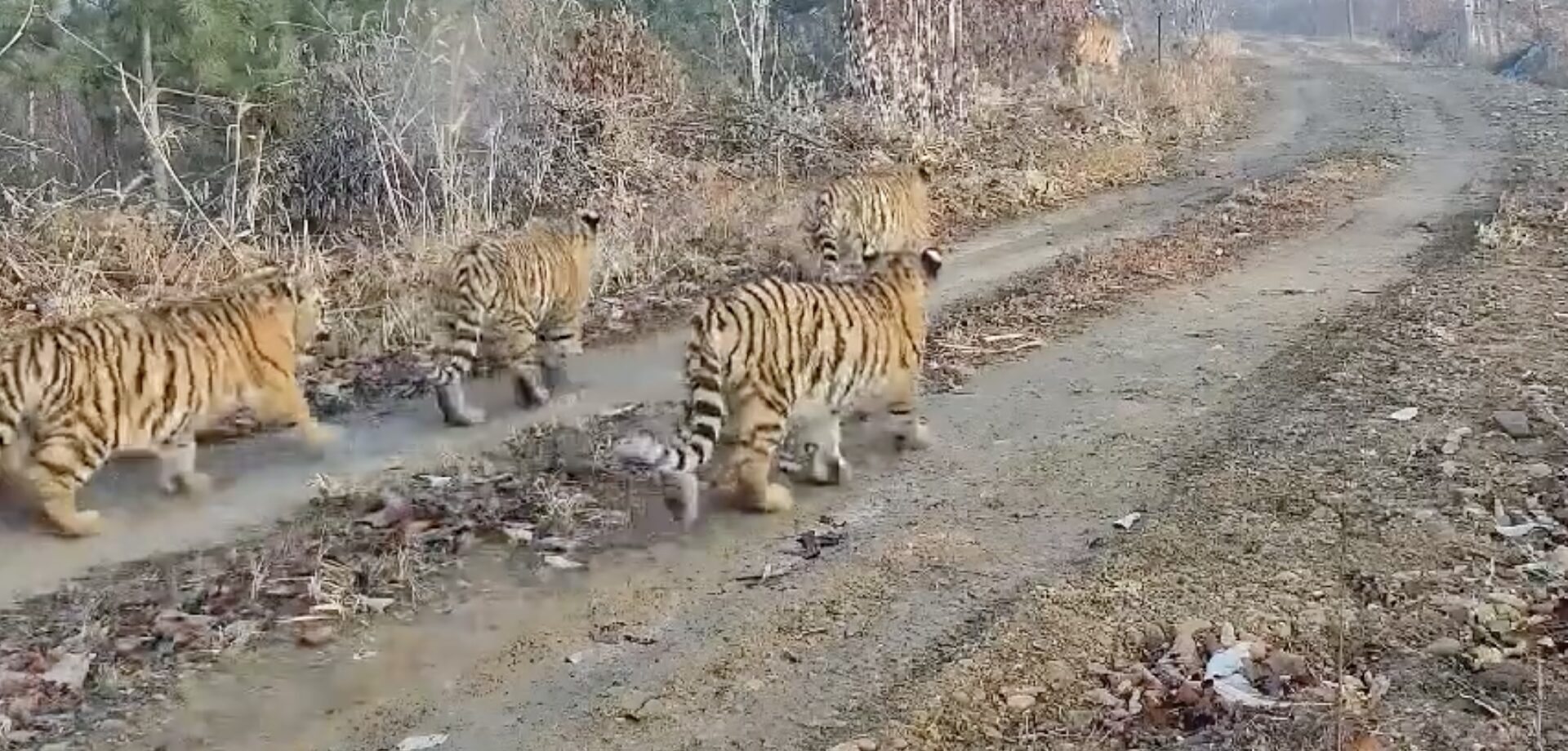
Camera traps installed in the world’s largest tiger reserve, in China, have captured footage of an Amur tigress and her five cubs for the first time.
Recorded in November 2025, the footage from Northeast China Tiger and Leopard National Park shows an adult tigress ambling along a dirt road, and four young cubs tootling behind her. After a few seconds, as two of the cubs pause to sniff what looks like a stone, a fifth tries to catch up with the rest of the family.
Scientists say they believe the tigress is about 9 years old (tigers typically live for about 10-15 years in the wild), and the cubs are about 6-8 months old.
The 14,100-square-kilometer (5,400-square-mile) national park has China’s largest populations of Amur, or Siberian, tigers (Panthera tigris altaica) and leopards (Panthera pardus orientalis). It’s seen an increase in tiger numbers in recent years: in 2024, 35 cubs were born there.
Amur tigers, which roam the dense forests and snowy mountains of northeast China, Russia’s far east and parts of the Korean peninsula, are endangered due to poaching, forest logging, habitat fragmentation and prey scarcity. By the 1930s, scientists estimated there were fewer than 30 Amur tigers left in the wild. Latest estimates from the IUCN, the global wildlife conservation authority, suggest there might be 265-486 tigers in Russia and roughly 70 in China, mostly in Northeast China Tiger and Leopard National Park.
“Amur tigers were all but written off in China only twenty-five years ago when, after a century of declining numbers, surveys suggested fewer than a dozen left,” Jon Slaght, regional director of the temperate Asia program at the Wildlife Conservation Society (WCS), told Mongabay by email. “Since then, habitat protections and anti-poaching efforts have allowed tigers to triumphantly return, and today there are 70-80 of them,”
Tigers typically have one to four cubs, so sighting a female with five cubs — the first such sighting recorded in China — is extremely rare. “This is fantastic news, and a clear indication that tiger conservation in China is working,” Slaght said.
As apex predators, tigers require large, connected habitats and healthy prey numbers to thrive. In recent years, China has worked with many NGOs to ban hunting and logging, establish protected areas, improve monitoring and antipoaching efforts, and mitigate human-tiger conflict by working with local communities. “The first footage of ‘six wild tigers in one frame’ recorded in China reflects that China’s conservation actions have been effective,” Zhou Fei, chief program officer of WWF-China, said in an emailed press release.
However, the population in China is “still not demographically or genetically secure,” and requires “expanding suitable habitats, restoring prey populations, strengthening ecological corridors, reducing poaching, and enabling tigers to disperse into broader potential habitats beyond the current core areas,” Wang Jing of WWF-China told Mongabay by email.
Banner image: Screenshot of Amur tiger cubs, courtesy of Northeast China Tiger and Leopard National Park.
