
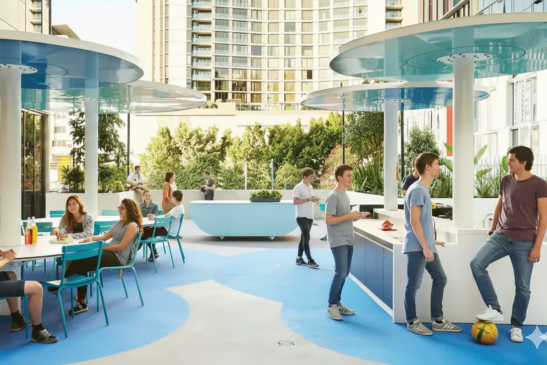
BRISBANE, Australia — On an afternoon in Scape South Bank – Student Accommodation in December, the lobby of the 15-story residence buzzed less like a dormitory than a technology campus.
The building in a riverside district just south of Brisbane’s central business area contains 783 beds and a suite of amenities more commonly associated with hotels: shared kitchens, lounges designed for group study, rooftop gardens and 24-hour on-site management.
It is part of a growing category of housing known as purpose-built student accommodation (PBSA), which Australian cities have increasingly embraced since the mid-2010s as international student numbers surge and urban rental markets tighten.
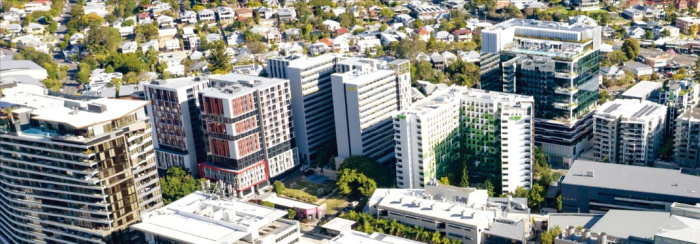
Purpose-built student accommodation clusters along South Bank in Brisbane, Queensland. The green building is the city’s first PBSA (Courtesy of Scape)
Australia’s PBSA market is a case study in how private developers has converted the growth in student housing demand into a specialized housing product.
According to CBRE, international students now account for 31% of Australia’s higher-education enrollments, a higher share than in other major English-speaking markets such as the UK and the US.
At the University of Sydney, overseas students made up more than half of incoming class for the first time in 2024.
University dormitories supply only about 100,000 beds nationwide, far short of 1.6 million college students in the country.
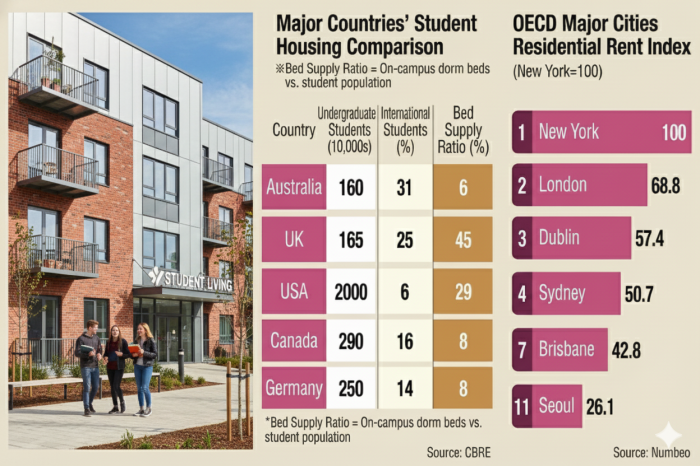
Image by Yeonhee Kim · Gemini (Nano Banana)
To redirect that demand, federal, state and local governments have offered incentives to private PBSA developers, including higher density allowances, reduced infrastructure charges and flexible zoning rules.
The result has been a wave of high-rise student housing projects in central districts of Sydney, Melbourne and Brisbane.
Brisbane illustrates the shift.
In the early 2010s, the city had just one PBSA property. Today, more than 20 operate across the city, providing roughly 16,000 beds.
Across Australia, about 120,000 PBSA beds are currently in operation, with as many as 25,000 more expected by 2027.
Even so, industry analysts say supply remains well short of demand, particularly as international student arrivals rebound sharply following the pandemic.
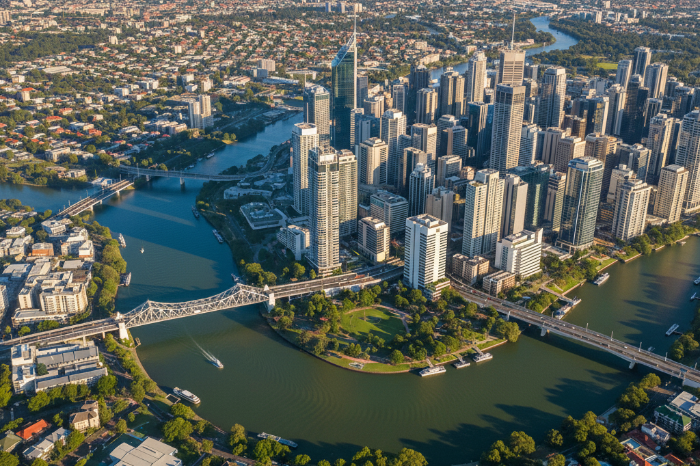
A bird’s eye view of Brisbane, image created by Gemini (Nano Banana)
Rather than basic accommodation, PBSA operators emphasize experience-led living, with designs that encourage social interaction and foster community.
Shared spaces are carefully programmed, security systems are tightly managed, and interiors are often tailored to younger tenants’ preferences, including gaming rooms, creative studios and branded common areas.
“The sense of community is what makes the biggest difference,” said a student from India living in a Sydney PBSA residence. “It’s not just a place to sleep.”
Scape South Bank, a leading Australian PBSA operator, manages about 40 properties nationwide, totaling more than 20,000 beds, which account roughly 40% of the market by capacity.
The company plans to expand to about 23,000 beds with projects currently under development.