
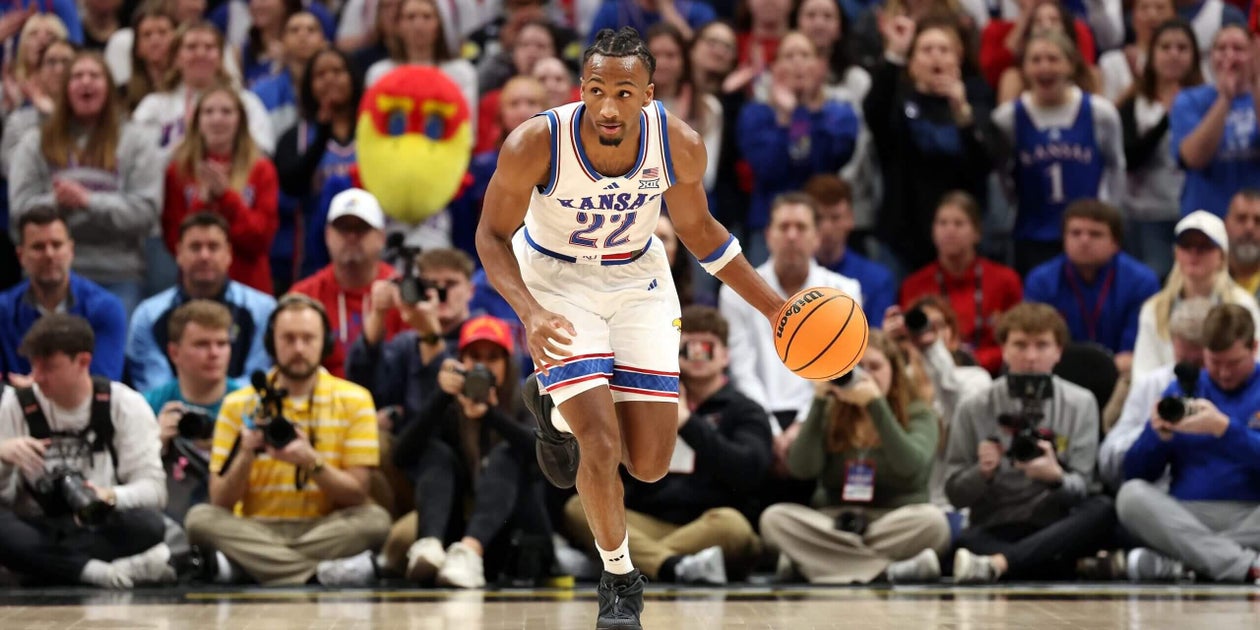
It’s time for the first 2026 NBA Draft Big Board of the cycle, breaking down the top 100 prospects in what looks to be an exceptional class.
The top three — AJ Dybantsa, Darryn Peterson and Cameron Boozer — still headline the group, but this class has exceeded expectations from a depth perspective. Point guard prospects, whom we’ll discuss below, have really broken out. The freshmen class has many standout performers, with players like Illinois’ Keaton Wagler, Washington’s Hannes Steinbach, Alabama’s Amari Allen and Iowa State’s Killyan Toure showcasing one-and-done upside. The sophomore class has also been quite good, with Vanderbilt’s Tyler Tanner and Alabama’s Labaron Philon showing huge improvement in the SEC, Cameron Carr at Baylor breaking out and Duke center Patrick Ngongba finally getting healthy to showcase his long-foreseen immense talent.
This looks like one of the best draft classes of the last decade and might end up having a case as the best, depending on how conference play goes. There’s value to be found all over the place if most of these players stay in the draft, which is always a question given the riches being offered by college basketball in the name, image and likeness era.
In that vein, to make this remotely resemble what the NBA Draft prospect pool could look like in the NIL era, I had to implement some rules for the top 100:
• I don’t rank freshmen outside of the top 40. If you are a freshman who will not be taken in the first round, you should not declare for the draft. There is too much money to be made by staying in school. If you are a player who is good enough to be taken in the second round, the odds are that you will make more than the NBA minimum in college. Players impacted this time around include Stanford guard Ebuka Okorie, Kentucky center Malachi Moreno, Duke wing Nik Khamenia, NC State guard Matthew Able, Miami (Fla.) wing Shelton Henderson and Houston wing Isiah Harwell.
• I also don’t rank underclassmen outside of the top 70. As R.J. Luis learned last year, there is no reason to declare for the NBA Draft if you aren’t going to be selected — or even if you are selected but end up on a two-way contract. You will likely make three times as much money in college as you would on a two-way contract. Players who this rule impacted this time around include San Diego State wing Miles Byrd, Arkansas wing Karter Knox, Connecticut guard Solo Ball, Iowa forward Alvaro Folgueiras, Purdue big Daniel Jacobsen and dozens of others.
• Ages are as of draft day in 2026. Heights are those listed by the player’s school or team, unless he was measured officially at a combine or event.
RankNamePositionSchoolAgeHeight
1
AJ Dybantsa
Wing
BYU
19
6-9
2
Darryn Peterson
Guard
Kansas
19
6-5
3
Cameron Boozer
Forward
Duke
18
6-9
4
Caleb Wilson
Wing
North Carolina
19
6-8
5
Kingston Flemings
Guard
Houston
19
6-4
6
Jayden Quaintance
Big
Kentucky
19
6-10
7
Koa Peat
Forward
Arizona
19
6-8
8
Yaxel Lendeborg
Forward
Michigan
23
6-8.5
9
Hannes Steinbach
Big
Washington
20
6-9.5
10
Mikel Brown Jr.
Guard
Louisville
20
6-4
11
Keaton Wagler
Wing
Illinois
19
6-6
12
Thomas Haugh
Forward
Florida
23
6-9
13
Labaron Philon
Guard
Alabama
20
6-2.75
14
Patrick Ngongba II
Big
Duke
20
6-11
15
Cameron Carr
Wing
Baylor
21
6-6
16
Darius Acuff Jr.
Guard
Arkansas
19
6-1
17
Braylon Mullins
Wing
Connecticut
20
6-5
18
Nate Ament
Wing/Forward
Tennessee
19
6-9
19
Joshua Jefferson
Wing
Iowa State
22
6-9
20
Christian Anderson
Guard
Texas Tech
20
6-2
21
Benett Stirtz
Guard
Iowa
22
6-4
22
Amari Allen
Wing
Alabama
20
6-8
23
Chris Cenac Jr.
Big
Houston
19
6-9.5
24
Neoklis Avdalas
Wing
Virginia Tech
20
6-7.5
25
Tounde Yessoufou
Wing
Baylor
20
6-4
26
Karim Lopez
Forward
NZ Breakers
19
6-8
27
Tyler Tanner
Guard
Vanderbilt
20
5-11
28
Henri Veesaar
Big
North Carolina
22
7-0
29
Dash Daniels
Wing
Melbourne United
18
6-6
30
Killyan Toure
Guard
Iowa State
20
6-3
31
Dailyn Swain
Wing
Texas
20
6-8
32
Aday Mara
Big
Michigan
21
7-3
33
Brayden Burries
Wing
Arizona
20
6-4
34
Alex Karaban
Wing
Connecticut
23
6-6.5
35
Richie Saunders
Wing
BYU
24
6-5
36
Isaiah Evans
Wing
Duke
20
6-6
37
Meleek Thomas
Wing
Arkansas
19
6-5
38
Braden Smith
Guard
Purdue
22
6-0
39
Ryan Conwell
Guard
Louisville
22
6-4
40
JoJo Tugler
Big
Houston
21
6-8
41
Sergio De Larrea
Guard
Valencia
20
6-5
42
Dame Sarr
Wing
Duke
20
6-6.5
43
Tarris Reed Jr.
Big
Connecticut
22
6-11
44
Alex Condon
Big
Florida
21
6-11.25
45
Tamin Lipsey
Guard
Iowa State
23
6-1
46
Milan Momcilovic
Wing
Iowa State
21
6-8
47
Milos Uzan
Guard
Houston
23
6-3.25
48
Johann Grunloh
Big
Virginia
20
6-11
49
Nate Bittle
Big
Oregon
23
6-11.25
50
Flory Bidunga
Big
Kansas
21
6-7
51
Braden Huff
Big
Gonzaga
22
6-10
52
Morez Johnson Jr.
Big
Michigan
20
6-9
53
Bruce Thornton
Guard
Ohio State
22
6-2
54
Juke Harris
Wing
Wake Forest
20
6-7
55
Jaden Bradley
Guard
Arizona
22
6-3
56
Zuby Ejiofor
Big
St. John’s
22
6-8
57
Silas DeMary Jr.
Guard
Connecticut
22
6-4
58
MoMo Faye
Big
Paris Basketball
21
6-9
59
Adam Atamna
Guard
ASVEL
18
6-5
60
Tomislav Ivisic
Big
Illinois
22
7-1
61
Kwame Evans Jr.
Wing
Oregon
21
6-9
62
Paul McNeil
Wing
NC State
20
6-5
63
Pryce Sandfort
Wing
Nebraska
22
6-6
64
Nolan Winter
Big
Wisconsin
21
7-0
65
JT Toppin
Big
Texas Tech
21
6-7
66
D’Shayne Montgomery
Wing
Dayton
22
6-4
67
Blue Cain
Guard
Georgia
21
6-5
68
Andrej Stojakovic
Wing
Illinois
21
6-7
69
Tahaad Pettiford
Guard
Auburn
20
6-0.25
70
K.J. Lewis
Guard
Georgetown
21
6-4
71
Baba Miller
Wing
Cincinnati
22
6-11
72
Ja’Kobi Gillespie
Guard
Tennessee
22
6-1
73
Motiejus Krivas
Big
Arizona
21
7-2
74
Tyler Bilodeau
Forward
UCLA
22
6-9
75
Darrion Williams
Forward
NC State
23
6-4.5
76
Nick Martinelli
Wing
Northwestern
22
6-6
77
Cade Tyson
Wing
Minnesota
22
6-7
78
William Kyle
Big
Syracuse
22
6-9
79
Keyshawn Hall
Forward
Auburn
23
6-7
80
Emanuel Sharp
Guard
Houston
22
6-3
81
Nick Boyd
Guard
Wisconsin
25
6-3
82
Donovan Dent
Guard
UCLA
22
6-2
83
Maliq Brown
Big
Duke
22
6-9
84
Trey Kaufman-Renn
Big
Purdue
23
6-9
85
Tucker DeVries
Wing
Indiana
23
6-7
86
Joshua Dix
Wing
Creighton
22
6-6
87
John Blackwell
Guard
Wisconsin
21
6-4
88
Otega Oweh
Wing
Kentucky
23
6-4.25
89
Elijah Mahi
Forward
Santa Clara
22
6-7
90
Lamar Wilkerson
Guard
Indiana
24
6-4
91
Kylan Boswell
Guard
Illinois
21
6-2
92
Dillon Mitchell
Wing
St. John’s
22
6-8
93
Ben Henshall
Guard
Perth Wildcats
22
6-5.5
94
Trevon Brazile
Big
Arkansas
23
6-9
95
Michael Ruzic
Big
Joventut
19
6-11
96
Michael Ajayi
Wing
Butler
23
6-7
97
Oscar Cluff
Big
Purdue
24
6-11
98
Jordan Burks
Forward
UCF
21
6-9
99
Fletcher Loyer
Guard
Purdue
22
6-4
100
Bryce Hopkins
Forward
St. John’s
23
6-7
Editor’s note: A way-too-early version of the Top 100 was initially uploaded with this story. Those rankings have been adjusted.Why I have Dybantsa No. 1 … for now
In my opinion and that of most NBA scouts, the three-man race at the top of the class between Peterson, Dybantsa and Boozer still exists. It’s razor close, and if you ask 10 scouts or executives who their choice is, you’ll probably get a breakdown of four for one player, and three for each of the other two, depending on whether they care about numbers, pre-college tape or upside as their guiding principle.
I started the year with Peterson first, Boozer second and Dybantsa third. For this board, Dybantsa is No. 1.
Why? Mostly because I think Dybantsa has shown the most growth from the start of the season, which is a massive part of projecting success at the next level. These players are not finished products by the time they reach the NBA, and the draft evaluation is a snapshot in time. It’s undeniably an important one in players’ lives, given that it tells them where they’ll start their careers and how much money they’ll make, but it’s just where a player is at that moment while projecting how he can grow. And in this case, Dybantsa’s athletic profile — he blends pure power and explosiveness with touch and coordination — has a chance to give him the highest ceiling of these three players.
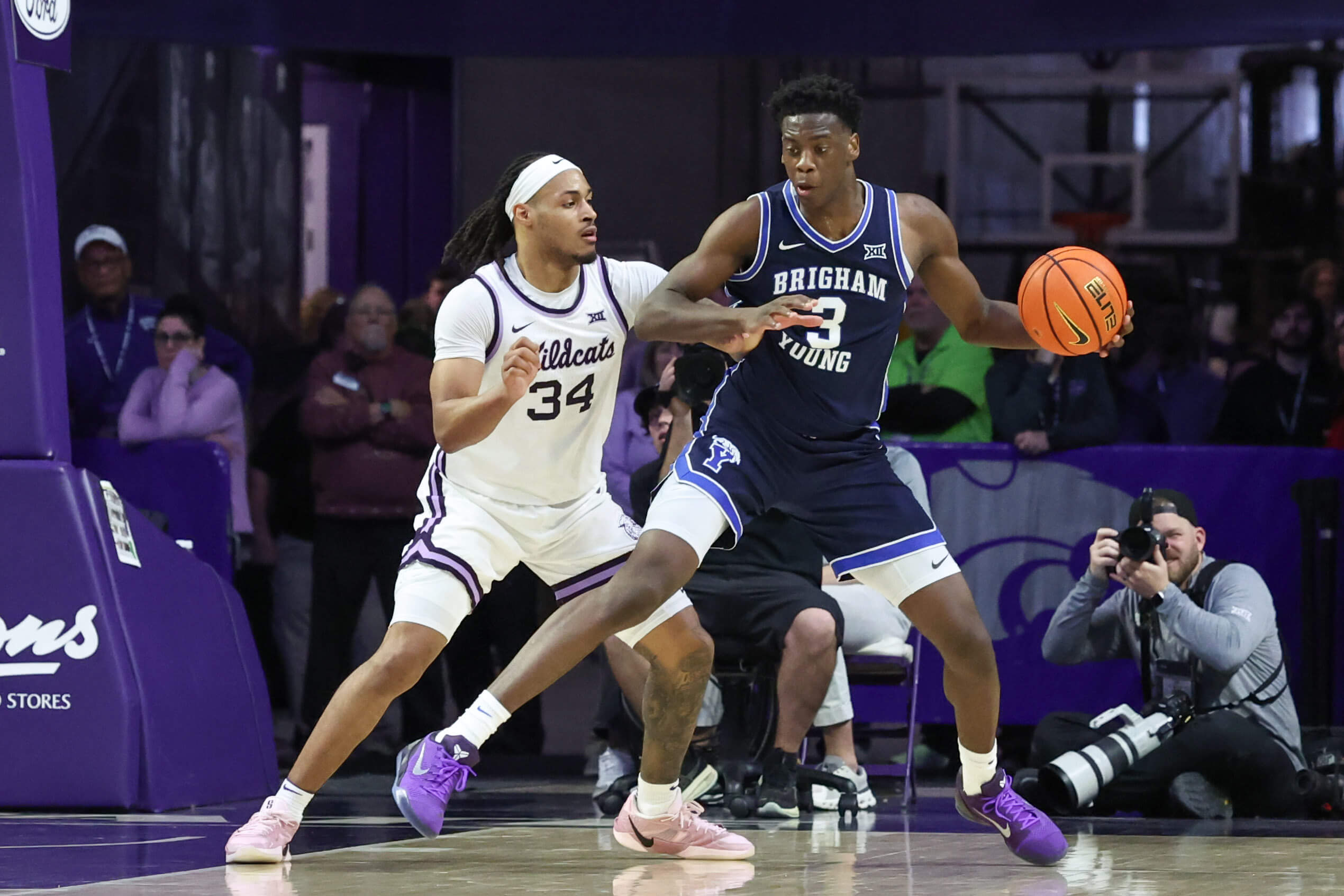
Dybantsa, who doesn’t turn 19 until Jan. 29, is averaging a robust 23.1 points, 7.2 rebounds and 3.8 assists for BYU while shooting 58.6 percent from the field. The 6-foot-9 wing is getting to the line an absurd eight times per game and shooting 76.5 percent there. But more than just the numbers, it’s the way he’s getting them. Dybantsa is a walking paint touch, as no one can stop him from getting downhill unless they really load up against him.
AJ Dybantsa works in the post as Kansas State’s Nate Johnson defends. (Scott Sewell / Imagn Images)
Early in the year, that was a genuine strategy that teams like Connecticut employed with success. If you can muddy the picture against Dybantsa on his drives, it can get complicated as he tries to read through what he should do. Saturday’s game against Kansas State showcased that, as he turned the ball over seven times. He doesn’t have the most refined handle, which means he can lose the ball more than you’d like against aggressive defenses. But from December onward, Dybantsa has averaged 5.3 assists per game and shown real passing growth.
I also like the way that he has figured out where help is coming from mid-game and processed that information to figure out how to structure his forays toward the rim. Defensively, Dybantsa needs work in knowing where his rotations need to be and how quickly they need to come. But his ability to pressure the rim without a particularly developed handle is serious and should allow him to grow and blossom as a perimeter player over the next 10 years. The thing that I think people often miss when it comes to evaluating handle is that the pure control aspect over the ball can be improved. Often, struggles with ballhandling occur when someone is limited in their hip flexibility or explosiveness. Dybantsa doesn’t have those issues.
Will this order change next week? It could. Peterson might start playing and dominating. Boozer might take another leap and just become so overwhelmingly productive that it’s impossible to rank anyone ahead of him. That’s what conference play tape is for. It separates players in a big way because teams scout for their opposition’s coaching staffs and can take away what a team wants to do after years of playing against the same scheme in many cases.
Does Peterson’s injury impact his draft stock?
Peterson’s injury has become one of the critical talking points of the college basketball season, and the way it has been classified has changed throughout the process.
Early in the season, Kansas coach Bill Self referred to it as a hamstring injury. Then, after Peterson struggled late with the injury on Dec. 13 against NC State, it was called quad cramping. Peterson came back against UCF on Saturday and sat out the final 11 minutes after scoring 26 points in 23 minutes due to what Self said after the game was a minutes restriction. Then on Monday, Self said Peterson’s legs wouldn’t let him play longer. On Tuesday night, Peterson scored 32 points against TCU but sat out the overtime period because of what Self called cramping.
When he’s played, Peterson has been a dominant perimeter scorer who hasn’t looked like he’s had the explosiveness to get to the rim, something he did easily in high school. It looks like he hasn’t been 100 percent all season. So has this complicated injury situation impacted his draft stock?
I reached out to five NBA executives and scouts, and the overall impression was that Peterson’s stock has not been hurt. But the injury situation has at least raised questions for scouts to dig into once Peterson enters the pre-draft process. Under the new NBA collective bargaining agreement, all prospects are required to undergo medical examinations, which are then distributed to teams. In Peterson’s case, his tests will likely not be distributed beyond the top-10 teams in the draft order. However, teams at the top end of the draft will examine those results closely to determine if there is any potential long-term impact from whatever is going on.
“The good news is that we don’t have to make this decision now,” said one front-office executive, who was granted anonymity because he is not authorized to speak publicly about draft prospects. “We’ll find out the information that matters on his leg at the combine and go from there. With scouting him, I’d love to see Peterson play. In the end, if he ends up not playing enough, it might result in the team at No. 1 feeling more comfortable with one of the other two guys at the top from a safety perspective.
“I can’t speak for everyone, but I have seen enough from Peterson both at the high school level and in college to feel comfortable that he’s at least a top-three player in the class as long as his medical comes back clean long-term.”
The NBA teams I’ve spoken with also are not under the impression that there is anything nefarious afoot with Peterson or that he is sitting to preserve his draft stock. Self has been adamant that there has been no discussion of Peterson “shutting it down” for the season.
Quaintance is back and wreaking havoc on defense
After missing the first 11 games of the season while recovering from a torn ACL that he suffered late in his freshman season at Arizona State, Jayden Quaintance finally debuted for Kentucky and showcased all the skills that had scouts excited about him both in high school and after his first year in college. Quaintance, who reclassified into the Class of 2024, was not eligible to declare for the 2025 NBA Draft because he doesn’t turn 19 years old until July. What got scouts so enthusiastic about him at Arizona State was how advanced he was defensively for someone who played his entire freshman season at 17.
In just 18 minutes in his first game of the year against St. John’s, Quantaince again looked like a lottery pick. He had a pedestrian-looking 10 points and eight rebounds, but his defense gave the Wildcats the clear backbone that they’d been lacking throughout the season. Quaintance is one of the best ball-screen defenders in the country, a savant at understanding the cat-and-mouse game that bigs must play with ballhandlers when defending in space before recovering to bigs. His timing and length — Quaintance possesses a 7-5 wingspan — is used to expert-level effect with how he’s able to show out onto ballhandlers before recovering, even when playing in a higher drop coverage setting as opposed to when he’s hedging. He’ll stunt using his high foot and arm length to keep an offensive player at bay while his guard recovers off a screen and then push off to get back to his man. Don’t sleep on the fact that he’s an excellent post defender, either. He’s great at using his frame to wedge players off the block and fight for position.
This possession is a perfect encapsulation of how Quaintance can be everywhere on defense at once and create multiple opportunities for his team to get stops.
Quaintance’s length and mobility allow him to cover an immense amount of ground. That should translate exceedingly well in the NBA, where the offensive zone is even larger because of highly skilled shooters and the increased distance of the 3-point line. But it’s not all just physical traits, either. Quaintance’s basketball IQ as a defender is innate in a way that is difficult to teach. His timing is terrific. He’s more of a technician on defense than he gets credit for, and he also looks much stronger this year.
Whether Quaintance can break into the top-five conversation will depend on where his offensive level goes. He shows flashes of ballhandling and passing ability and is very comfortable in dribble-handoff settings on the perimeter. He’ll even showcase some ability to drive to the rim in matchups against centers, using his bend and his crossovers to get past bigger players. He hasn’t shown enough yet in ball-screen settings as a roller because of his lack of vertical pop. More of a long leaper than an explosive one, Quaintance’s dunks tend to come because of his long arms as opposed to getting off the ground quickly. In general, he can be a bit more below-the-rim than you want from a center. And his best position looks like it’s going to be center from a skill perspective unless he drastically improves as a shooter. Quaintance will occasionally show some touch from midrange areas, but he’s never been all that impactful as a free-throw or 3-point shooter.
Still, this is an easily projectable high-level defender who is probably somewhere in the middle of the premium defender spectrum, where one end is Isaiah Stewart and the other is Bam Adebayo. He’s not quite as explosive or fluid athletically as Adebayo, but he also doesn’t possess the pure strength Stewart did even when Stewart was a teenager. The name I like to compare Quaintance to most is Robert Williams III, a player whose knee injuries robbed him of perennial All-Defensive team berths. These types of big men are incredibly valuable in high-leverage situations, and I’d expect Quaintance to be the same as long as his own knee injury comes back with a clean bill of health at the combine.
Point guard class looks terrific
The depth of this class can be found in how terrific the point guards are. On this board, I have four point guards ranked in the lottery — albeit potentially lower in some cases than where others will have them — and two others in the top 21. But is that right? In an era when the Atlanta Hawks’ Trae Young — a point guard who is more talented and gifted than all of these players with his ball-screen passing and overall gravity as a scorer — might not be good enough to be a franchise building block, should we value lead guards as highly as what this board says?
On some level, I think you need to just take what the board gives you. If a player tells you they’re an NBA player in an era when about 20 players per draft class end up becoming difference-makers or real rotation players, that’s a good sign. If you believe in a player being an NBA rotational guy, having them somewhere 12th to 20th on the board is probably about right, although it is worth noting that every evaluation lives on a continuum of upside and downside, and that you need to consider the expected value of what happens if a player hits their perceived ceiling. Is that player, such as a Carr from Baylor or Thomas Haugh from Florida, more valuable than some of the score-first guards we see here? Probably, because of the positional value portion of the equation. Still, I think there are several guards here who profile as good NBA players.
• Kingston Flemings is my highest rated of the bunch at No. 5 because he has done the best job of showcasing star-quality upside blended with the proven ability to play both on and off the ball. He’s a tremendous athlete who has scored from all three levels and has shown strides as a ball-screen passer and defender this season. He’s been excellent, but scouts want to see where the shooting lands.
• Mikel Brown Jr. comes next for me, even though his performance has been more up and down. He’s averaging 16.6 points and 5.1 assists, but he’s been inefficient largely because his jumper has bizarrely abandoned him. He’s only made 26.8 percent of his 3s. I haven’t talked to a scout yet who is concerned about Brown’s shooting once he gets to the NBA, and Brown is dealing with a lower back injury that has held him out of multiple games over the last month. He needs to improve on defense, but Brown’s intersection of explosiveness athletically, shooting and passing looks pretty special.
• Darius Acuff Jr. has been remarkably productive as a freshman, averaging 19 points and six rebounds per game for John Calipari’s Arkansas team. But he might be the most Trae Young-adjacent player here, as he’s been ball-dominant and poor on defense. And yet, he’s a skilled shot maker and scorer who is starting to show better passing flashes. He looks poised to go somewhere in the top 20, with a high ceiling and low floor on draft night, depending on how SEC play goes and if there is an executive who falls in love with his skill set.
• Labaron Philon was the final player to choose to return to college last season after a dalliance with the draft process, and all he has done is improve in every category across the board. He’s averaging 21.5 points and 5.4 assists while shooting 53.6 percent from the field, 38.6 percent from 3 and 73 percent from the line. He’s an athletic player who gets to the rim, creates high-level kickout opportunities for teammates and makes the right play. On top of it, he showed last season he can capably play off the ball when starting next to Mark Sears. There’s rightfully a lot of excitement about Philon’s growth.
• Bennett Stirtz is a basketball savant who runs Iowa’s offense to a crisp tempo and drills shots from the perimeter. Christian Anderson is one of the most productive guards in the country as a dynamic ballhandler and creator, averaging 20.5 points and 7.5 rebounds on terrific percentages. Vanderbilt’s Tanner is this year’s analytics darling while running the Commodores’ offense, with his blend of shooting percentages, rim finishing, assist-to-turnover ratio and steal rate. They all feature in the 20s because of size and potential defensive issues.
Why I’m bullish on Iowa State’s players
Iowa State has been one of my favorite teams to watch this year. Ranked third in the country with an unblemished 14-0 record, the Cyclones have taken a massive leap on offense this year while still being the elite defensive program that they’ve always been under coach T.J. Otzelberger. Why has that leap occurred? First, the team is protecting the ball better than it ever has under Otzelberger, posting a 14.7 turnover percentage that is top 50 in the country. It’s also getting better ball movement, shooting and spacing improved; Iowa State is drilling 42 percent from beyond the 3-point arc.
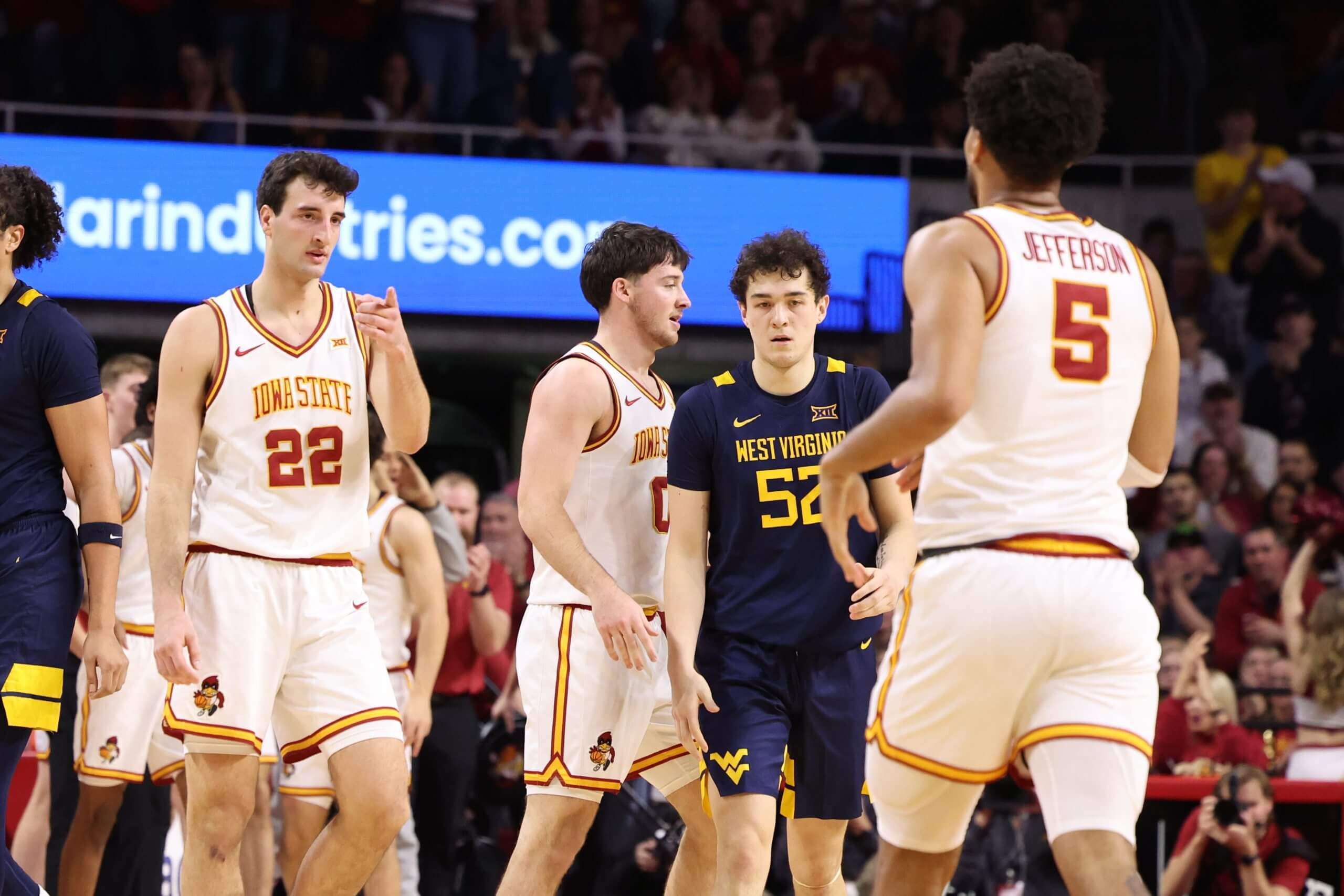
That’s why you’ll see Joshua Jefferson, Killyan Toure, Tamin Lipsey and Milan Momcilovic ranked higher here than you will in other places. I have Jefferson and Toure in the top 30 and then both Lipsey and Momcilovic in the top 50. Jefferson and Lipsey are the only two players here guaranteed to be in the class as seniors, but I think all four are worth merit as NBA players.
Milan Momcilovic, left, and Joshua Jefferson, right, celebrate an Iowa State bucket against West Virginia. (Reese Strickland / Imagn Images)
Jefferson is the real standout. The idea here is that he’s a 6-8 do-it-all wing whose lone weakness used to be that he couldn’t hit a shot. However, this season he’s started to show some growth there, making 39 percent of his 2.6 3-point attempts per game.
Jefferson’s superpower, though, is his brain. He thinks the game quicker than anyone else in college basketball on both ends of the court and makes life easier across the board for his teammates. The box score numbers show that, as he’s averaging 17.5 points, 7.3 rebounds, 5.4 assists, 1.6 steals and 0.9 blocks. I think the tape is somehow better. Jefferson throws passes on the move or from the post. He’ll drive from beyond the 3-point line or catch short rolls. He always knows where everyone is on the court and completely understands where help defenders are being sent from. His 5.4 assists per game are terrific, and he throws them with either hand off a live dribble. It’s probably the closest thing I’ve seen to Draymond Green’s Michigan State tape offensively since Green was in college.
Jefferson has been on the radar since last season, and some scouts tried to persuade their teams to assure Jefferson a second-round spot last year if he stayed in the draft. Iowa State looks great largely because of the way he dictates the game on both ends.
Lipsey is the other driver of play for this team. The easiest way that I can explain him is that he’s a walking turnover battle victory. Every time he’s on the court, Iowa State is guaranteed to get more positive possessions than its opposition. Why? Because he never turns the ball over and is one of the elite ball thieves in the country on defense. Lipsey is averaging 5.9 assists per game versus a paltry 0.8 turnovers, a downright VanVleetian profile that is buoyed by him also grabbing 2.4 steals per game with his aggressive point-of-attack defense.
He can be overaggressive and get beaten at times, and I don’t think he’s nearly the scorer that Fred VanVleet was from an NBA perspective because of his inability to shoot. But Lipsey looks like a good backup guard prospect.
Toure is the big long-term bet, and I think I would wager on him going back to Ames next season. But I think Toure is the best perimeter defender in college basketball as a freshman. He’s so strong and physical at the point of attack and also has very fluid hips and an extremely high-end motor that allows him to fight and recover through ball screens. Toure looks like a Lu Dort starter kit every time that I watch him, and it doesn’t hurt that he’s also averaging 10 points and 2.7 assists per game. The 3-point shooting has been streaky, and he’ll need to show flashes there over the next two months. But I’m not sure I’ve seen a better point-of-attack defender over the first two months of his collegiate career in quite a while. He’s that physical and aggressive.
Finally, Momcilovic looks like the next Steve Novak, an absolute sniper from distance who is drilling an obscene 56.3 percent of his seven 3-point attempts per game while averaging 18.5 points. If you leave him remotely open, it’s over. The ball is going in the hoop. At 6-foot-8 with a powerful 220-pound frame, he has also shown some useful occasional mid-post scoring ability. But this is a score-only profile for a hyper-elite catch-and-shoot player. That can stick on an NBA roster, but you’d love to see him continue to round out his game.