

Let’s paint a picture of the world we’re entering here. A 62-year-old man. Slacks. Collared golf shirt. Glasses. Dad energy, to be clear. Walking through a tunnel with strobing blue lights. His accomplishments were announced on a loudspeaker like a pro wrestling entrance. Spotlights follow him as he enters the arena. And is that… is that a sketch of a golf hole on the massive screen?
This is a hype video entrance for a golf course architect — no, really — announcing him as part of an indoor golf simulator league. So, yeah, this is all a little different. That’s the fun part.
“We’ve definitely leaned into it,” said Gil Hanse, the dad in question.
A new face has been added to TGL’s lineup…
We’re thrilled to have Gil Hanse join our hole design team to help us expand the full catalog of holes for Season 2! ⛳ pic.twitter.com/jFWvpF3J2Q
— TGL (@TGL) December 2, 2025
Hanse is a legend, one of the core course designers of the last 30 years with multiple top-100 courses on his CV. The USGA essentially handed the reins to him and partner Jim Wagner to restore every iconic (and needy) U.S. Open venue in recent memory. He loves the classics. He spends every chance he can out in the dirt, hopping on bulldozers, surveying the land he’s given, and making beautiful, traditional golf courses.
Now he’s got a blank slate and a computer screen.
So why did Hanse take this gig helping design holes for TGL, the two-year-old indoor league that plays its matches in an intimate arena with top PGA Tour players like Rory McIlroy and Xander Schauffele hitting shots into a 53-foot-tall screen? Why would he take an unnecessary job that elicits chuckles from his buddies and raised eyebrows?
“Why not?” he asked. “It could be a lot of fun. Turns out it was.”
Much of this is due to tradition. Traditional golf. Traditional design. The traditional way to do anything. When somebody starts talking about breaking those customs, it can be met with an eyeroll. Perhaps it often should be. None of this is that serious. However, there might be something beautiful in the removal from tradition happening in TGL, if you look closely enough.
Hanse is tradition, right? You know who’s not? Agustin Pizá. He’s from Mexico, the self-proclaimed first Latin American person to earn a master’s degree in golf course architecture from Edinburgh University. He does things differently. His first solo design was on a man-made island. He designed courses for fewer resources, like an 18-hole course using six greens or “butterfly golf,” using loops of six holes for different formations. He’s worked with virtual reality headset golf companies.
He’s not Hanse, or Beau Welling, or Jack Nicklaus Design, the other men and companies asked to design TGL’s original holes. Being asked to take part in this was a little scary, to be honest. It’s a big stage. But Pizá lives pretty big.
When you think of the strangeness — Pizá prefers the word extravagance — of TGL holes, you’re likely thinking of Pizá. Volcanoes. Floating triangle islands. He has a new hole for Season 2, which began Dec. 28, where players essentially have to hit a low-flight stinger under a rock formation, and there’s another with a ski-ball like backboard above a green on the Yucatan Peninsula. Extravagance.
“I like to think of myself — and my practice — as alchemists,” Pizá said. “That we’re still in search of the best artistic and, in general, expression of golf. I love the Golden Age of architecture. Alister MacKenzie is my favorite architect of all time. And I’ve studied a lot about him and, of course, modern architecture and the Golden Age of architecture, and I love it, and I respect it. … But I do not think that’s the maximum form of expression of golf.
“I’m still in search for it.”
And then there’s Hanse, who sincerely assumed he was brought on to be the preserver of tradition. He watched Season 1, thought it was cool and noticed the most memorable holes were the ones that felt like a video game. “I thought, ‘Well maybe it should be our role, since we are more traditionally thought of, to build more traditional golf holes.’” So he made one that honored A.W. Tillinghast, the man behind Bethpage Black and Winged Foot. Another for Tom Simpson, an Englishman who worked on Muirfield. Hanse thought, “It would be a really cool take on bringing a great old dead architect’s work to life on this screen.”
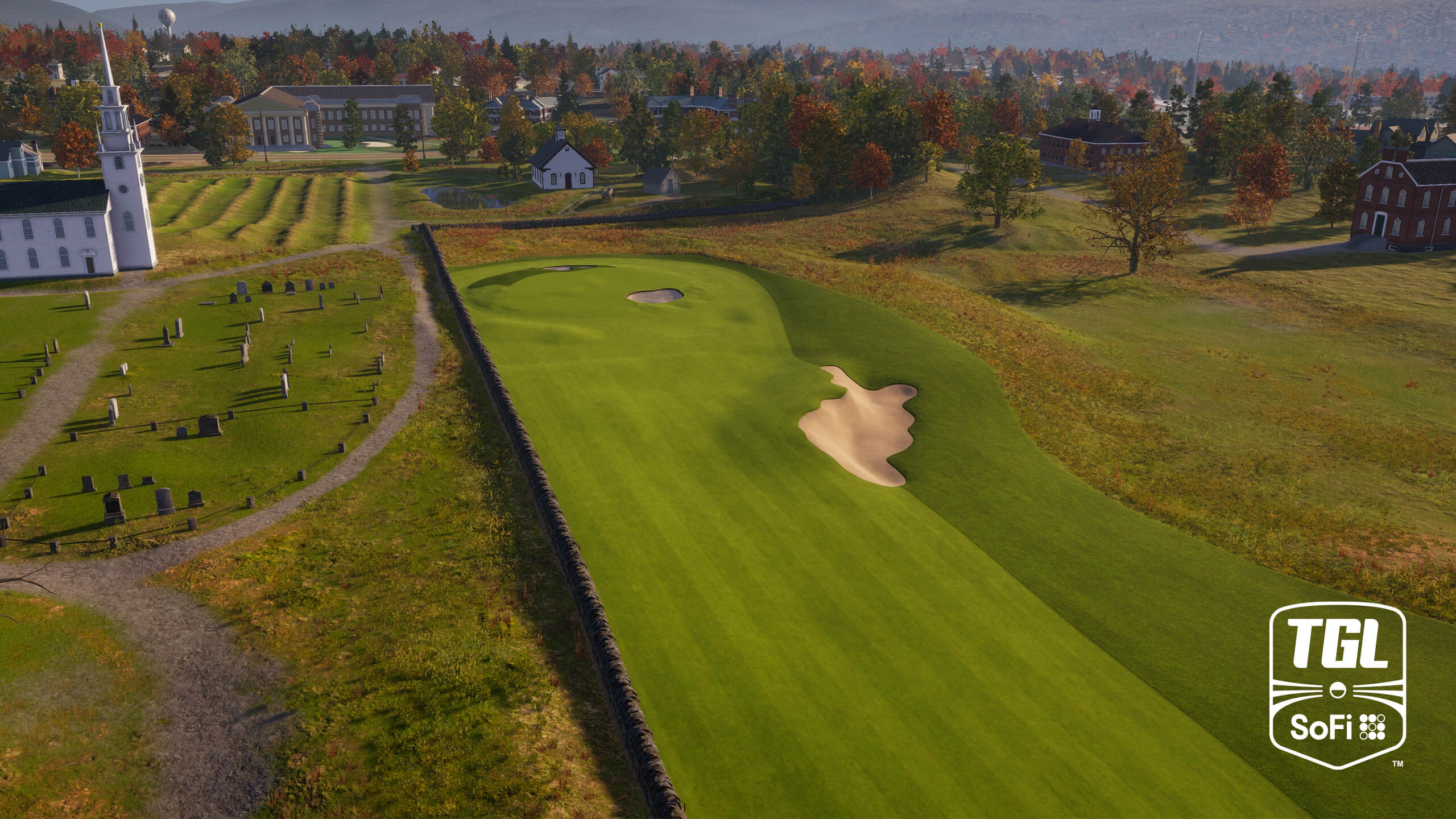
Stone & Steeple is one of Gil Hanse’s early hole designs, with a church and cemetery defending the left side of the green. (Courtesy TGL)
But the more they worked on it — and by the way, Hanse says it takes longer to design a TGL hole than a physical course hole — the more their minds wandered. What if we put this inside Philadelphia? What if we did a dystopian landscape? He and teammates Kevin Murphy and Ben Hillard realized the fun might come in taking those traditional tentpoles but making them weird.
Sorry. Extravagant.
They signed on for five holes. The first three could have existed in the real world. The last two, Hanse said, are “based on the classic principles of architecture, but in settings that we would never ever be able to design in. That was liberating in a way.”
This is truly a whole new world for Hanse. He and his team don’t even use computer design tools for their sand-and-grass courses. It’s all via pencil, usually drawn up on-site as they adjust to the land they’re given. TGL is an actual blank slate in a field in which blank slates don’t exist. They’re taking drawings to the computer graphics teams and seeing them pop up on screen, adjusting this angle here, leveling that ground there. Complete freedom. Suddenly, courses had collapsed bridges in the background, because why not?
Pizá lives for this part because he was born into it. He was asked what the number one thing he learned from Season 1 was: Verticality.
Usually, he says, architects play with the horizontal. They use angles, left to right, to challenge the golfer. But the world is their oyster here. So in Season 2, he got vertical. Hence Stinger, the hole inspired by Tiger Woods’ famous low tee shot. The first three players to play the hole hit directly into the rock formation, failing to get low enough. It wasn’t until youngster Michael Thorbjornsen hit a low iron that somebody succeeded.

Stinger has become a signature hole already for TGL, asking participants to hit a low, running shot to get under a canyon ledge. (Courtesy TGL)
Or Cenote, the Yucatan Peninsula hole with a massive ramp above the hole that takes different strategies depending on the pin location. One can try to hit a dart with a long iron, but most of the time, they will need to hit a driver and use different distances to gain momentum down the ramp to roll on the green. The higher up the drive, the longer and faster the roll.
As Pizá discusses these holes, his excitement grows. He doesn’t want to look at other holes by his contemporaries, because he reveres these minds. The mere idea of the name Pizá being in the same conversation as Hanse and Welling warms his heart. This is not just a playful hobby to him. These new holes? They are just the beginning. He has more coming; he hopes to create “surprise factor” as they get unveiled later in the season.
“I thought that Cenote and Stinger, you know, did more than expected,” he says.
“I knew that we had something special. You know how that… when you’re a songwriter, you know that you have a special song that’s out there? I knew that Stinger was special.”
Golf is a rather stuffy, self-serious game. The clubs. The courses. The people. And if TGL isn’t for you, that’s completely fine. But if there’s a world where the Pizás and Hanses of the world can enter the same arena and end up meeting somewhere in the middle… that’s pretty cool.