
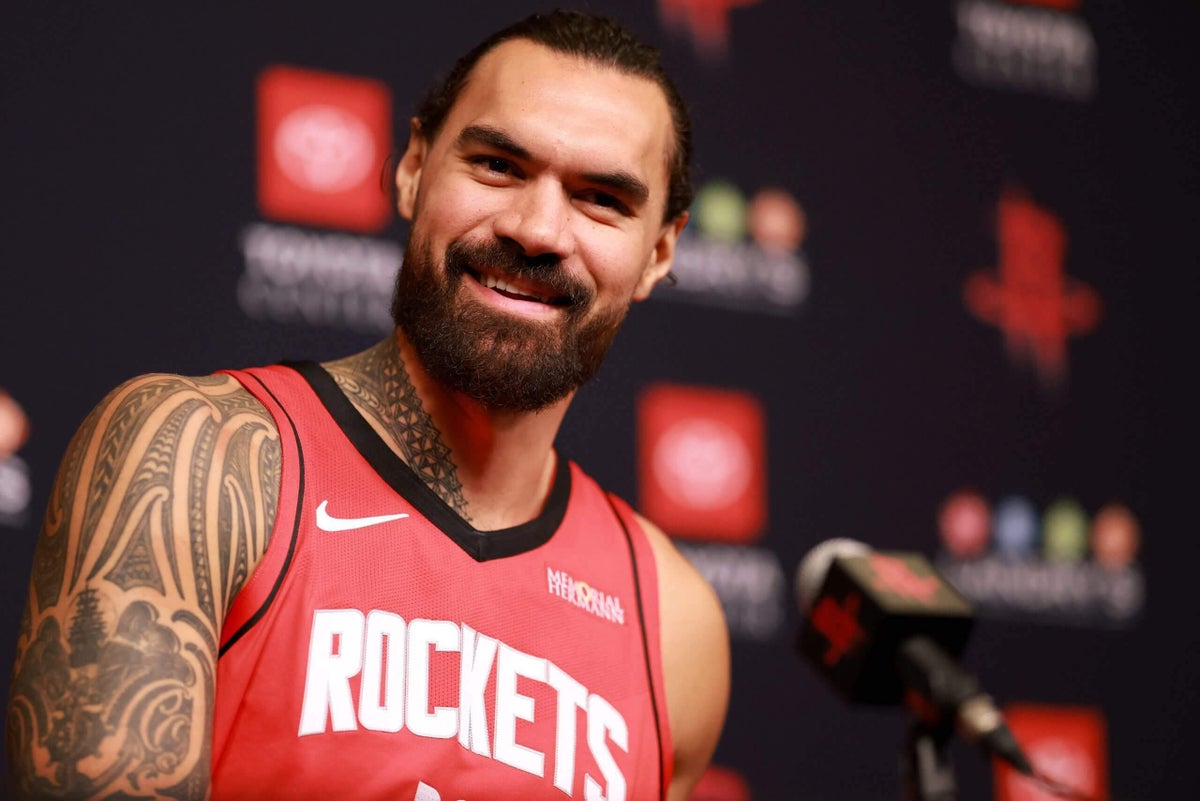
HOUSTON — When Steven Adams pulled off his defining moment of the 2025-26 season, his teammates on the Houston Rockets bench had a bigger reaction than he did.
In a Nov. 30 win over the Utah Jazz, Adams soared through the air to swat a Brice Sensabaugh shot off the glass. Adams immediately responded by sprinting down the middle of the court, catching a pass from Kevin Durant and rising up to throw down a one-handed flush over Utah big Kyle Filipowski.
The entire Rockets bench roared with elation, while Adams jogged back on defense like it was another day.
STEVEN ADAMS.
TWO-WAY FORCE AT THE RIM.
Watch here: https://t.co/qvuGAmOU3i pic.twitter.com/oXHPJlYZzq
— NBA (@NBA) November 30, 2025
For Rockets fans at home, it was a sign that their bruising reserve center was starting to look like the younger version of himself.
Only one person wasn’t moved by the viral highlight: Steven Adams.
“People are like, ‘Oh he can dunk!’” Adams halfheartedly told The Athletic in a one-on-one interview last month. “I’m 7-feet, bro. That doesn’t mean s—.”
Adams has never attached success to his numbers in the box score or his highlights on YouTube. But that game and others have been about Adams showing off the kind of athleticism many thought he’d lost after years of nagging knee issues derailed his career. One of the league’s most unique role players has pushed past the injuries and reclaimed his form on a team with serious NBA title aspirations.
And he’s not just another guy in the rotation. Adams exemplifies what makes the Rockets different from other Western Conference challengers.
He developed a deeper appreciation for smaller wins during one of the darkest stretches of his career. These flashy plays are good for everyone else to embrace. But in his eyes, the work that he’s done along the way is where he takes the most pride.
After playing seven seasons in Oklahoma City and one in New Orleans, Adams found a new home as the starting center of a Memphis Grizzlies team that was on the rise. Adams was beginning to show he could still be a force on a winning team, even when he wasn’t surrounded by legendary talents like Durant and Russell Westbrook, both then with the Thunder.
After diving for a loose ball during a game in January 2023, Adams experienced sharp pain in his right knee. Doctors diagnosed him with a sprain in his posterior cruciate ligament. The typical recovery timeline for such an injury is three to five weeks.
As the weeks went by, however, Adams was still experiencing pain. His knee wasn’t responding the way the medical staff anticipated. To assist with the healing process, he received a stem cell injection in his knee, effectively eliminating any chance of his return during the rest of the 2022-23 season.
Without Adams, the second-seeded Grizzlies were eliminated in the first round by the seventh-seeded Los Angeles Lakers.
As Adams ramped up his rehabilitation during the summer, there was optimism in Memphis that he’d be ready for the start of the following season. Adams played in a few preseason games and seemed to be doing well. But as the regular season approached, his knee still wasn’t responding the way he hoped.
In an effort to fully address the issue, Adams elected to undergo surgery on his PCL, which would sideline him for the entire 2023-24 season.
In February 2024, the Grizzlies traded Adams to the Rockets in exchange for Victor Oladipo and three future second-round picks. In one year, Adams went from an essential piece of the Grizzlies’ core to a player they salary-dumped before the trade deadline.
“There were times when it f—ing sucked. It was no easy road,” Adams said. “There’s a lot of pressure you put on yourself, and the rehab gets really tedious from day to day.”
As Adams worked his way back, his trainers helped him focus on every detail to rebuild his knee and make sure the nagging issues that once sidelined him were a thing of the past. Adams said he even had to learn how to walk again to retrain his mind and body.
At times, the mental toll was a bigger obstacle than the physical pain.
“It kind of feels like you’re taking a test,” Adams said. “You’ll be more mentally exhausted than physically. Again, it’s just walking. It’s not like you’re pushing 500 pounds or something. But you will be mentally drained at the end because of the amount of concentration it takes to get the patterns right and repeating those patterns that are healthy and efficient.”
Adams learned that progress isn’t always linear. Some days, he’d feel amazing; a few days later, it would feel like he was back to square one. During those times, he had to learn the importance of embracing the small wins, even if they didn’t feel like much.
“There was some range-of-motion stuff that took a long time to recover. You might see an improvement of one or two degrees over two months,” Adams said. “It’s very tiny, but those are still huge.
“It’s about redefining a win and being happy with those wins once you get there. But as you make those improvements, you learn how to be more efficient with your movement.”
That attention to detail bled over to Adams’ workout regimens in the weight room. This is part of the reason why his November sequence in Utah wasn’t as much of a thrill for him.
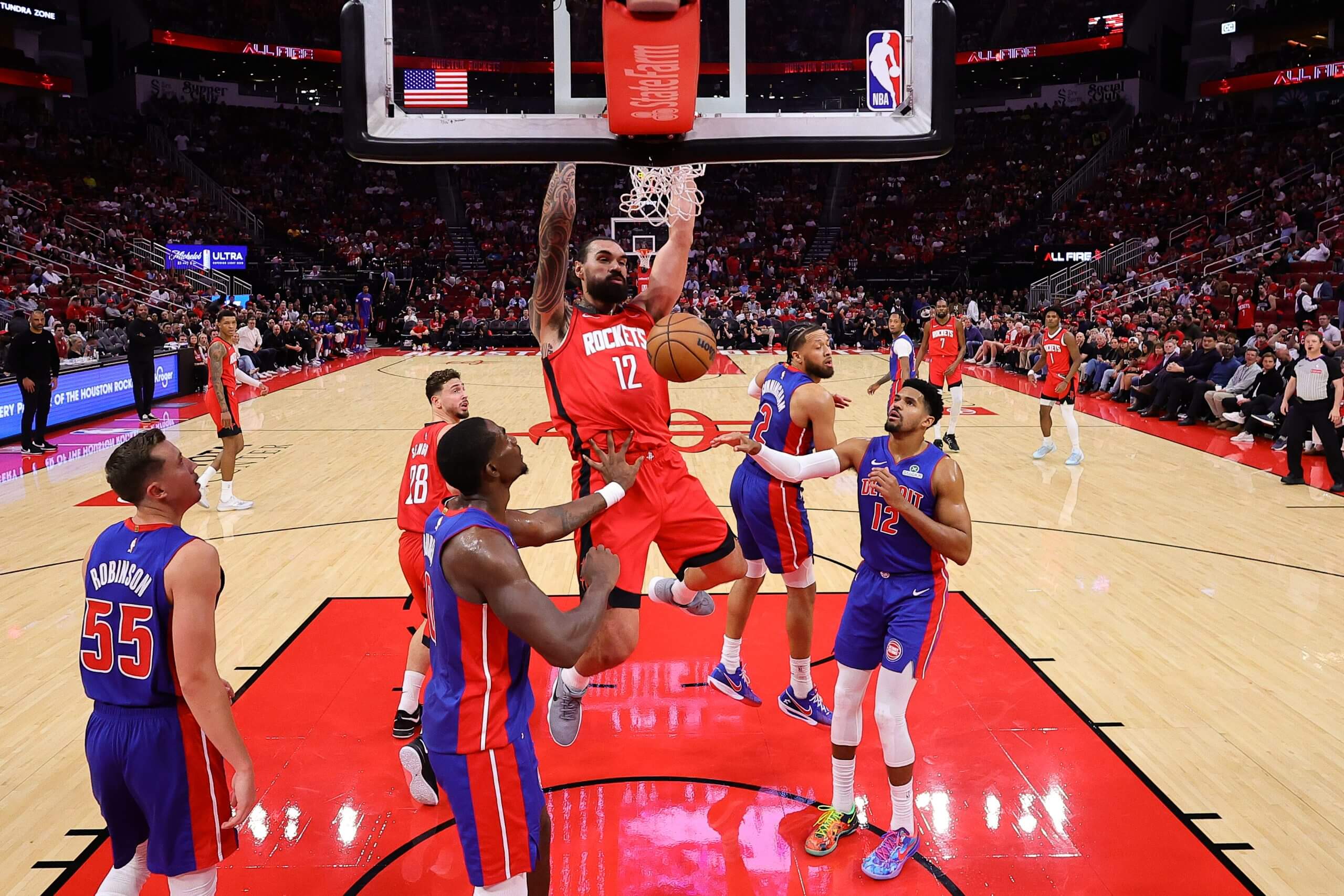
Injuries have put hurdles in front of Steven Adams, but at 32, he’s been able to bounce back and play a significant role on both ends of the court for the Houston Rockets. (Alex Slitz / Getty Images)
What really energized Adams was showing a new level of flexibility during his workouts. Building up strength in his core and in his legs. Being able to test his body’s limits in ways he couldn’t the previous day. That’s where the real progress was felt.
“Everybody gets excited about a dunk. For me, it’s more about pushing myself in the weight room to see the biggest difference,” Adams said. “It’s more like, ‘Can you get into this position? Can you get out of that position effectively?’ That’s how you can make sure you avoid certain instances when you’re at risk of reinjury. It’s about moving properly.”
Once he got past all those hurdles, it was time to prove he could still be the same player he once was.
Adams was finally cleared to get back on the court at the start of the 2024-25 season, but doctors were still very cautious to make sure he wasn’t overworking himself.
He was limited to playing five-minute stretches with no back-to-backs. If there was any concern about how his body was responding, he was held out. He didn’t play more than 20 minutes in a game until late January of last year.
In Ime Udoka’s first year as head coach in Houston, the Rockets were one of the surprise teams in the West, and Adams was one of the new veterans who helped bring a professional mindset to a locker room filled with young, unproven players.
Rather than viewing Adams as an aging veteran, Udoka understood his value to the team was greater than what he could do on the court. His presence in the locker room was pivotal, and as he got healthier, having a high-IQ player with so much experience was invaluable.
“He’s really good in his own way. He does it a little bit differently with his leadership style,” Udoka said. “He says it in his own way. It’s probably a cultural thing. He’s very direct and blunt. You love to have that from some of your veteran players. His leadership style is different, but it’s very valuable to the group.”
As doctors cleared him to play more, Udoka leaned on Adams to become more of a presence on the court. Late in the season, Udoka found a combination that intrigued him and gave his team the toughness he was looking for in the middle.
While much of the league was trending smaller and faster, the Rockets began unveiling jumbo lineups, with Adams playing alongside All-Star center Alperen Şengün. While spacing was a concern, Şengün’s elite passing skills made it easier for them to operate together, and having Adams on the floor allowed Şengün to focus on his offense and leave all the dirty work to Adams.
Those double-big lineups played a major role in Houston pushing the Golden State Warriors to seven games during an intense first-round playoff series. Although Şengün and Adams gave Houston a distinct size advantage Golden State had no answer for, it still wasn’t enough to overcome Stephen Curry and Jimmy Butler. The Rockets were eliminated after a 52-win season.
Despite the loss, Houston left the series knowing they had discovered something that could be sustainable and dangerous in the right matchup.
“We knew this was going to be our identity going into next season,” Şengün told The Athletic in November. “We want to push teams around, be tougher, more physical. Having Steven is a key part of that.”
Heading into the 2025-26 season, Adams went through a full offseason without any setbacks. He came in ready to pick up where he left off, and he was joined by a familiar face in Houston: Durant, his former Thunder teammate.
Durant’s arrival transformed Houston from a fun, up-and-coming team to one with a championship-or-bust mindset. Having reliable role players like Adams in the fold makes those aspirations even more realistic.
Houston doubled down on its commitment to Adams being part of this team’s future by signing him to a three-year, $39 million extension in June that would keep him in Houston through the 2027-28 season. No one was happier to see Adams’ new deal than the guy he’d be theoretically competing with for minutes.
“I’m the (starting) center for this team. Any other center in this league wouldn’t be happy (with the team) signing another good center,” Şengün said in December. “This summer, when we signed Steven, I was so happy. Playing with him and the way he brings the toughness on this team … he’s huge for us.”
As important as Durant has become to the Rockets’ success, Adams may be the player who best embodies this team’s identity. The Rockets take pride in being the bully on the block. They don’t want to play a pretty brand of basketball. They’d rather challenge opponents to a wrestling match with no holds barred.
More specifically, Houston has used that mentality to become one of the most dominant offensive rebounding teams the NBA has ever seen. And Adams, one of the greatest offensive rebounders in league history, leads the charge with that approach.
Per Cleaning The Glass, Adams has grabbed 21.4 percent of Houston’s missed field goals when he’s on the floor, which would be a career high. Only the New York Knicks’ Mitchell Robinson grabs a higher percentage of his own team’s misses this year.
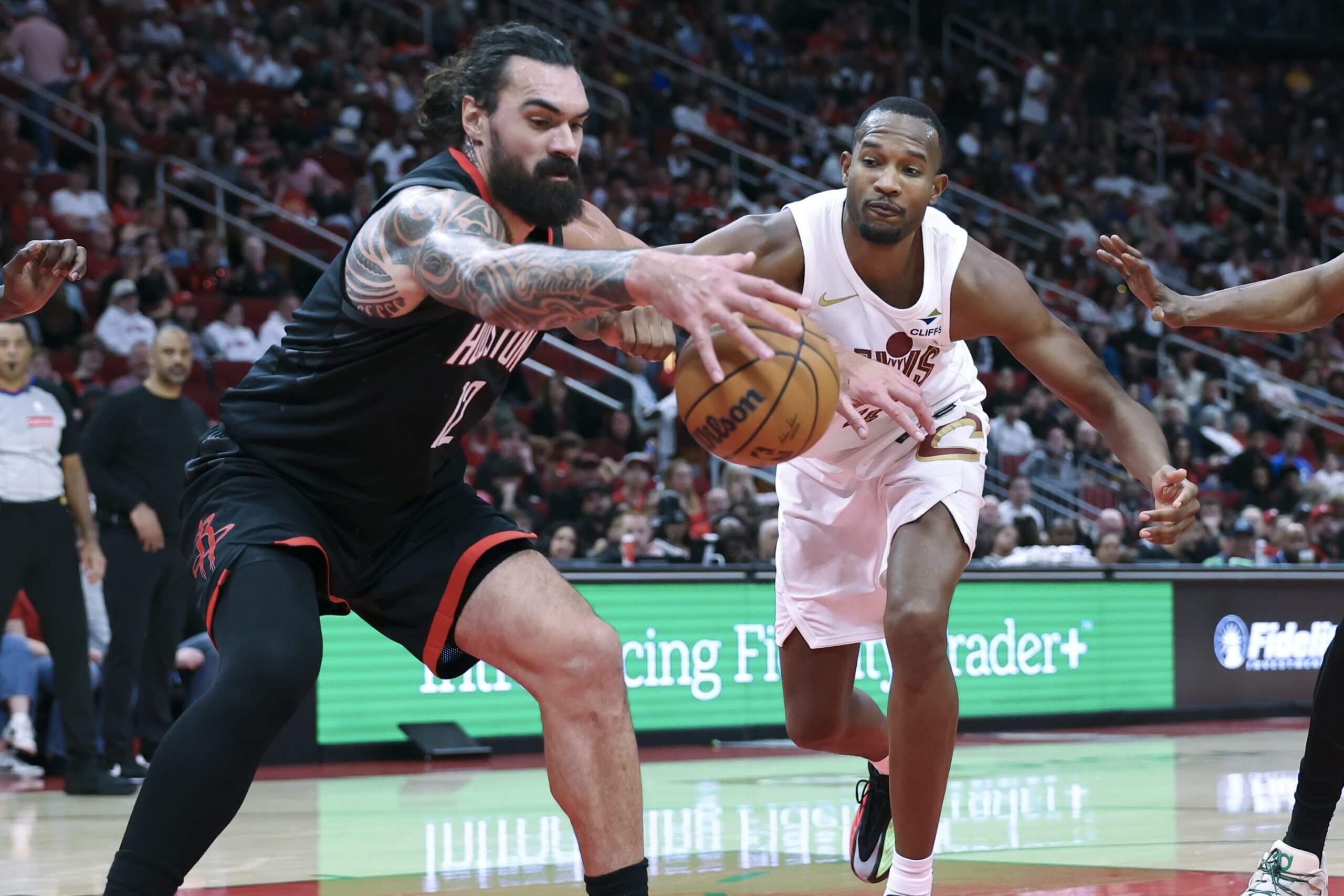
Steven Adams and Cleveland Cavaliers big Evan Mobley fight for a loose ball during a December game at Toyota Center. Adams is one of the NBA’s best offensive rebounders. (Troy Taormina/ Imagn Images)
At 32, Adams is still relentless in the paint. Udoka even described him as “spry and youthful.” With Adams leading the way, Houston leads the NBA with a 39.3 offensive rebounding percentage, per Cleaning The Glass. That’s four percentage points higher than the team with the second-highest offensive rebound rate, the Detroit Pistons.
Even when he plays in short stints, Adams can flip the tenor of a game in a few minutes by throwing people around under the basket and creating second-chance opportunities. He sets the tone with his physicality and unselfishness.
Houston tried relying on a heavy dose of jumbo lineups earlier this season, which included starting Adams and Şengün together on opening night against the defending-champion Thunder. They’ve gone away from it some in recent weeks, as Adams and Şengün have both dealt with minor injuries, but the Rockets know it’s a weapon they can use whenever they want to push around smaller teams.
Through 26 games, Adams is averaging six points and 8.5 rebounds while averaging a little more than 22 minutes per game. The Rockets will ask him to step up even more in the coming weeks, as Şengün is expected to be sidelined for 10 to 14 days with a sprained ankle.
The Rockets can lose their All-Star center and replace him with one who helps maintain the team’s identity and produces at a starter level.
“I got so much respect for Steven and the work he’s done to be a guy that’s still a valuable piece at this stage in his career,” Durant told The Athletic. “With his style of play, it ain’t easy. He’s down there fighting under the basket and throwing his body around every game. That stuff adds up after a while. But he puts the work in, and he really loves the game.
“He really loves sacrificing for the team. Those are the guys you always want next to you when you go to battle.”
With expectations higher in Houston, Adams has learned to embrace each minute on the court — because he was forced to face his basketball mortality much sooner than he expected.
But much like he’s done most of his career, Adams is willing to do whatever it takes to help his team win. Now, he has the tools to understand how to get the most from his body and keep performing at a higher level despite being in the latter stages of his career.
“It’s a never-ending thing. This is the stuff that happens to your body; you’ve got to manage it for the rest of your life,” Adams said. “But I love playing. I love being part of this team. That’s just the cost of it.”