
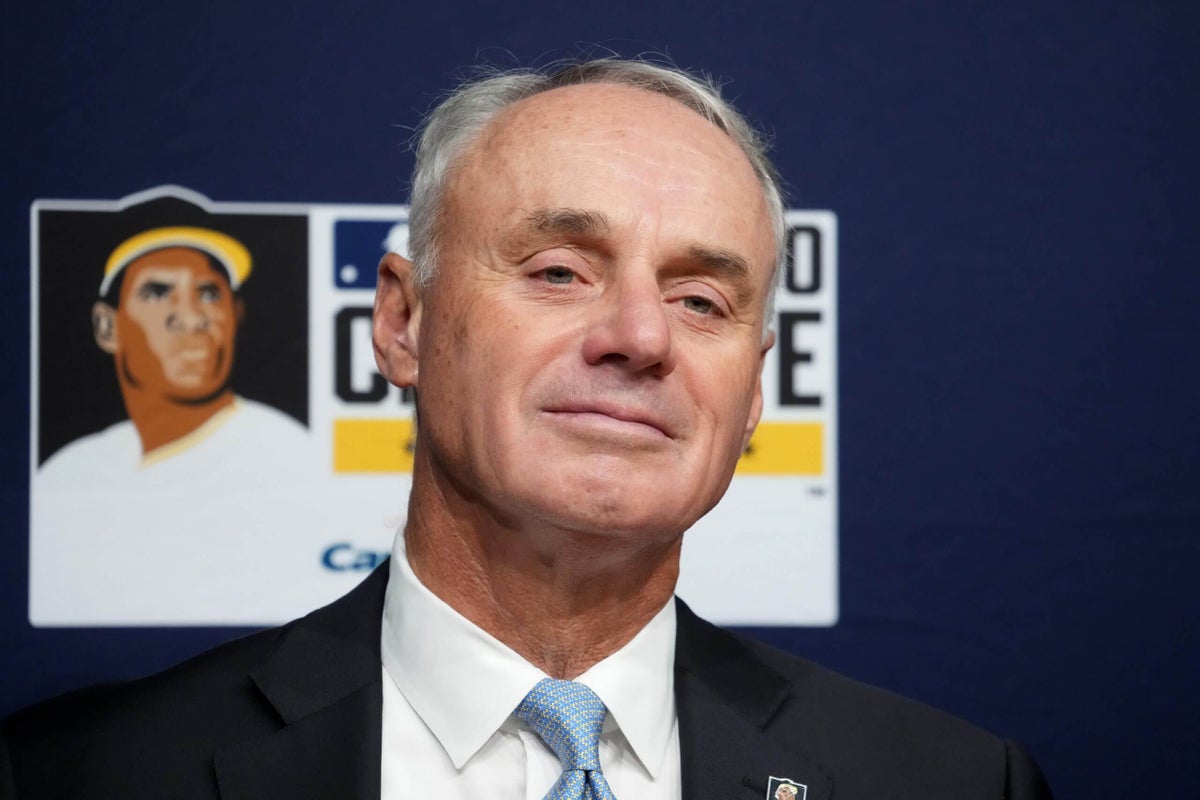
Major League Baseball commissioner Rob Manfred said he is considering major shakeups to the league’s schedule, including the possibility of a split season or an in-season competition similar to the NBA Cup.
“We’ve talked about split seasons. We’ve talked about in-season tournaments,” Manfred said Thursday in a radio interview with WFAN’s Craig Carton and Chris McMonigle. “We do understand that 162 (games) is a long pull. I think the difficulty to accomplish those sort of in-season events, you almost inevitably start talking about fewer regular-season games.
“It is a much more complicated thing in our sport than it is in other sports. Because of all of our season-long records, you’re playing around with something that people care a lot about.”
Whether players would go for such a format change would also be a key factor. The MLB Players Association declined comment.
One vision Manfred does not have at the moment: a world where the New York Mets and New York Yankees end up in the same division.
Manfred has discussed his desire to add two expansion teams for years, bringing the league total to 32 clubs. From there, he has long said he wants to realign the sport geographically into eight divisions of four teams. Manfred said on Thursday that markets that have multiple major-league teams — Chicago, New York, Los Angeles — should not have both teams in the same division.
“I think you would try to keep the two-team cities separate,” Manfred said. “That would be my thinking.”
Manfred added that much still needs to be done to get to that point. That includes awarding the new franchises, which he has said in the past he hopes to accomplish by the time his contract expires in January 2029.
“You would realign, you would do it along geographic lines, which would alleviate — could alleviate — a ton of the travel burden that’s on players. Remember, we ask our players (to play) 162 times in 186 days. … You can eliminate a lot of that travel and make it less burdensome, which would be a great thing in terms of player health and safety.”
The postseason schedule would also benefit, Manfred reiterated.
“We have those four-window days that I love,” Manfred said of the early rounds of MLB’s playoffs. “You get four baseball games in a day, it’s awesome. But when you think about the fans in the individual markets, you always end up with — because of the way we’re set up — you get Boston versus Anaheim in one of the early rounds. So you’re either going to be too late (in the day) for the fans in Boston or too early.
“If you realign geographically, you would look more like other sports, where you play up east into the World Series, and west into the World Series, and that 10 o’clock game on the (East) Coast that sometimes is a problem for us becomes a primetime game on the West Coast for the two teams that are playing. So there’s a lot of advantages to it.”
Manfred has previously said he intends to retire in January 2029. Some in the industry have wondered whether he ultimately will want to come back to such a high-paying, high-profile job. He was firm Thursday when asked about his plans.
“I’m done at the end of this contract,” Manfred said. “I’ve told them (the owners) that, and I’m gonna stick to it. I’ll be 70. It is enough. … You have a certain period of time when you have things that you want to accomplish, you take your best shot, you try to get as much done as possible. And then it’s sort of time for the next guy with his set of things. And I think that’s healthy and good for this.”
Manfred was also asked about his legacy. He took over as commissioner 11 years ago and has overseen the introduction of the pitch clock, which has been almost universally positively received. Revenues are at record highs, eclipsing $12 billion in 2024.
He has also overseen his share of scandals. The A’s left Oakland and are playing in a minor-league stadium through at least 2027. At his direction, MLB also controversially removed 40 minor-league teams from the league’s affiliated umbrella. Manfred also presided over the electronic sign-stealing era and today has to reckon with gambling issues that threaten baseball’s integrity.
“I hope that people accept the fact that while there were changes that not everybody loved, that what we did and what we continue to do, is we listen to our fans, and we tried to make the game better for our fans. Every single day, when I go to work, I try to take a minute at the beginning of the day and think: ‘Remember, it’s about the fans.’
“You can worry about the money and worry about all the issues that you got to deal with. At the end of the day, it’s about the fans. If you get the fans right, you get momentum surrounding the sport, which we are enjoying right now that you can’t buy.”
A major labor negotiation and possible reinvention of the sport’s media rights system loom before his expected departure.
“Legacy’s for dead guys,” Manfred joked. “I’m not ready to be dead yet.”