
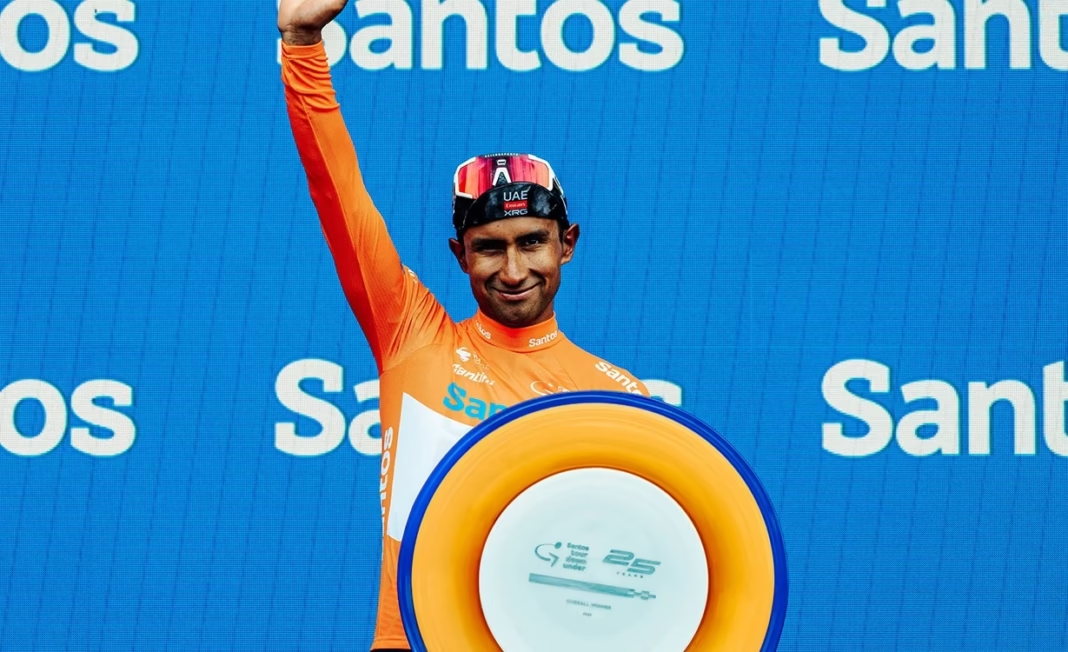
The men’s Santos Tour Down Under is not just “the first stage race of the season”. It is its own sporting ecosystem: January heat, restless winds on open roads, and a week of racing where time gaps tend to be measured in seconds rather than minutes. Riders arrive in wildly different states of readiness, teams are still settling into new combinations, and yet the racing is immediately full-blooded. That tension has shaped the race from its debut in 1999 through to the modern WorldTour era.
The honour roll reflects it. The Tour Down Under has crowned sprinters in sprint-heavy editions, puncheurs when the decisive finish rewards an uphill kick, and climbers when one signature ascent becomes the central GC battleground. The common thread is not rider type, but how the race “adds up”: bonuses, positioning, and the ability to be sharp early in the year.
It also began with a purpose beyond sport. The event was created as a South Australian showpiece, designed to pull crowds, tourism, and attention into Adelaide and the surrounding regions. That festival feel has never left. If anything, it is now part of the race’s competitive story, because atmosphere and expectation push teams to race rather than simply train.
How the Tour Down Under is usually won
The Tour Down Under is often decided by a straightforward equation that becomes brutally complex in practice.
First, time bonuses and intermediate seconds can keep the overall classification “alive” on days that look like routine sprint stages. A sprinter or fast finisher does not need a mountain to build a lead here, they need the right lead-out, the right wheel, and the right timing.
Second, the race typically offers one key uphill finish or selective hilltop finale where the strongest riders can finally force separation. The gaps are often small, but the damage is real. If you lose five to ten seconds on the decisive climb, you rarely win it back unless you can harvest bonuses elsewhere.
Third, it is January. Some riders arrive on the limit, others are still climbing into form. That unevenness amplifies every mistake. Overheat once, miss one split, get caught behind one crash, and suddenly the race is not about watts, it is about damage control.
This is why the Tour Down Under keeps producing different kinds of winners. The parcours can tilt the balance, but the race’s core identity remains constant: seconds matter, and being ready to race from day one matters more.
The race name and identity: from early backing to the Santos era
From the start, the Tour Down Under positioned itself as an Australian event with its own signature. One of the most visible expressions of that was the shift to the ochre leader’s jersey in 2006, replacing the standard yellow and giving the race a look that belonged to its landscape and culture.
The event’s public identity has also been shaped by long-running sponsor partnerships. Early editions carried prominent wine-industry backing, while the modern era has been defined by Santos as the naming rights partner. The practical impact has been stability: the race has been able to grow infrastructure, crowd engagement, and a recognisable “Tour Down Under week” that feels bigger than a single bike race.
1999-2007: the race is born, and Australia takes it personally
The Tour Down Under began in 1999 as a statement of intent, a professional race built to stand on its own rather than borrow prestige from Europe. The earliest fields blended international professionals with Australian riders who treated the week as a flagship home target, and that dynamic helped the race find its tone quickly.
The first edition delivered a home hero straight away: Stuart O’Grady won in 1999 and again in 2001, establishing the idea that Australian riders could make this race their own. That theme continued in 2002 when Michael Rogers won overall, a result that hinted at the kind of rider the Tour Down Under could reward even in sprint-leaning years: the all-rounder who avoids trouble, stays near the front, and takes time when it appears.
Those early editions also helped set the race’s long-term rhythm. With limited “big” climbs compared to European stage races, the Tour Down Under encouraged aggressive racing for seconds, and general classification outcomes often depended on consistency and timing rather than one decisive mountain stage.
By 2006, the next major story began. Simon Gerrans won the race for the first time, a breakthrough that would evolve into the Tour Down Under’s defining GC record.
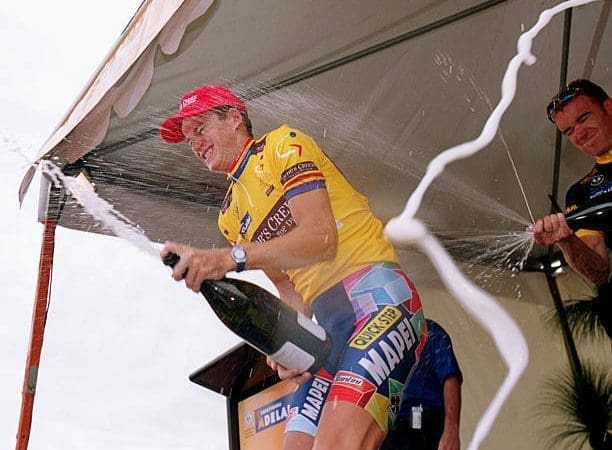 Photo Credit: Tony Lewis/Getty ImagesMichael Rogers of Australia celebrates after winning the 2002 Tour Down Under
2006: the ochre jersey arrives and the brand sharpens
The introduction of the ochre jersey in 2006 mattered because it made the race instantly identifiable. It also matched the event’s wider goal: to be more than a warm-up race, more than a southern add-on. The Tour Down Under wanted its own symbols and rituals, and ochre became the clearest one.
On the road, the mid-2000s were also the period where the race began to feel more “repeatable”. Teams arrived with clearer plans, sprint trains became more organised, and controlling stages for bonuses started to look like a deliberate strategy rather than opportunism.
2008-2011: WorldTour status, sprint power, and the global spotlight
In 2008, the Tour Down Under stepped into the top tier of the sport, becoming a WorldTour-level season opener. The immediate effect was depth. Stronger teams brought stronger line-ups, the racing tightened, and the margins that already mattered became even more decisive.
These years underlined one of the Tour Down Under’s quirks: a sprinter can win the overall. André Greipel did exactly that, taking overall victories in 2008 and 2010 and building a stage-winning record that still defines the event’s sprint history. It was the purest demonstration of the race’s structure: if you can consistently win stages and harvest bonuses, you can control the ochre jersey without needing a mountain day.
The event’s global profile surged further in 2009 with the return of Lance Armstrong to racing at the Tour Down Under, which drew extraordinary attention and pushed the race deeper into the mainstream sporting conversation.
Then came one of the most telling GC outcomes the race has ever produced. In 2011, Cameron Meyer won the Tour Down Under by two seconds. It is the perfect Tour Down Under statistic because it captures what the race often becomes in practice: six stages of racing distilled into time bonuses, positioning, and the smallest possible margin.
 Photo Credit: Getty
2012-2020: the Willunga era, repeatable GC pressure, and Australian dominance
From 2012 onwards, the modern identity of the Tour Down Under locked into place around a signature GC battleground: the Adelaide Hills and, most memorably, Willunga Hill. With a reliable, selective climb on the menu, teams had a clear pressure point to ride towards, and the race gained a yearly “centre of gravity” for general classification.
This era delivered three intertwined storylines.
Simon Gerrans builds the record
Gerrans returned to win again in 2012, 2014, and 2016, finishing with four overall titles, still the most in race history. What made those wins so Tour Down Under in character was how they were constructed: sharp racing, smart placement, and an instinct for taking seconds where they existed, not necessarily where the course looked “hardest” on paper.
Richie Porte turns Willunga into a personal narrative
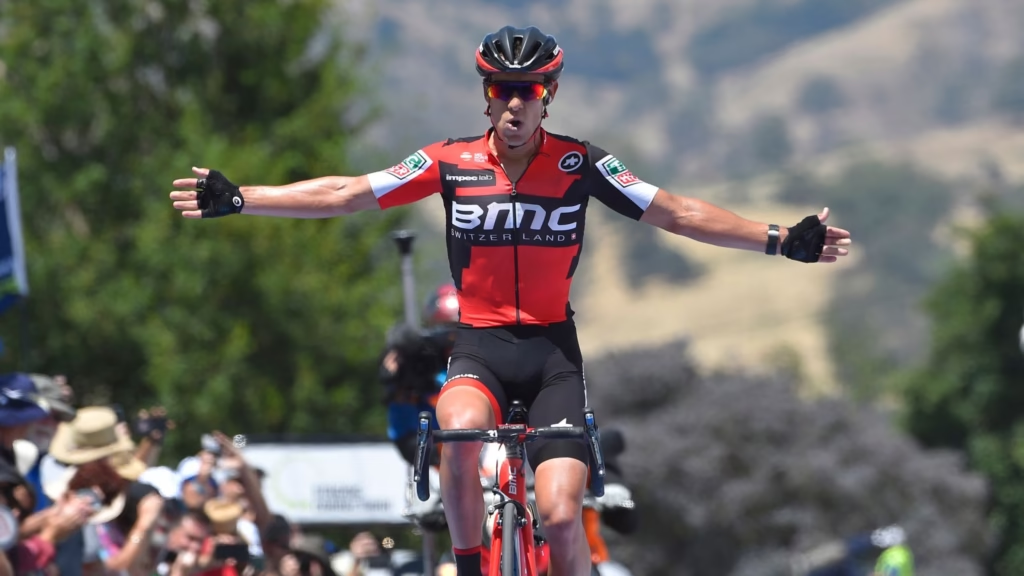
If Willunga gave the Tour Down Under a landmark, Richie Porte turned it into a yearly chapter. He won the Willunga Hill stage six consecutive times from 2014 to 2019, a streak that became part of the event’s annual storyline. It is worth being precise here, because it strengthens the myth: Porte’s run ended in 2020, when he won the overall again but the Willunga stage itself went elsewhere.
Daryl Impey does what nobody else has done
In 2018 and 2019, Daryl Impey won back-to-back overall titles and remains the only rider to successfully defend the ochre jersey. Those wins reinforced another Tour Down Under truth. You do not need to “win the mountain”. You need to manage the whole week, take bonuses when you can, and avoid losing time when the decisive moments arrive.
This period also saw the organisers lean into new signature roads and fresh finales, keeping the event from becoming predictable even as its identity strengthened.
2021-2022: the pandemic break that snapped the annual rhythm
The Tour Down Under was not held in 2021 or 2022 due to COVID-19 disruption. That mattered because this race is built on continuity. It is the sport’s yearly restart, and missing two editions broke the rhythm for teams, fans, and the event itself.
When the race returned, it was not simply a continuation. It felt like a re-opening.
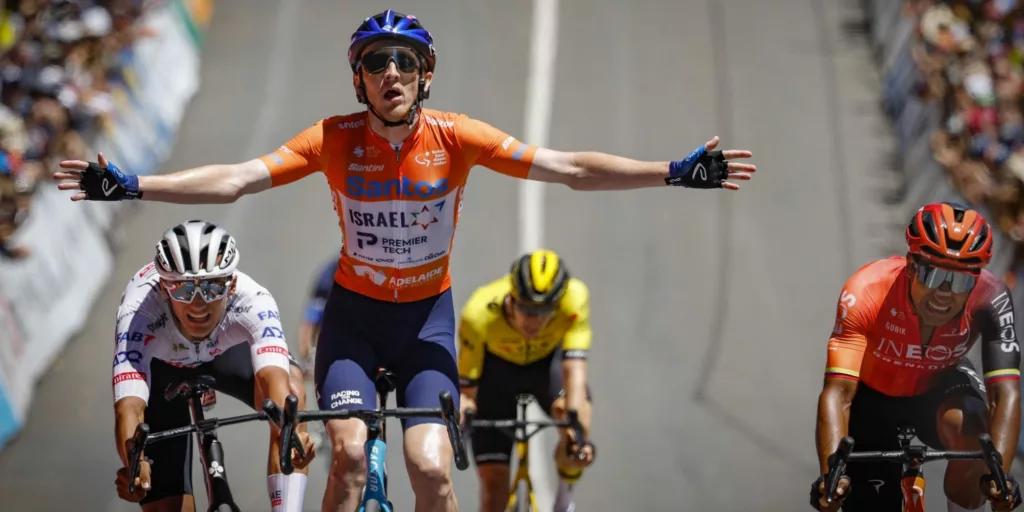 Photo Credit: Cor Vos
2023-2025: the return, modern finales, and new winners
The post-hiatus editions have had a clear feel: full WorldTour intensity, a refreshed sense of occasion, and finales that reward riders who can combine climbing strength with a fast finish after a hard effort.
2023: Jay Vine wins on return
Vine’s victory reinforced how quickly the Tour Down Under punishes hesitation. The race came back, and it came back sharp.
2024: Stephen Williams breaks through
Williams won the overall in 2024, continuing the modern pattern of punchy racing where the decisive climb is not about slow attrition, but about timing, acceleration, and tactical precision.
2025: Jhonatan Narváez takes the ochre jersey
Narváez’s 2025 win fits the modern Tour Down Under profile neatly: a rider who can survive the selective moments, position well, and still deliver speed at the end of a hard day.
Notable moments and defining snapshots
2011’s two-second GC remains the clearest example of how the Tour Down Under can be decided by bonuses and margins rather than big time gaps.
Greipel’s dominance is the reference point for the sprinter-led GC win, and for what a fully functioning sprint team can do across a week in South Australia.
Porte’s Willunga sequence (2014-2019) is the signature streak of the modern era, tied to one climb and one recurring storyline.
The 2021-2022 hiatus reshaped the event’s continuity and made the 2023 return feel like a relaunch rather than a routine restart.
Overall winners by year
YearWinnerNation1999Stuart O’GradyAustralia2000Gilles MaignanFrance2001Stuart O’GradyAustralia2002Michael RogersAustralia2003Mikel AstarlozaSpain2004Patrick JonkerAustralia2005Luis León SánchezSpain2006Simon GerransAustralia2007Martin ElmigerSwitzerland2008André GreipelGermany2009Allan DavisAustralia2010André GreipelGermany2011Cameron MeyerAustralia2012Simon GerransAustralia2013Tom-Jelte SlagterNetherlands2014Simon GerransAustralia2015Rohan DennisAustralia2016Simon GerransAustralia2017Richie PorteAustralia2018Daryl ImpeySouth Africa2019Daryl ImpeySouth Africa2020Richie PorteAustralia2021Not held–2022Not held–2023Jay VineAustralia2024Stephen WilliamsGreat Britain2025Jhonatan NarváezEcuador
Records and stats that define the Tour Down Under
Most overall wins
Simon Gerrans: 4
Two wins each: Stuart O’Grady, André Greipel, Richie Porte, Daryl Impey
Only successful title defence: Daryl Impey (2018-2019)
Most stage wins all time
André Greipel: 18
Robbie McEwen: 12
Caleb Ewan: 9
Richie Porte: 8
Next tier of prolific stage winners: Allan Davis and Simon Gerrans both sit among the race’s most successful stage hunters, while modern sprint editions have rapidly lifted newer names up the all-time list.
Most stage wins in a single edition
Only a handful of riders have managed to win four stages in one Tour Down Under, a feat that captures how sprint-heavy editions can be when the parcours and time bonuses align for a dominant fast finisher:
Robbie McEwen (2002)
André Greipel (2008)
Caleb Ewan (2017)
The Willunga streak that became a race signature
Richie Porte: six consecutive Willunga Hill stage wins (2014-2019)