
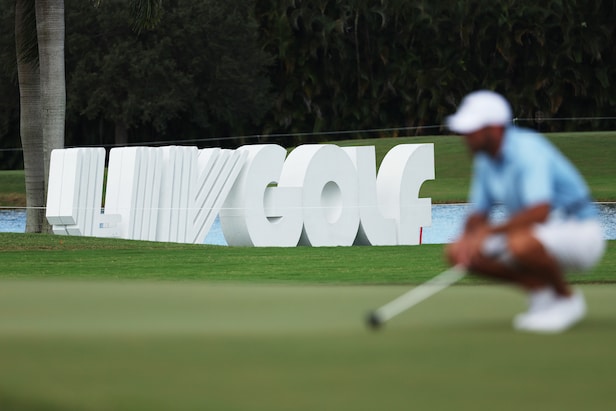
Starting today, the LIV Golf League is holding its version of Q School, dubbed LIV Golf Promotions, at Black Diamond Resort in Florida.
This is the first time in three years that it has been held in the US (or in the Western Hemisphere for that matter), and the PGA Tour responded by confirming that any of its tour members participating in this “unauthorised event” would be subject to disciplinary action.
MORE: PGA Tour members competing in LIV Golf Promotions event will face DISCIPLINARY ACTION
Additionally, non-tour members would face a blanket one-year ban from all PGA Tour-sanctioned events, including the Korn Ferry Tour and PGA Tour Americas, and any associated Monday qualifiers. In other words, it’s a pretty comprehensive penalty for any player trying to break into the professional game. The top three finishers at LIV Golf Promotions will play the 2026 LIV Golf season, and the top 10 will be exempt into the “International Series” affiliated with the Asian Tour. When you consider that the field size is 78 players, it’s a pretty big risk for an aspiring player to miss out, and know your career is basically stalled for a year.
Among the reactions to this decision, conveyed in November, the most prominent online has been something close to rage. Ryan French, among the best at covering the game’s journeymen and aspirants at Monday Morning Q, was particularly incensed, writing on X/Twitter that “The Tour and its board should be embarrassed that cutting these very players from the tour they prevent them from even having a chance to earn a living.”
Here is the full LIV Q-school field.
All of them will be suspended a minimum of a year once they hit a shot.
I understand PGA Members getting suspended if they played. But for Americas Tour players or even worse non-members being suspended is petty, ridiculous, and in talking… pic.twitter.com/4c1u9AUc6V
— Monday Q Info (@acaseofthegolf1) December 22, 2025
The distinction he and others made is that while suspending PGA Tour members who defect is justified, doing the same for developmental tour players or non-tour members amounts to firing them for taking a job interview. French’s position is that the decision is anti-competitive, possibly illegal, and overall petty and cruel to players who are just trying to make a living.
He’s obviously arguing in good faith as someone who cares about the plight of the average golfer, and taken narrowly, the sympathy play is seductive. He cites young pros like Callum Terren and Aussie Brett Drewitt, neither of whom are major players on the world golf stage, and who on paper wouldn’t materially hurt the tour if they happened to make LIV Golf. There’s a problem with that argument, in my mind though: the framing is so narrow that it ignores the entire context for why it’s happening, and who’s actually to blame.
Imagine for a moment that an army invades your country. When you fight back, a cook from the invading army accidentally gets killed. The other side milks that for all it’s worth; “he wasn’t even a soldier! He didn’t have a gun!” In a vacuum, the cook’s death would be sad and tragic. Clearly, though, you can’t discuss it, or understand it, without explaining the larger context.
The PGA Tour has been fending off an invader for a few years now. LIV has attempted a hostile takeover of professional golf, bankrolled by Saudi billions. The PGA Tour has fought back with every weapon at its disposal. A few of those, like player loyalty or pleas to morality, ended up being mostly feeble and occasionally embarrassing (the leaked rah-rah speech written for Tiger Woods, the 9/11 virtue signalling that blew up in their face at the merger). Others were more effective, in particular its institutional leverage. The tour could wield influence with the OWGR or sponsors and – most germane to this topic – they could suspend players.
In all, the PGA Tour had to scramble to provide a serious disincentive for players to go to LIV, because the incentive (namely, making insane amounts of money) was so strong. And though there were plenty of stumbles along the way, tour officials managed to create a hybrid disincentive that was potent enough to hold on to a lot of important players. They lost some big names, but the defections weren’t decisive. Arguably, the most interesting part of the whole story is that, despite starting at an enormous financial disadvantage, the PGA Tour now appears to be winning.
To get there, the tour had to protect its interests in every arena, and that includes something as apparently minor as LIV Golf Promotions. It’s true that we’re not talking about Bryson DeChambeau or Jon Rahm competing this weekend, but this is still a critical part of the LIV ecosystem. The purse is $US1.5 million, so these players who are allegedly just going for a “job interview” will be making money from LIV. The fact that it’s a Q School means it’s part of the plan to open up the LIV shop and get more OWGR points, which is bad for the PGA Tour. And it’s being held in America in part to land stronger fields, which is a direct challenge to the tour on its own turf. (Being played in North America is why, in this instance, it is considered an “unauthorised event.”) As minor as the players involved may seem, it is a fundamental part of the ongoing fight. In turn, the tour has to challenge them whenever it can with the understanding that the PIF money isn’t going away. So if you feel bad for poor Callum and Brett, turn your ire to where it belongs, on to the group that started this fight and prompted these kinds of reactions. Hell, if this tournament was back in Abu Dhabi or Riyadh, we wouldn’t even be having the conversation!
MORE: PGA Tour player suspended for participating in LIV Golf influencer event
As far as the possibility that what the PGA Tour is doing is “illegal,” that’s not the argument-ender that LIV proponents think it is. True or not, it has to be proven in court, and arguing semantics about whether it passes legal muster is, once again, missing the bigger picture. This whole fight has always been about money and power, and the legality of any of it has been a footnote precisely because the legal advantage on this (and so many other topics) tends to land on the side with the most money. Is it legal to spend $5 billion on a golf league without much return on investment, with the ultimate goal of dominating professional golf? Probably, but it’s not like any “free market” most of us have ever known in the sports world, where if you lose a lot of money, you fold. Don’t confuse “legal” with “right.” PGA Tour vs LIV has always been fought in ethical shades of grey, and telling a few journeymen there are consequences for taking a 4 percent chance of making LIV is one of the last things that should inspire outrage. (Incidentally, when it comes to the legal arguments, there’s also a pretty good one that if this fight is ever waged in a courtroom, it will benefit the tour to show that they treat Bryson DeChambeau and Callum Terren exactly the same.)
As minor as the players involved at LIV Golf Promotions may seem, it is a fundamental part of the ongoing fight. In turn, the PGA Tour has to challenge them whenever it can with the understanding that the PIF money isn’t going away.
Plus, if we really want to talk about lost playing opportunities for golf’s middle and lower class, a deeper truth has to be acknowledged. What if LIV Golf had succeeded in its original goals, secured the top 50 players in the World Ranking, and become far and away the most prominent tour in the game? The PGA Tour would be floundering at best, along with all its feeders and affiliates. So would the DP World Tour, and the only “minor leagues” in professional golf would be whatever feeder system LIV felt like propping up. It’s all hypothetical, but there’s no reason to imagine the remnants would be anywhere near as expansive as what exists today. When it comes to the journeyman golfer, there is no threat as grave as LIV’s ultimate success.
Whatever you think of the PGA Tour, the reality is that it has been under intense stress from a powerful enemy now going on a fourth year, and its survival has depended on constantly leveraging every countermeasure at its disposal. You can feel bad for the guys who get banned this week, but from a tactical perspective, the tour is smart to stay consistent – its survival depends on never blinking in the face of the PIF onslaught. It’s justified from a business perspective, and as far as the emotional argument goes, there’s an easy response: If you don’t like when playing opportunities are taken away, just wait until you see what happens if the other guys win.
– Shane Ryan writes for Golf Digest in America