
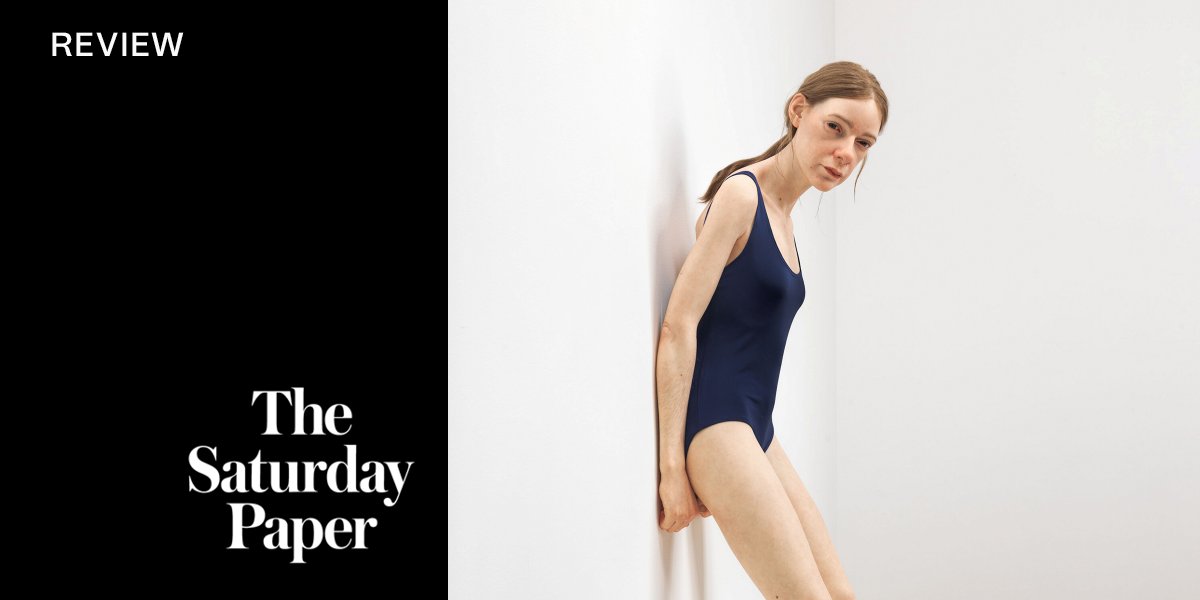
Walking in to Encounter, Ron Mueck’s retrospective at the Art Gallery of New South Wales, one is immediately confronted by a bum.
It’s a significant rump, too. The sculpture of a woman is two-and-a-half-metres tall, with its back facing the entrance to the exhibition.
The effect, and presumably the intention, is literal and explicit: a larger-than-life, cheeky invitation to not take yourself, or the idea of art, too seriously.
It’s easy to appreciate the craft of Mueck’s hyperrealism; the disquiet and uncanny effect his sculptures produce are visceral and immediate. He plays with detail and the idea of scale. Some sculptures are titanic and others are heartbreakingly miniaturised.
Mueck’s exhibitions have broken attendance records in Brazil and South Korea, and Encounter is the equal-largest collection of his work ever assembled, bringing 15 of his 50-odd sculptures to Sydney for the summer. It’s the first solo show he’s held in the city in two decades, and the two newest works here – This Little Piggy (2023-25) and Havoc (2025) – have never been seen before. Seven more of these sculptures are being shown in Australia for the first time.
The irreverence in Mueck’s work draws crowds, but it is the opaque angles of his thinking that make his work most interesting.
To walk around that bum and view the front of the sculpture – Pregnant Woman (2002) – is to be surprised with something confronting and challenging. The shock of her swollen abdomen, looming over your head, is provocative in an entirely different way.
That’s the core of Encounter and of Mueck’s work in general. With this exhibition, the Australian-born, England-based sculptor is inviting the viewer to pause, look, reflect, and look again.
Some of the works reward the viewer’s voyeurism, with attention to detail not visible to a passing glance. The figures in Young Couple (2013) are sweetly innocent – the tenderness and terror and endless yearning of a first affection. Yet that impression belies something sinister that closer inspection will reveal.
The scarred hands of Woman with Sticks (2009-10) speak to a mythological endurance present in a very quotidian, unprotected body. Man in Blankets (2000) requires the viewer to loom over the work, hovering like a parent who wants to admire their child without disturbing them.
In fact, getting in close to the works is part of the point. AGNSW is playing with fire here – the invigilators have clearly been briefed to stay alert with this one, as visitors frequently get too personal with the works.
Mike Hewson’s work in the Tank downstairs, The Key’s Under the Mat, is explicitly tactile and child-friendly. At first glance, Encounter can similarly seem almost like a haptic playground, a place for touch and smell as well as sight, yet it is the opposite.
None of Mueck’s figures are really met – one can only observe and reflect. Sometimes that attention is unwelcome. To be in the presence of Crouching Boy in the Mirror (1999-2002) or the lanky teenager of Ghost (1998/2014) is almost painful.
Standing more than two metres tall, sallow and sullen, what she clearly wants is to be left alone and unseen. Yet here she is, awkwardly exposed, as though at a public mole-mapping: subject to the judgement of viewers, their perusal or casual dismissal. It’s a cruelty to observe her.
In looking back, he’s moving forward, and there’s the hint of an exciting new direction for the sculptor.
The similarly epic Big Man (2000) presents a terrifying bulk of flesh. The giant man squats sulking in the corner of the exhibition with a childish sneer of resentment. Like Cormac McCarthy’s Judge Holden – or Lucian Freud’s painting of a naked Leigh Bowery, And the Bridegroom (1993), held in the Naala Nura building – the corporeality of this figure – colossal, meaty, hairless – is unsettling. His embodied humanity, his presence, is threatening in a way that extends into the inhuman.
Encounter invites visitors to look at something static, something private, blown up or under the microscope, and make it public and dynamic. It asks whether it’s possible to understand the interiority or life-world of another being simply by viewing it, whether perceiving is the same as experiencing, and whether the image of the thing is the same as the thing in itself.
There’s much visible and much hidden in these works. Dark Place (2018), which features a massive, entombed head as a form of portraiture, both brings us in to witness the subject’s pain while keeping us distant from ever really understanding it.
chicken/man (2019) is an absurd kitchen-table meeting between a man in his underwear and a chicken, reminiscent of Jan Švankmajer’s Food (1992). It could be a confrontation or a conversation, or simply a chance meeting of two strangers.
In some ways, Encounter is a grotesquerie of waxy flesh and faux intimacy. It could substitute for a visit to Madame Tussauds – come and take a selfie with Jackie Chan, or Princess Diana, or the King of Pop. It’s also eerily similar to a Gunther von Hagens exhibition, in which plastinated human corpses are presented sliced into cross-sections, or arranged in tableaux vivants without their skin; cords and organs and meat on display.
That hint of ghoulishness is deliberate. Depicting the reality of flesh, as in Hans Holbein the Younger’s The Body of the Dead Christ in the Tomb (1521), or Caravaggio’s The Incredulity of Saint Thomas (1601-02), blurs the line between the holy and the mundane. There’s the offer of transubstantiation here, if you want it: you, with all your sags and wrinkles and weird bits, are also something divine.
Mueck wants you to know there’s more here than the spectacle of the human body or the gimmick of perfect mimicry. The viewer is a collaborator in the work, a participant in the encounter. By placing oneself in and among these people, the visitor becomes part of the moment that Mueck has captured. By responding to it, the viewer completes the artwork.
The more recent works continue the fascination with scale and embodiment, but the practice of the work has been made visible. Skeuomorphic design elements are left in Havoc and This Little Piggy – thumbprints and chisel marks, deliberate signatures or vestigial reminders of the artifice behind their creation. In doing so, Mueck reminds the viewer there’s a process and a craft involved.
The pack of snarling dogs in Havoc resemble CAD files, with the blocky shapes and over-smooth geometry of computer-aided design. Their grey colour emulates 3D-printed resin or cement, and the cartoonish proportions and lines are evocative of Warhammer miniatures. The large scale of the work makes the figures into statues or gargoyles.
These dogs of war are arranged in a circle, without any clear provocation or sense of allegiances. Everyone’s just angry at everyone else.
This Little Piggy, by contrast, is a set of tiny maquettes depicting men doing the work of slaughtering a pig. Recalling Mueck’s background – his German parents, immigrants to Australia, were toymakers – the figures are more doll-like than the photorealistic sculptures of his earlier years.
That quality is contrasted with the violence of the models. The men are casually brutal, scrimmaging over the pig in its last moment of desperation. Havoc and Piggy are more explicitly morbid and mobile than the earlier pieces and interested in something broader and more social than the one-to-one interactions in most of Encounter.
Perhaps Mueck is angrier than when he got started, or perhaps the world is uglier now, or maybe he’s just seeing it differently. Whatever the case, the new works also display some atavism in his techniques, a gentle move towards abstraction.
When the simulation is perfect, as most of Mueck’s work is, it can seem immaculate, as though it arrived fully formed. Showing the work involved, by leaving in imperfections, puts a spotlight on the intention and effect.
It’s a new phase for Mueck, in which he seems to be less interested in exact simulacra and more in representation. In looking back, he’s moving forward, and there’s the hint of an exciting new direction for the sculptor.
Ron Mueck: Encounter is showing at the Art Gallery of New South Wales until April 12.
ARTS DIARY
EXHIBITION The Hooligans
White Rabbit Gallery, Gadigal Country/Sydney, until May 17
CIRCUS Cirque Alice
Her Majesty’s Theatre, Kaurna Yarta/Adelaide, until January 18
FESTIVAL NGV Kids Summer Festival
National Gallery of Victoria, Naarm/Melbourne, until January 16
MUSICAL Annie
Lyric Theatre, Meanjin/Brisbane, until January 31
PHOTOGRAPHY Edge of the Earth
Western Australian Museum, Whadjuk Noongar Country/Perth, until April 27
Last Chance
MUSIC Cygnet Folk Festival
melukerdee Country, Cygnet, Tasmania, until January 11
This article was first published in the print edition of The Saturday Paper on
January 10, 2026 as “Close encounters”.
For almost a decade, The Saturday Paper has published Australia’s leading writers and thinkers.
We have pursued stories that are ignored elsewhere, covering them with sensitivity and depth.
We have done this on refugee policy, on government integrity, on robo-debt, on aged care,
on climate change, on the pandemic.
All our journalism is fiercely independent. It relies on the support of readers.
By subscribing to The Saturday Paper, you are ensuring that we can continue to produce essential,
issue-defining coverage, to dig out stories that take time, to doggedly hold to account
politicians and the political class.
There are very few titles that have the freedom and the space to produce journalism like this.
In a country with a concentration of media ownership unlike anything else in the world,
it is vitally important. Your subscription helps make it possible.
Send this article to a friend for free.
Share this subscriber exclusive article with a friend or family member using share credits.

Used 1 of … credits
use share credits to share this article with friend or family.
You’ve shared all of your credits for this month. They will refresh on February 1. If you would like to share more, you can buy a gift subscription for a friend.
SHARE WITH A FRIEND
? CREDITS REMAIN
SHARE WITH A SUBSCRIBER
UNLIMITED
Loading…
Fashion
Westwood | Kawakubo at NGV International
Lucianne Tonti
Two of the most influential fashion designers of the 20th century are finally brought together in an NGV show that compares their anarchic visions of dressing women.