
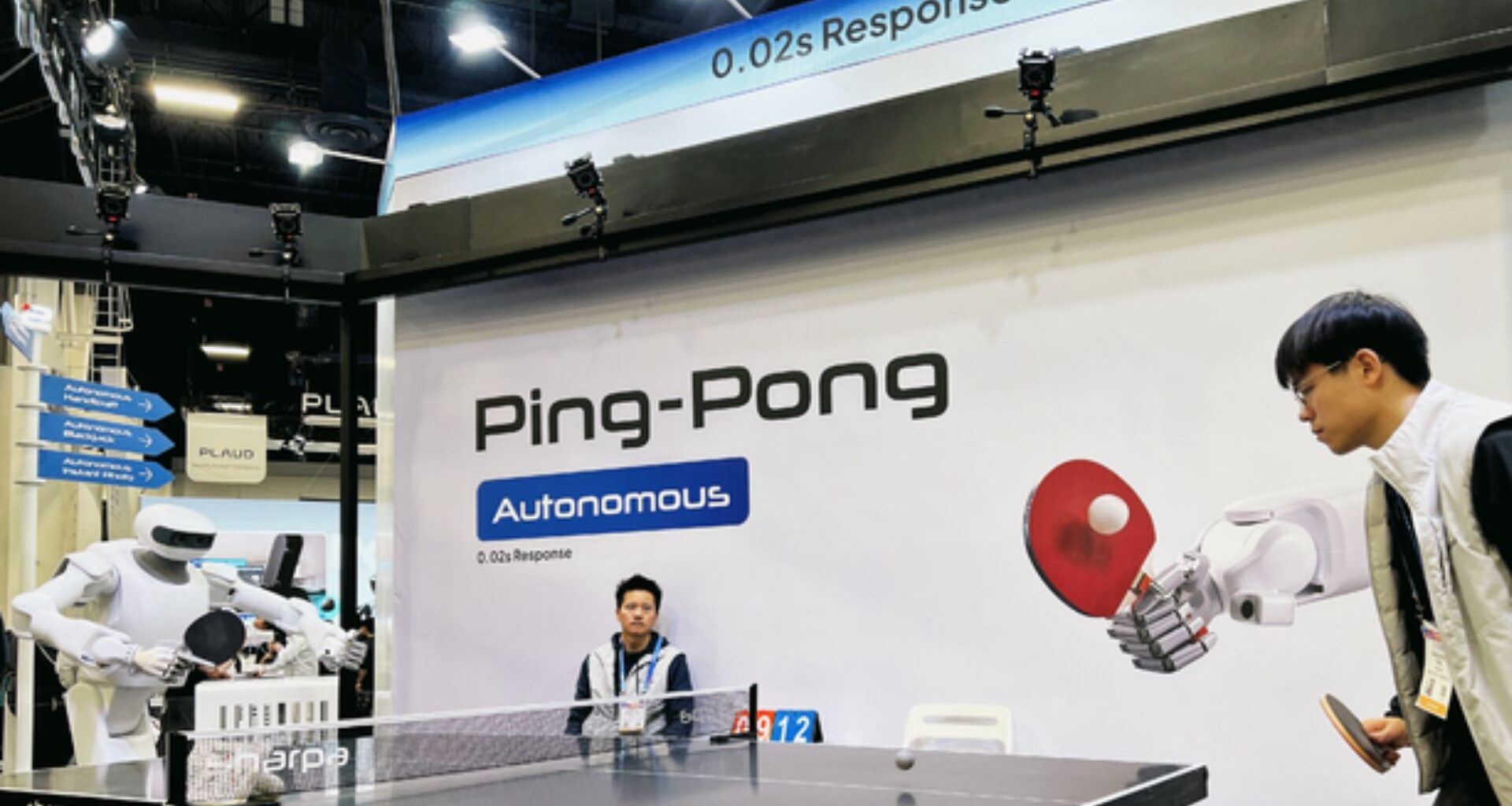
At CES 2026, Singapore-based company Sharpa has redefined general-purpose robotics with the debut of its first autonomous humanoid.
Named North, the robot has been designed to showcase that autonomous machines can now match human dexterity.
Interestingly, this full-body humanoid can build a paper windmill and win a ping-pong rally autonomously.
In contrast to robots bound by preset code, North is built for instantaneous response. It features a 0.02-second reaction time, enabling it to process and respond to environmental changes almost the moment they occur.
This speed allows it to quickly track and intercept objects, such as ping-pong balls, in real time.
At CES 2026, North completed a series of fully autonomous live ping-pong trials that required no human intervention.
“As long as the robot detects the ball coming toward it, it can prepare its movement. The system reacts in about 0.02 seconds, so it knows where the ball will go. It moves there accordingly during the game,” Bowei Liu, a representative from Sharpa, told Interesting Engineering at the CES show.
Human-scale dexterity
The speed allows North to calculate trajectories in real time, moving its wheeled base and torso to the ball exactly where it needs to be.
The centerpiece of this mechanical marvel is the Sharpa Wave, a mass-produced dexterous hand that mirrors human anatomy at a 1:1 scale.
The robotic hand stands out for its high level of dexterity, with 22 active degrees of freedom that enable fluid, lifelike movement.
But it’s the fingertips that change the game.
Each finger is packed with over 1,000 tactile pixels, providing sub-millimeter resolution.
This allows North to perform tasks that have long been challenging for other robots, such as extracting a single card from a fresh deck or assembling a delicate paper windmill in a 30-step sequence.
The future is general-purpose
Beyond its hand dexterity, the robot features an extensive upper-body range of motion — stretching from the neck to the waist — enabling it to mimic human-like fluidity.
This physical agility is backed by a proprietary neural network and advanced optimization, enabling the robot to excel at “contact-rich” tasks.
The company says the true breakthrough of North lies in its endurance. It maintains high precision over “long-horizon tasks,” shifting the focus from flashy stunts to dependable, real-world utility.
“Many robots you see today are designed for only one task. Some are built to play ping pong. They usually only have two arms and don’t even have hands, and their intelligence is often limited to that single activity,” Liu explained to IE.
“This robot is different because it’s a full-stack humanoid platform. It has the software and control system needed to learn different tasks. It’s not limited to ping pong — it can be trained to do other activities as well,” Liu added.
At CES 2026, North also captured photos with 2 mm precision and used multimodal reasoning to deal cards in real time via vision and language processing.
Most notably, North completed a 30+ step handicraft sequence to build a paper windmill, maintaining flawless hand-eye-tactile coordination throughout.
“The windmill demo represents one of the longest continuous autonomous manipulation sequences publicly demonstrated by a robot to date,” the company stated.
Ultimately, Sharpa aims to transition these general-purpose capabilities into everyday life, empowering people to reach their full potential by offloading the burden of monotonous tasks.
For ongoing news, in-depth reporting, and key developments from CES 2026, read the IE team’s coverage here.