
By Chad Jennings, Andy McCullough and Sam Blum
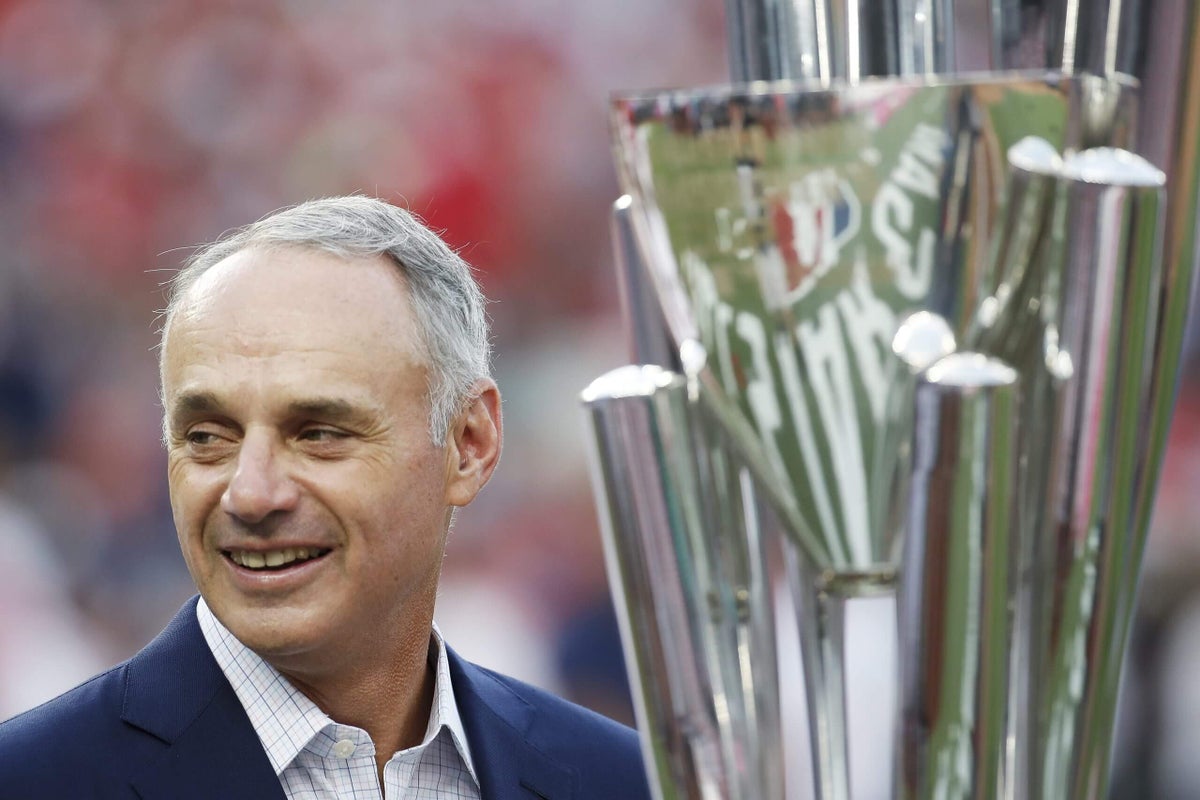
Baseball commissioner Rob Manfred has acknowledged for more than a decade that MLB could alter the relentless 162-game schedule that is both defining and draining for the sport and its players. Manfred floated the possibility again this week, saying in a radio interview that the league has “talked about” splitting the season, adding an in-season tournament, and potentially cutting back on regular-season games.
But such changes have always been more easily said than done because any change to the schedule — especially the addition of an NBA Cup-style in-season tournament — changes the logistics, bargaining, and tradition of baseball itself.
“It is a much more complicated thing in our sport than it is in other sports,” Manfred said.
Since 1962, that 162-game schedule has been fundamental to Major League Baseball. The players call it a “grind,” but it’s affected everything from roster sizes to player salaries to the legitimacy of a home run record. Baseball has been open lately to making out-of-the-box changes, some of which have proven more popular and effective than many naysayers expected, but a change to the schedule would be an even bigger swing than extra-inning ghost runners or an automated strike zone.
Baseball is steeped in statistical tradition that, if trifled with, could impact what the vast majority of its fans still view as important. Changing the number of games played in the season, adding a tournament, or creating any scenario where individual statistics over 162 games are viewed differently than they are now could be a dangerous game.
What would an in-season tournament actually look like?
In-season tournaments are common in soccer, but international soccer schedules have little in common with Major League Baseball’s daily marathon. The more apt and recent model for an in-season tournament is surely the NBA Cup, which was introduced in 2023 and starts with essentially a regular-season round-robin from which eight teams advance to a week-long, single-elimination tournament. It’s formatted so that all but the championship game count in the regular season standings, and teams that don’t advance to the knockout round play non-tournament games to keep the schedules even.
Maybe baseball could pull off something similar, especially if a tournament were added within a 32-team expansion that creates eight, four-team divisions, from which some sort of divisional play-in format could fit a typical regular season schedule while creating an eight-team tournament field.
But then what?
Baseball typically plays series, not single games. And would an in-season tournament happen at the All-Star break? In place of the All-Star break? In addition to the All-Star break? Players surely would welcome an additional mid-season pause to rest and refresh, but expanded playoffs already push the World Series into November. A second break could send Game 7 even further into the chill of fall.
“I think the difficulty to accomplish those sort of in-season events,” Manfred said in his interview on WFAN’s The Carton Show, “you almost inevitably start talking about fewer regular-season games.”
Players have long advocated for a shorter schedule — Anthony Rendon, somewhat infamously, said in 2024, “We gotta shorten this bad boy up” — but fewer games changes everything.
Teams would generate less revenue, which could trickle down to lower salaries. A shorter schedule could also reduce the need for extra players, potentially leading to shorter rosters or fewer call-up opportunities. Easing baseball’s grind could inadvertently take away a bit of its charm.
And how many meaningful tournaments can the league support? The World Baseball Classic seems to be gaining steam as a marquee event, and MLB is at least considering sending its players to the 2028 Olympics. Is an MLB Cup worthwhile if it’s the fourth-most prestigious event on the baseball calendar?
Why would they go through with it?
Given the past half-decade of labor strife — the contentious negotiations over the Covid-shortened 2020 season, the lockout after the 2021 season and the prospect of another lockout after this coming season — what would behoove Major League Baseball and the MLBPA to collaborate on establishing this tournament?
Well, money.
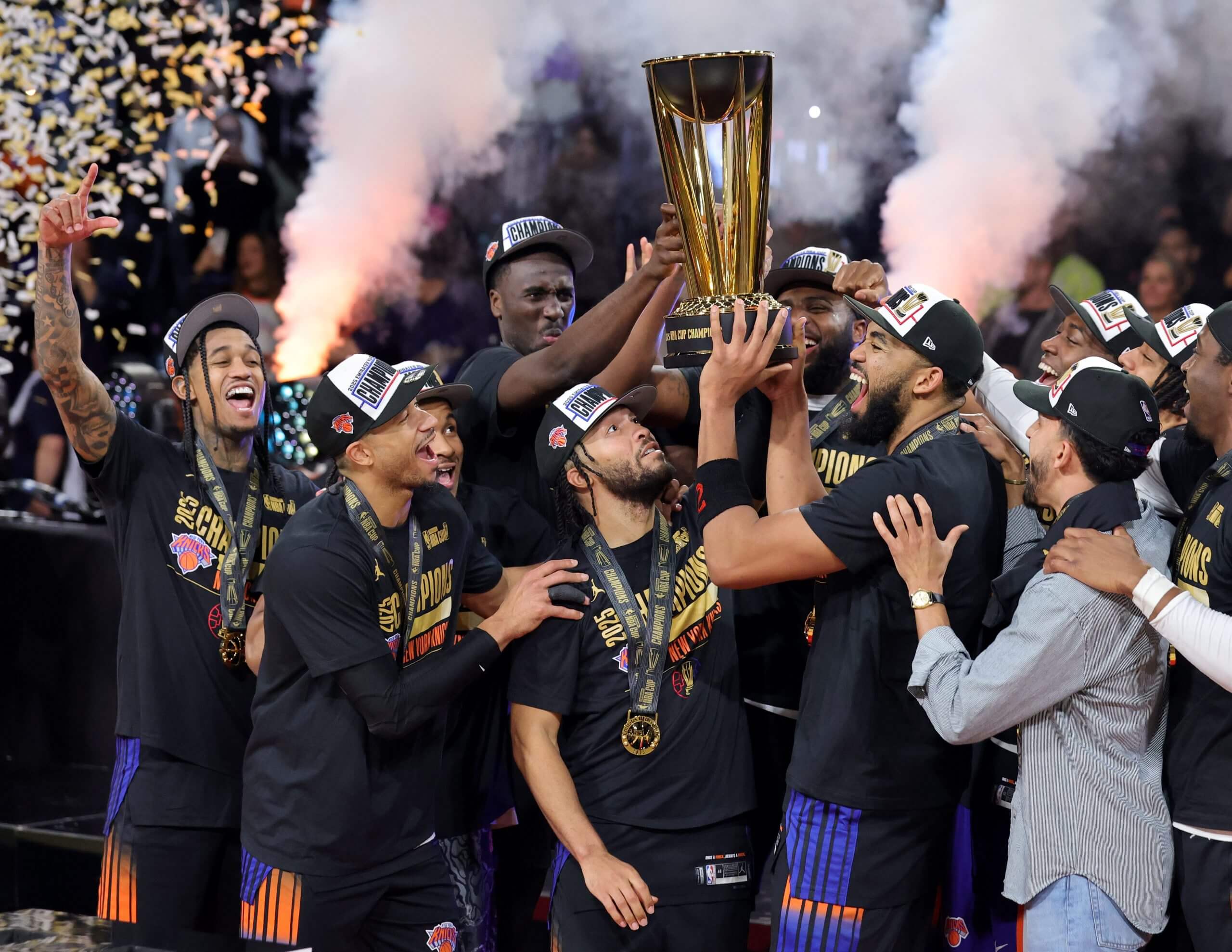
The New York Knicks captured the NBA Cup on Dec. 16 with a 124-113 win over the San Antonio Spurs in Las Vegas. (Ethan Miller / Getty Images)
The NBA used its in-season tournament to enhance its new $77 billion media rights deal and found a lucrative sponsorship with Emirates. To entice the players, the NBA Cup features cash bonuses: $530,933 per player for the victors of the most recent edition, with small prizes for those who also advanced in the tournament. Those sums would likely be diluted, given baseball teams carry 26 players and NBA teams carry up to 15, but money is still money. And MLB would not mind adding another potential jewel to its broadcast package, especially with its national television contracts set to expire after the 2028 season.
The NBA hashed all of this out while negotiating its collective bargaining agreement in 2023. For baseball, therein lies some of the rub. The owners and the MLBPA do not exactly have a chummy working relationship these days. Consider how MLBPA chief Tony Clark reacted to Manfred floating the concept of a free-agent deadline during that same WFAN interview: Clark said blowing up the sport’s current system would be “a self-defeating calculation of massive proportions.” Given the stakes of the upcoming labor negotiations, in which some of the owners are once again expected to push for a salary cap, it may be difficult to deal with all the logistical entanglements of setting up an in-season tournament.
Then again, the two sides can find common ground when there is money to be made. One new quirk that came out of the CBA struck during the 2021-22 lockout was the expansion of the postseason field to 12 teams. The impetus, of course, was the prospect of added revenue through television contracts. So it can be done.
What stands in the way?
Nobody likes change. That’s a societal constant, transcendent far beyond sports.
In years past, MLB commissioner Rob Manfred suggested changes that initially drew the vast ire of its fans and teams, but were ultimately viewed as success stories post-implementation.
Banning the shift, introducing a pitch clock, adding a free runner in extra innings — all changes that the most entrenched traditionalists argued would materially alter the game. All changes that those same people now largely accept, and in many cases, appreciate.
Perhaps an in-season tournament, and the changes that come along with it, will follow that same trajectory: One of intense skepticism, followed by a gradual acceptance.
But if this potential change gains any traction, the league could be playing with fire in a way that it hasn’t previously.
Baseball is defined by those 162 games. It’s about the drumbeat and personality that each series takes on. An in-season tournament almost by definition impacts the importance of the 162-game schedule, and all that comes with it.
Last season, fans watched in awe as Cal Raleigh chased a 60-home run season, battling Aaron Judge in a tit-for-tat MVP race. The year before that, Shohei Ohtani’s 50-50 pursuit created must-see television.
“Because of all of our season-long records, you’re playing around with something that people care a lot about,” Manfred said on WFAN.
MLB clearly wants to replicate the early success the NBA has had in its first three seasons of an in-season tournament. The NBA has seen revenue growth and increased fan interest.
But baseball is not basketball.
In the NBA, there are only a small handful of teams capable of winning a championship — and teams that get the final play-in spots often find themselves in a disadvantageous organizational limbo.
Just two seasons ago, the Dallas Mavericks tanked the final two games of the season, despite being on the doorstep of the final play-in spot, to improve draft position.
When was the last time an MLB team on the cusp of the postseason tried to lose? It simply doesn’t happen. The lottery ticket of entry to the playoffs is far more valuable in baseball, where there are fewer playoff teams and a greater potential for a postseason upset.
Yes, playing 162 games inherently means that each game carries less meaning. But the entire 162-game schedule is of far greater significance than in the NBA, where 20 of the 30 teams will play games beyond the regular season. And where being good enough to make the postseason does not necessarily give you any chance to win a championship.
It’s easy to clump this in as just an extension of the moves Manfred has already introduced. But this is a different animal, with implications for the traditionalism that has long been part of baseball’s lasting appeal.
For better or worse, nobody likes change. Manfred has bucked that maxim before, with success. It remains to be seen if he can do so again.