
Sometimes it takes a discriminating eye to see things as they really are.
So goes the thinking behind Pandora, a NASA mission whose purpose bears on one of the biggest mysteries of all: Is there life out there?
Once a matter of pure speculation, the question of life on other worlds has become serious science, in large part because over the past 30 years technology has enabled the detection of thousands of exoplanets – planets that orbit distant suns far outside our solar system.
Yet even as the discoveries mount, astronomers face a barrier that makes it difficult to say with confidence what these distant worlds are like, including whether or not they might harbour life.
Even the mighty James Webb Space Telescope, the largest astronomical instrument every launched, can’t avoid the problem. Instead, Webb has revealed more plainly than ever that the data we acquire about other planets is often hard to separate from the busy and unpredictable flickering of the stars those planet orbit.
“Every single target you look at now, you can tell that there’s some contamination going on,” said Jason Rowe, an exoplanet specialist and professor at Bishop’s University in Sherbrooke, Que., who is a member of Pandora’s science team.
At Bishop’s University, professor Jason Rowe works on the Pandora science team with Kelsey Hoffman, who is also affiliated with the SETI Institute in California.Andrej Ivanov/The Globe and Mail
Annoyingly for astronomers, one piece of information that can be affected in this way is whether or not a planet’s atmosphere contains water – a detail that is especially pertinent if the idea is to understand where else life may reside in the galaxy. It’s for this reason that Dr. Rowe has spent the past five years helping bring Pandora to life.
Now the satellite is stowed aboard a SpaceX rocket that could lift off as early as this Sunday. The same launch has multiple customers, including Kepler Communications Inc. of Toronto, which is set to deploy 10 small satellites that will function like a distributed computer system in orbit.
But from an astronomical perspective, Pandora is the main event. If all goes well, researchers involved with the mission hope it will usher in a new era – one in which the atmospheric conditions on several exoplanets can be studied in a meaningful way.
“This is the fun part,” said Dr. Rowe.
Pandora is not large, as telescopes go, but the microwave oven-sized machine has its advantages.
NASA’s Goddard Space Flight Center/Conceptual Image Lab / Animator: Jonathan North (eMITS)
Given the magnitude of its task, Pandora is a surprisingly small spacecraft. In orbit it will essentially operate as a solar-powered telescope that is not much larger than a microwave oven. Unlike Webb’s mammoth 6.5-metre eye on the sky, Pandora’s main mirror is only 45 centimetres across.
The size is deceiving, because Pandora is like a miniature Sherlock Holmes, equipped to perceive its targets in a way that no other exoplanet mission can.
It takes a double-barrelled approach, using its two different instruments to observe the same object at two different wavelengths – visible light and infrared. When the information is combined it can help distinguish real data coming from the atmosphere of an exoplanet from unrelated phenomena that may be occurring the surface of its parent star.
The idea is straightforward, but the challenge lies in making it work in a small satellite that relies on off-the-shelf parts and has a budget of US$20-million – a pittance for space science missions.
“There were a lot of doubters early on,” said Elisa Quintana, a researcher a NASA’s Goddard Space Flight Center in Greenbelt, Md., and the mission’s principal investigator.
“These small missions, they’re high risk. There’s a lot that can happen along the way so for us to still be here, on the launch pad, it’s thrilling.”
Once in orbit, Pandora will set about staring at its target list of stars with known exoplanets, following a complex schedule that ensures it spends as much time as possible drilling down to get clean data. But it will not observe any exoplanets directly – they are too faint for that.
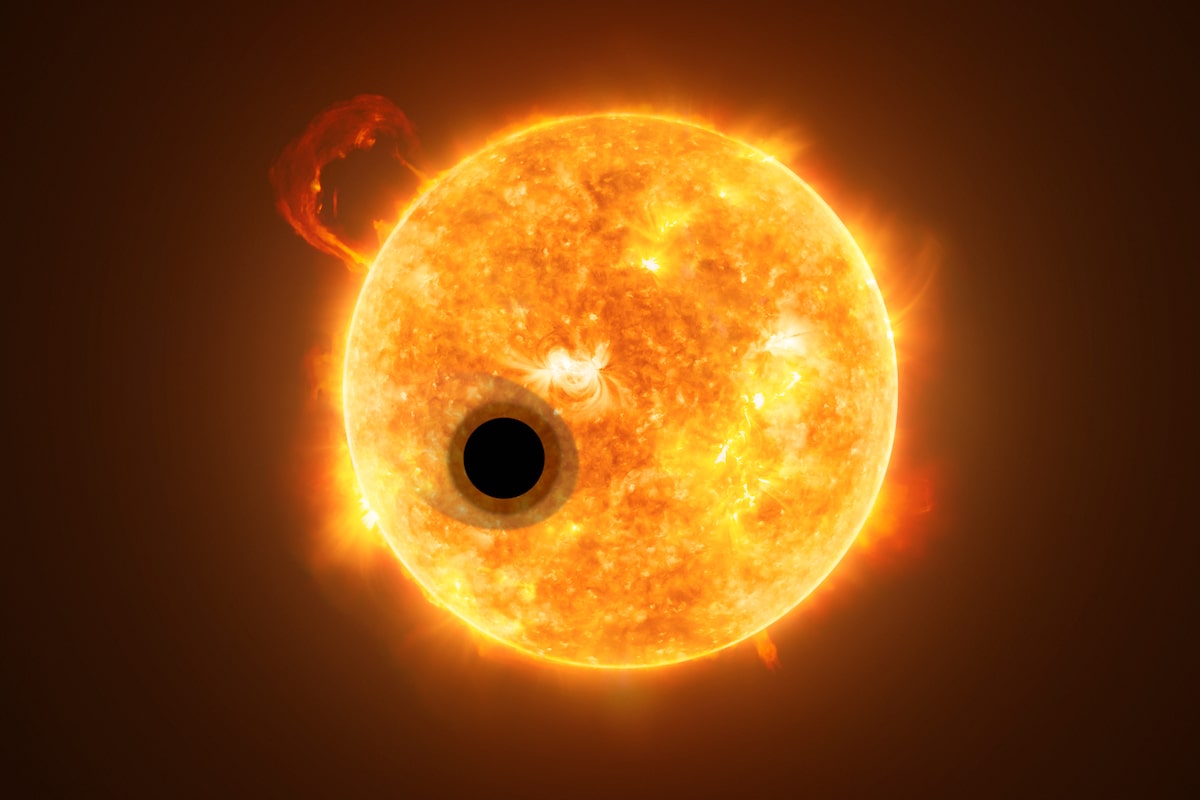
Instead, exoplanets are spotted when they cross in front of the stars they orbit. This event is known as a transit. It causes the star’s overall brightness to dim by a small amount, but because it happens repeatedly, like clockwork each time the planet completes another orbit, the planet’s presence can be deduced.
The degree to which the star is dimmed tells astronomers how large the planet is, while the amount by which the star is tugged by the planet’s gravity – obtained through a separate measurement – reveals its mass.
In this way, astronomers have discovered planets that are small and dense enough to be rocky, such as Earth, others that are large and gaseous, such as Jupiter, and others that fall somewhere in between, including some that consist largely of water.
The key to learning more lies in studying the atmospheres of exoplanets. If there is an atmosphere, then some of the star’s light will filter through it on the way to the telescope. The chemical signature of the planet is imprinted in the signal and can be analyzed when the star’s light is spread out into a spectrum of different wavelengths, like a rainbow.
The wrinkle with this strategy is that stars do not shine with a constant light. Like our sun – and often in a more volatile way – they have explosive flares, bright patches and dark spots that rotate in and out of view. The changing properties of these features can make it difficult to interpret the spectrum of an exoplanet and creates uncertainty about what is real.
K2-18b caused a stir after a now-discredited report suggested molecules on the planet indicated alien life.University of Cambridge/AFP via Getty Images
Last year offered a lesson in the consequences of such uncertainties when a team from the University of Cambridge announced they had detected a possible sign of life on the exoplanet K2-18b. This came in the form of sulphur-based molecules the team said they had discerned in the spectrum of the planet’s atmosphere. On Earth, the same molecules are produced by plankton in the world’s oceans.
Before long, other scientists found flaws in the team’s analysis and greeted their conclusions with intense skepticism. Yet the story still made headlines. The episode is likely to be repeated unless data that speaks to presence of water or the possibility of life on another planet is unambiguous – just as Pandora is uniquely equipped to provide.
“Pandora is our best test of whether this problem can truly be solved,” said Sara Seager, an MIT professor and exoplanet scientist who is moving her research program to the University of Toronto later this year.
Dr. Seager noted that Pandora will also offer a different kind of demonstration, about how small missions can make a big impact if they are well-designed.
Dr. Rowe said that the example is a good one for Canada’s space program, because it illustrates how to do ground-breaking science on a limited budget.
“We need these quick, nimble programs,” he said. “As much as I like working with my American colleagues, we’re at a state – we see it in the news all the time – where Canada has to grow its own legs and learn to walk.”
Andrej Ivanov/The Globe and Mail
Space is the place: More from The Globe and Mail
2025’s science quiz is as lit as the Trifid Nebula, but closer to home
UBC researchers delve into mysteries of galaxy formation
Astronaut Jeremy Hansen explains why Canada is moonward bound
Rocket launch proves to be a milestone for budding Nova Scotia spaceport