
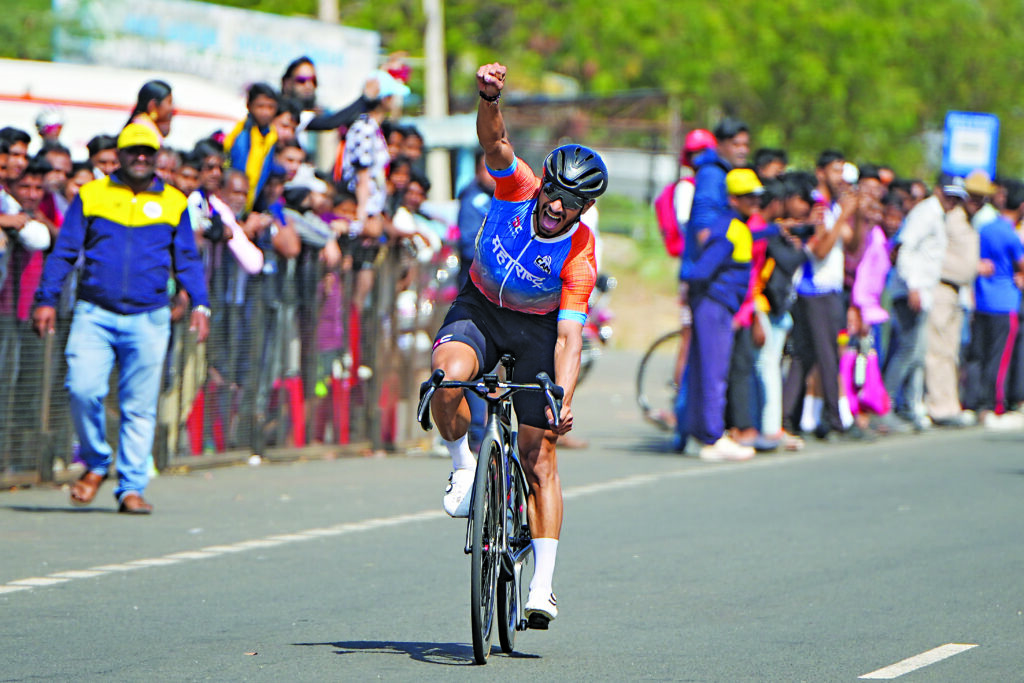
Pune hosting the Pune Grand Tour, a Union Cycliste Internationale (UCI) Class 2.2 status race, is one of the best things to have happened for Indian cyclists, says Surya Thathu, a cyclist from Pimpri-Chinchwad and a member of the Indian team set to participate in the Pune Grand Tour to be held from January 19 to 23. Thathu wholeheartedly praised the Cycling Federation of India (CFI) and the Cycling Association of Maharashtra (CAM) for organising such a prestigious event. Calling it a massive platform, he said Indian cyclists had never imagined getting such an opportunity on home soil. Speaking over the phone from the Netaji Subhas National Institute of Sports in Patiala, where he is training with fellow team members, Thathu shared that the national cycling camp began on December 25 and will continue until January 16, 2026.
A skater in his early years, Thathu took up cycling with the aim of improving his endurance. As he began cycling, he found it enjoyable, especially the thrill of covering long distances. After competing in several school-level cycling tournaments and winning medals, his confidence grew, prompting him to take the sport seriously from 2017. Thathu, who prefers road events over track cycling, achieved a major milestone in 2018 by winning a bronze medal in the 100 km mass start event at the Inter-University Road Cycling Championship.
Until 2023, Thathu trained independently and continued to win medals, but he felt the need for a more structured programme and professional coaching to reach the next level. Acknowledging the ups and downs in his career, the 27-year-old decided it was time to switch to a systematic training approach. From 2023 onwards, he began training under former international cyclist Arvind Panwar, which marked a turning point in his career.
The year 2024 proved to be a significant learning phase for Thathu as he competed in the Asian Road Cycling Championships in Kazakhstan and the Amateurs Flanders World Championship. Recalling the Asian Championships, he said the Indian team could not finish the 150 km race, managing to battle till 120 km on a very demanding course. He observed that cyclists from other nations adopt a far more aggressive racing pattern, marked by continuous attacks and sustained high intensity, keeping riders in the anaerobic zone for longer durations—something Indian cyclists are still adapting to.
Thathu explained that the Indian racing system traditionally focuses on a limited group of lead riders, whereas international racing is more aggressive, with every rider being chased. However, he noted that Indian cyclists have begun evolving their approach, with CFI placing greater emphasis on providing international exposure through overseas tours. In cycling terms, he clarified that “aggressive cycling” refers to both an assertive riding style and an aggressive bike setup, which enhances aerodynamics, power transfer and speed, though it demands strong core strength, flexibility and precise bike fitting to prevent injuries.
With the Pune Grand Tour just days away, Thathu said the Indian team’s mindset is to deliver their best across all stages. Emphasising teamwork over individual performance, he noted that certain stages feature tough ghats and steep gradients, where climbers in the team will be supported by others riding in a bunch. The team’s collective goal, he concluded, is to secure at least one podium finish at the Pune Grand Tour.