
New multi-year observations from the NASA/ESA Hubble Space Telescope and ground-based telescopes at the Fred Lawrence Whipple Observatory and Roque de Los Muchachos Observatory reveal how a faint companion star, dubbed Siwarha, carves a trail through Betelgeuse’s extended atmosphere, shedding light on decades-old stellar puzzles and advancing understanding of massive star evolution.
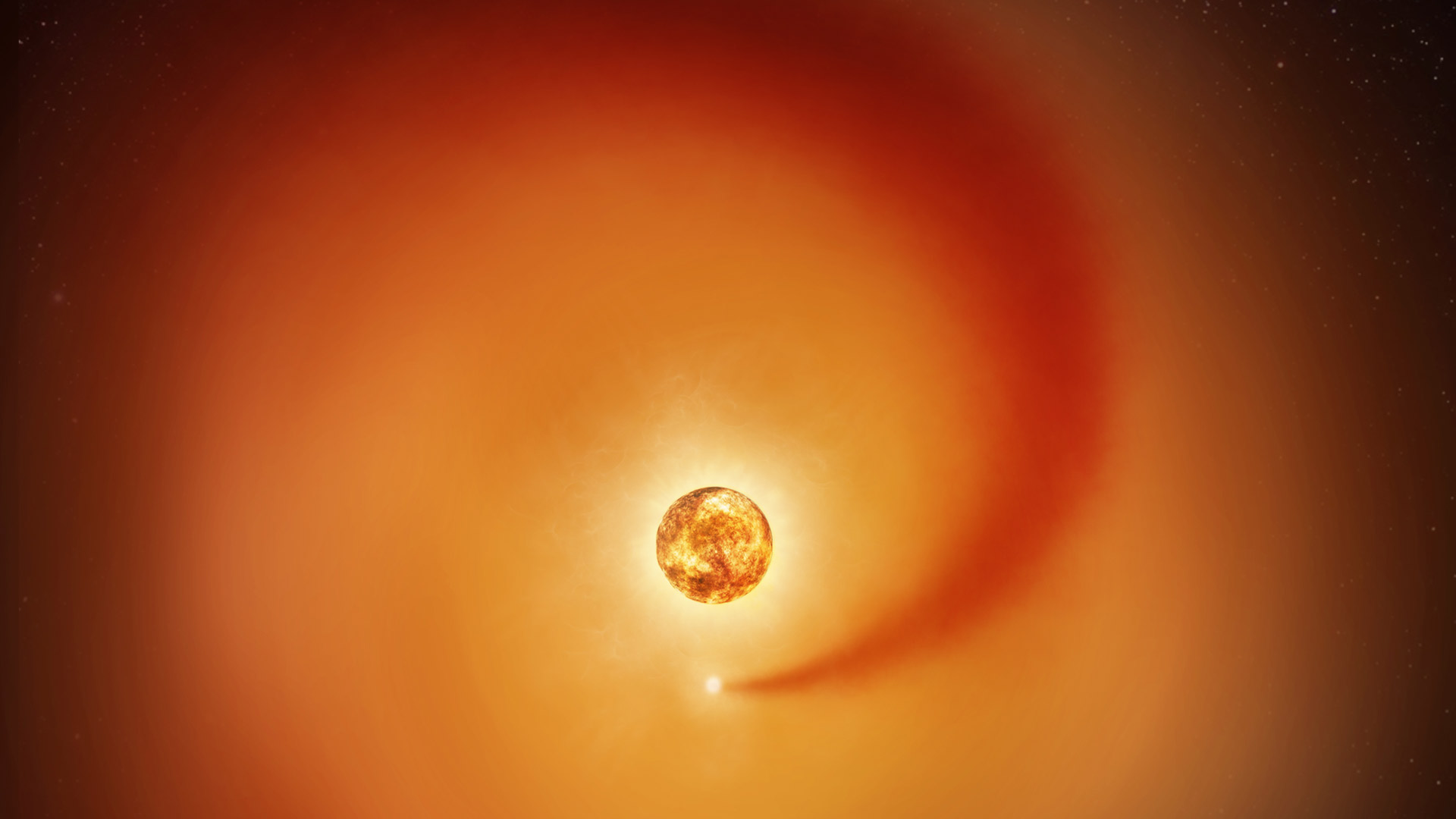
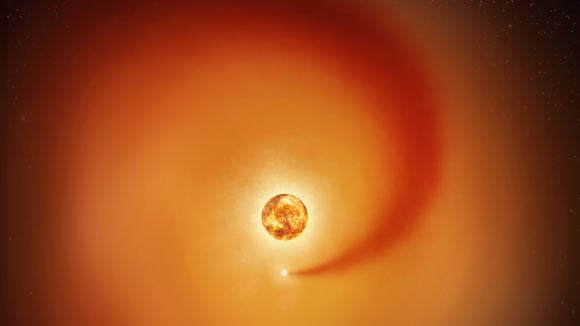
This artist’s concept shows the red supergiant star Betelgeuse and an orbiting companion star. Image credit: NASA / ESA / Elizabeth Wheatley, STScI / Andrea Dupree, CfA.
Betelgeuse is an 8-million-year-old red supergiant located approximately 724 light-years away in the shoulder of the constellation Orion.
With a radius around 1,400 times larger than the Sun’s, it is one of the biggest stars known.
Also known as Alpha Orionis or Alpha Ori, Betelgeuse is also one of the most luminous stars, emitting more light than 100,000 Suns.
The star is nearing the end of its life span, and when it explodes, the event will be bright enough to see during the day for weeks.
For decades, astronomers have tracked changes in Betelgeuse’s brightness and surface features in hopes of figuring out why the star behaves the way it does.
Curiosity intensified after the giant star appeared to ‘sneeze’ and became unexpectedly faint in 2020.
Two distinct periods of variation in the star were especially puzzling for scientists: a short 400-day cycle, recently attributed to pulsations within the star itself, and the long, 2,100-day secondary period.
Until now, scientists have considered everything from large convection cells and clouds of dust to magnetic activity, and the possibility of a hidden companion star.
Recent studies concluded that the long secondary period was best explained by the presence of a low-mass companion orbiting deep within Betelgeuse’s atmosphere, and another team of scientists reported a possible detection, but until now, astronomers lacked the evidence to prove what they believed was happening.
Now, for the first time, they have firm evidence that a companion is disrupting the atmosphere of this supergiant star.
This includes changes in the star’s spectrum, or the specific colors of light given off by different elements, and the speed and direction of gases in the outer atmosphere due to a trail of denser material, or wake.
This trail appears just after the companion crosses in front of Betelgeuse every six years, or about 2,100 days, confirming theoretical models.
“It’s a bit like a boat moving through water. The companion star creates a ripple effect in Betelgeuse’s atmosphere that we can actually see in the data,” said Dr. Andrea Dupree, an astronomer at the Harvard & Smithsonian’s Center for Astrophysics.
“For the first time, we’re seeing direct signs of this wake, or trail of gas, confirming that Betelgeuse really does have a hidden companion shaping its appearance and behavior.”
The team’s paper will be published in the Astrophysical Journal.
_____
Andrea K. Dupree et al. 2026. Betelgeuse: Detection of the Expanding Wake of the Companion Star. ApJ, in press; arXiv: 2601.00470