
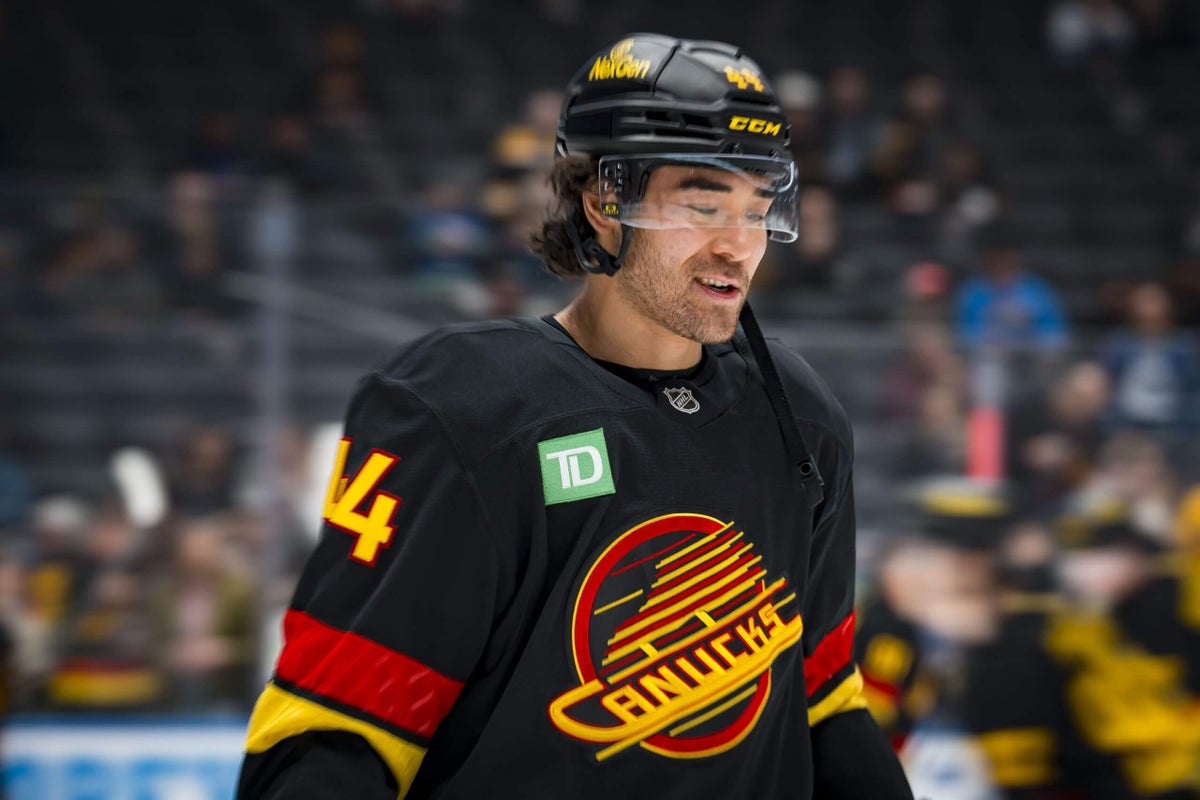
Kiefer Sherwood can be electrifying. He brings a lot of grit and physicality to the lineup, but this isn’t just a bottom-six grinder — he pairs that scrappy playing style with legitimate offensive skill. It’s a unique blend of talent that makes him somewhat of a unicorn in the NHL. And it’s incredibly cost-effective this year, since he only carries a $1.5 million cap hit.
Sherwood’s an important part of the Vancouver Canucks’ supporting cast. With Vancouver changing its direction and kicking off a rebuild, his importance has shifted — he is more valuable to the team as a trade chip. And his potential availability is generating buzz around the league, since a checking winger with his scoring ability is something that will catch most general managers’ eyes, especially for a playoff push. That demand and attention puts him No. 1 on The Athletic’s trade board.
But as much excitement as there rightfully is around Sherwood’s game, it also comes with some risk that acquiring teams have to consider.
Sherwood’s physicality is obviously eye-catching. He ranks second in the league among forwards with 210 hits, after leading the way last year with 460. He has had a multi-hit game in 42 of his 44 outings, and has even hit double digits a few times.
Most players who generally hit this often don’t possess the puck that much, but his 17 goals are somewhat of a saving grace. Those tallies put him in rare company, because only a handful of big hitters can clear the 20-goal mark. (Sherwood finished with 19 last season, and is on pace for 32 this season.)
The types of goals he scores only add to the lore. Sherwood doesn’t just crash the net to score. He can speed up the wing and toe-drag around defenders.
OH MY KIEFER SHERWOOD 😱
📺: Sportsnet pic.twitter.com/TqmkUdQDmH
— Sportsnet (@Sportsnet) October 27, 2025
He also has some variety to offer in those breakaway situations, which has helped him score two hat tricks already this season.
Kiefer Sherwood is on hatty watch 🎩👀
His second of the night ties the game ✌️ pic.twitter.com/0HCXKGrooe
— Sportsnet (@Sportsnet) October 31, 2025
That shot can be dangerous outside of one-on-one situations, too — he can snap it through traffic or slip it past goalies to shake things up.
KIEFER SHERWOOD IS OH SO HOT RIGHT NOW 🥵 pic.twitter.com/KHFNkGgLJj
— Sportsnet (@Sportsnet) November 12, 2025
Put his toolbox together, and it makes for the kind of supporting player general managers look for when the pressure rises: a tenacious forechecker who can bang bodies, play with pace, generate chances in transition and score timely goals. He is gutsy and can agitate without becoming a liability, and draws more penalties than he takes.
That can shine in the playoffs — it’s what made him a standout in Nashville, when the Canucks faced off against the Predators in the 2024 postseason. He built on that in 2024-25 with a breakout year in Vancouver, and this season he is upping his value with 17 goals in 44 games.
But a closer look at his season shows some red flags — like the streakiness in his goal scoring, fueled by extreme spikes (and dips) in shooting percentage.
Take this season. Sherwood scored 12 goals in his first 21 games, putting him in the top-10 in goal scoring (and hitting). At the time, he was on a 42-goal pace, but his shooting percentage was sky-high at 30.8 percent. The quality of Sherwood’s shots, before accounting for his finishing ability, only added up to 4.59 expected goals. What goes up generally comes down, and it started crashing in mid-November.
After scoring his 12th goal on Nov. 16th, he went 10 games without a goal and earned three assists in that span. He broke through on Dec. 11 against the Buffalo Sabres, then netted his second hat trick of the season three games later against the New York Islanders. But after that game on the 19th, he only notched another goal and two assists in his next 10 games. After those scoring droughts, his shooting percentage has come down to a more reasonable 15.7 percent.
Those scoring trends are a bit more concerning with last year in mind. Similarly, he started the season hot and racked up 12 goals and 19 points in his first 34 games, which put him on pace for 29 goals across an 82-game season. But he only notched seven goals in his next 44 games. When accounting for minutes played, he went from scoring 1.46 goals per 60 in all situations to just 0.63 after Christmas.
It would be one thing if this were a player in his early-to-mid-20s finding his footing in the NHL, but Sherwood is already 30 and still doesn’t have enough consistency or substance to his game to play at that high pace all season long. He attempts a lot of shots but doesn’t get enough of them on goal, or from the scoring areas, to maintain a 30- or 40-goal outlook, after getting off to such strong starts in each of the last two seasons. And he doesn’t make up for that enough below the surface, either, with his two-way play.
It’s possible Sherwood could stave off typical aging curves, since he is somewhat of a late bloomer. He only became an NHL regular at 28 years old, so there isn’t that same wear-and-tear. But that’s essentially canceled out by his playing style. Throwing five hits a night isn’t exactly a recipe for a long NHL career; physical players understandably don’t age very gracefully.
Sherwood’s comps don’t paint the most encouraging picture, either. Right now, that list includes players like Jannik Hansen, Darren Helm, Lars Eller and Bobby Ryan.

The list from his 2024-25 season wasn’t super promising, either — along with Helm, Hansen and Eller, his comps included Blake Comeau, Dave Bolland, Travis Boyd and Barclay Goodrow.
It doesn’t necessarily mean Sherwood can’t level up, even in the short term, for teams that view him as a rental. His environment is a part of the puzzle and likely contributes to the situation, between the turmoil last year and the bare lineup in Vancouver this season. He generally shared the ice with Teddy Blueger, Danton Heinen, Jake DeBrusk and Pius Suter last year, and Drew O’Connor, Evander Kane and Aatu Raty this season, after all. And now he doesn’t even have a spark like Quinn Hughes on the back end to lead the breakout.
That could all change, depending on his eventual landing spot.
A team like the New York Rangers, who are reportedly interested, doesn’t have the system to maximize someone like Sherwood right now. Even a team in the Boston Bruins’ position could be less than perfect. He feels like the exact type of player that front office would pursue, but Boston would likely need him to play a bigger role than he is cut out for.
The middle ground is a landing spot like the Detroit Red Wings or Montreal Canadiens — two younger teams with solid foundations that need top-six help to punch up the roster. Sherwood alone likely wouldn’t take these teams into the contenders’ circle; these organizations have the assets to swing this deal and other necessary deadline adds.
On teams like the Dallas Stars, Minnesota Wild, Vegas Golden Knights or Edmonton Oilers, Sherwood could be that final piece that solidifies a contender’s status. Any of those teams could put him in a fitting middle-six role, which gives him the two-way support to highlight some of his best traits.
But the cost of adding Sherwood could stop these teams from making any other needle-moving trades. The uncertainty of whether a change in scenery alone can keep him on a stronger trajectory across a full season adds risk to the situation. Acquisition price only amps that up.
Sherwood’s playoff-style hockey is pricey alone. His cost-effective salary only adds to that. Now factor in the market: there are a limited number of wingers expected to be available, and exactly how many isn’t clear yet with so many teams still in the playoff picture. The Pittsburgh Penguins are on that bubble, which means Bryan Rust’s place on the trade board could still be in limbo. That leaves buyers with few other utility options, like Sherwood and Blake Coleman. Otherwise, it’s off to the bargain bin for buy-low players like Andrew Mangiapane and Ondrej Palat, or teams will have to be willing to absorb multi-year obligations for aging stars like Steven Stamkos and Jonathan Marchessault.
Then there’s the ever-shrinking 2026 free agent market to consider, for teams that view him as more than a rental. There are no top-tier wingers available in 2026. Artemi Panarin and Alex Tuch are leading the class, followed by other supporting options like Oliver Bjorkstrand, Jordan Eberle and Mason Marchment. That could inflate the value of the middle class (similar to defensemen last summer) or generate more interest in a player like Sherwood. Some teams may want to see how Sherwood clicks with their organization early and try to beat the rising free-agent market in July.
Ahead of this season, Evolving-Hockey projected a Sherwood contract (outside of Vancouver) to come in with a $3.59 million AAV over three years. A four-year deal would carry a $4.65 million AAV. The latter would be a fair value, considering his comps. But a strong second half and playoffs (if the Canucks move him) could up the price, before even accounting for market trends. And that adds another layer to the situation for teams considering him as a long-term option.

All of that gives the Canucks room to get creative here and juice this situation for all its worth (assuming the front office can actually navigate this situation properly, and their track record says otherwise).
Sherwood has the type of skill set general managers covet. He can frustrate opponents with his pesky style, add a spark off the rush and energize a team when it matters most. But with a wide-open playoff field, there may be even more buyers thinking the winger could be what gives their team the edge, which could elevate the price and the pressure of this situation.
Maybe Sherwood can be the difference. Maybe he was only scratching the surface these last two seasons, and can find a new level of consistency with a contender. That is the reward any interested team has to hope for — it just has to be weighed with the risk of his streaky game and acquisition cost.
Data via Evolving-Hockey, HockeyViz, HockeyStatCards, All Three Zones, Dom Luszczyszyn, Natural Stat Trick and CapWages. This story relies on shot-based metrics; here is a primer on these numbers.