

This didn’t look the least bit likely only three weeks ago.
It was then, on Dec. 22, that the Toronto Maple Leafs arrived home from Dallas, where they had dropped their third game in a row, and fired Marc Savard.
“It’s not lost on us where the team’s at,” GM Brad Treliving said that week.
Since then, it’s been only good times. The Leafs have picked up points in nine straight games, winning seven times (7-0-2), including a 5-0 trouncing of the lowly Vancouver Canucks over the weekend.
Is this team for real, though? We’re about to find out, as the schedule is set to get very difficult.
The Leafs play 11 times in the next 20 days this month, including tonight in Colorado against an Avalanche squad that has yet to lose in regulation at home this season (19-0-2). The Avs have also won 17 in a row in Denver. It will be the first of two meetings versus the Avalanche in January.
The Leafs also will get Mitch Marner and the Vegas Golden Knights twice, a top-five team in the Minnesota Wild and equally hot squads from Detroit and Buffalo before a road trip through western Canada that will end against the otherworldly Connor McDavid’s Edmonton Oilers.
The Leafs own the sixth-hardest remaining schedule. Can they keep the upswing steady through all that?
Given how bleak things were not that long ago, this recent stretch has been impressive, especially amid injuries. Craig Berube deserves credit for leading this group out of the muck after struggling to find answers for the first three months of the season.
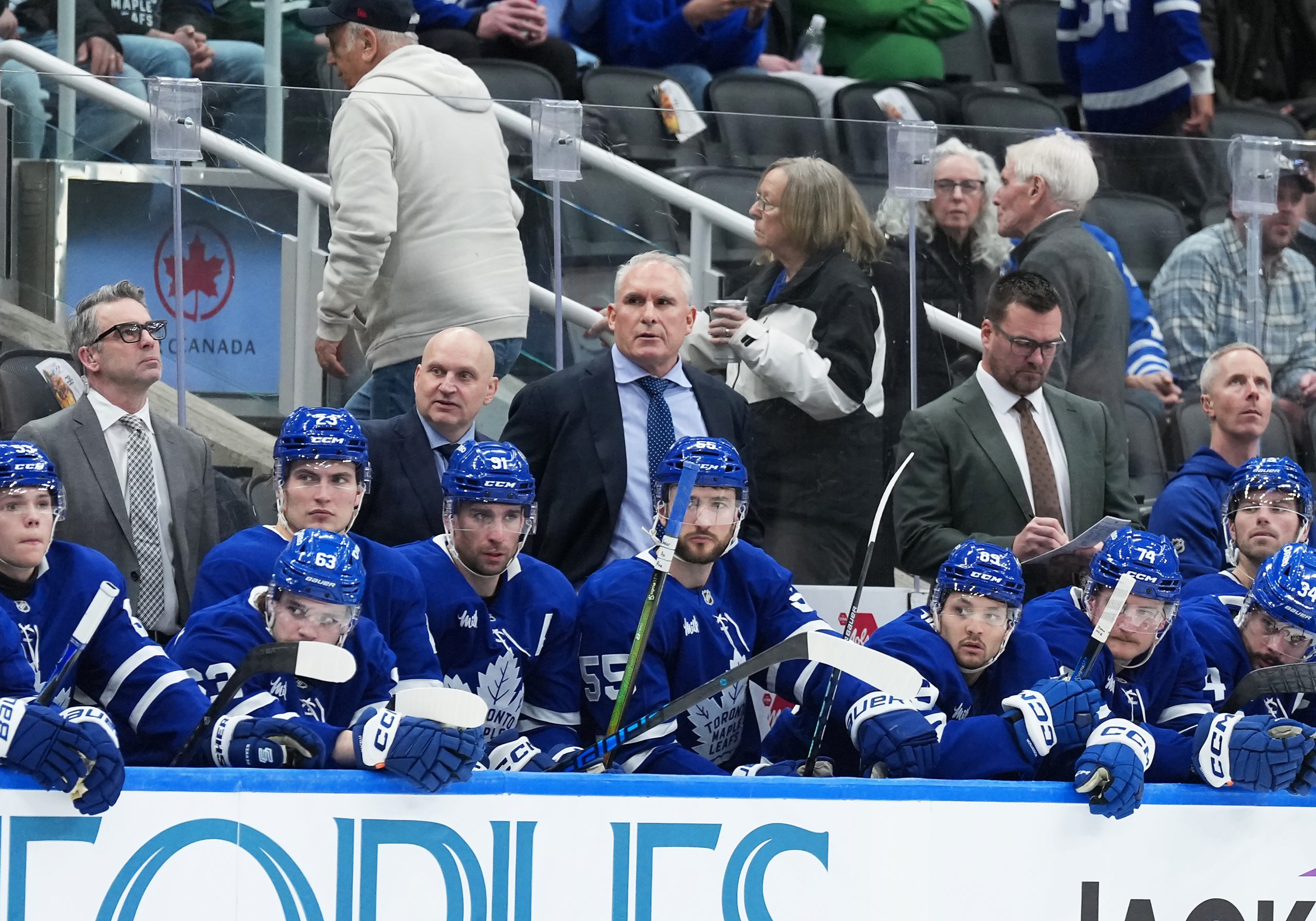
Craig Berube has led the Leafs back into the playoff mix. (Nick Turchiaro / Imagn Images)
Some context for what has been going on of late is also required.
Four of those seven wins, for instance, came against teams in dire straits: the Ottawa Senators, New Jersey Devils, Winnipeg Jets and Canucks. The Pittsburgh Penguins had lost eight of nine when they arrived in Toronto on Dec. 23.
Six of the seven victories came on home ice, where the Leafs have increasingly wrecked teams. They own the league’s second-best home record, in fact, at 16-5-5, and have outscored foes there by 20 goals. That’s a good thing, obviously, especially after failing to take care of business at home early on.
Yet no team in the NHL has played more home games (26) than the Leafs, or fewer games on the road (18). Which, of course, means there’s a bunch of road action ahead, including four games in four cities this week alone. And the road has been a struggle so far for this team; the Leafs are just 6-10-2, the fourth-worst record in the league by points percentage. Making the playoffs will require them to turn that around in a big way — and against a slew of tough opponents.
It’s also worth noting what’s going on under the hood: During this nine-game streak, the Leafs own the league’s second-best shooting percentage (15.6 percent) and save percentage (.920), a PDO dream combo that will be hard to sustain. The upcoming stretch will be especially taxing on goalies Joseph Woll and Dennis Hildeby.
It speaks to the hole the Leafs dug in October, November and December that they still sit outside a playoff position.
The winning has to continue. Do it through the gauntlet that lies ahead, beginning on Monday night, and we’ll know this team needs to be taken seriously.
Ten things I like, don’t like, or find interesting about the Leafs right now
1. A point in the Leafs’ favour: As of Sunday morning, they are 6-3-3 against the NHL’s 10 best teams (by points total) this season.
They have yet to face three of those teams — Colorado, Minnesota and Vegas — but have picked up wins against the Tampa Bay Lightning, Carolina Hurricanes, Montreal Canadiens, Buffalo Sabres (a top-10 team!) and Philadelphia Flyers.
2. Aside from the goaltenders, who have combined to post the No. 1 save percentage in the league while short-handed, the Leaf who deserves most credit for the penalty kill’s success is Scott Laughton.
Laughton has logged 58 minutes on the PK this season. Opponents have scored twice. So have the Leafs, for that matter, with Laughton netting two short-handed goals.
Only three players league-wide have been on the ice for fewer power-play goals against in 50 or more minutes. One of those players is Troy Stecher, on the ice for one power-play goal against in almost 60 minutes.
Great goaltending makes up for a lot. However, Laughton has been a pesky, disruptive force who has crushed it in the faceoff circle.
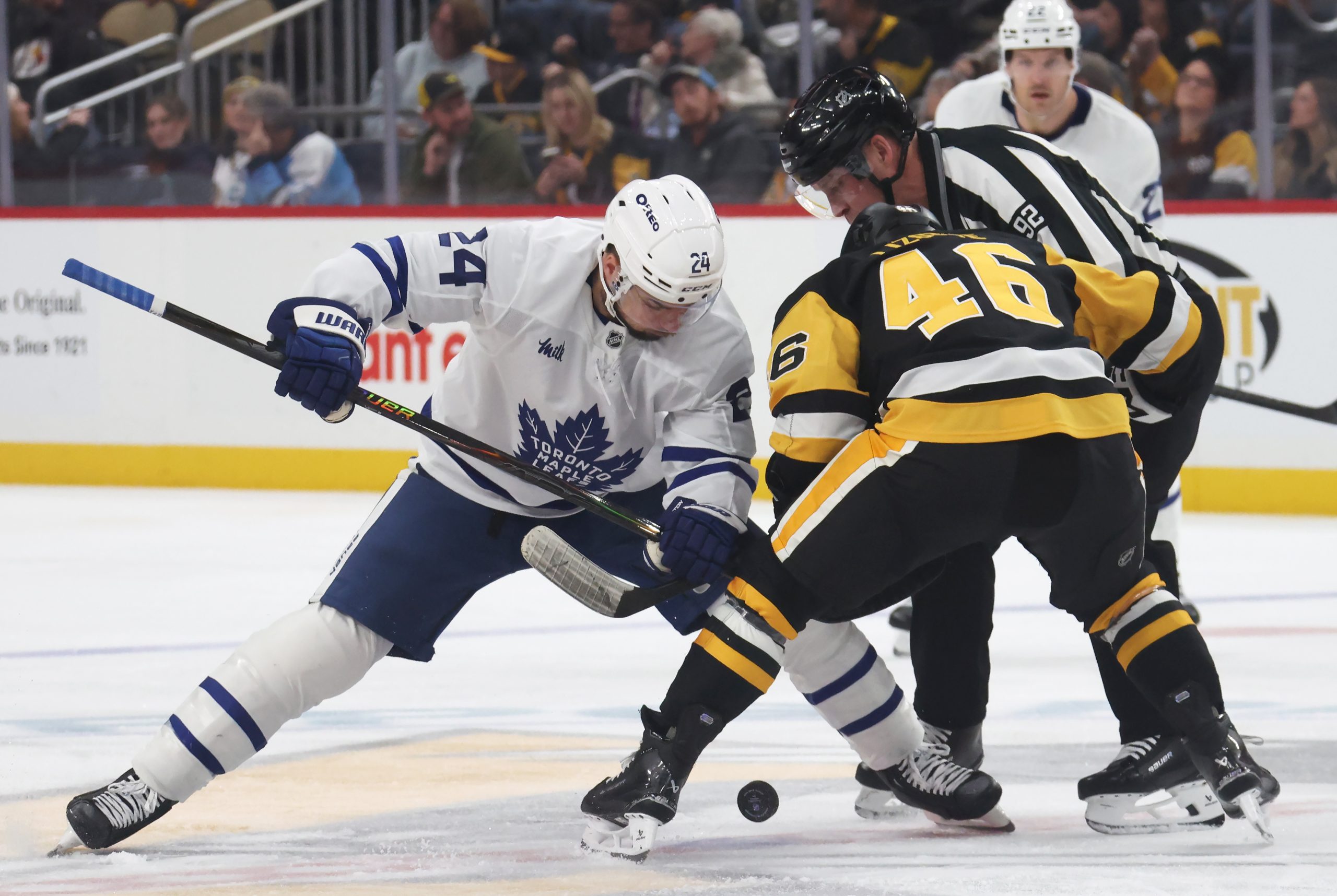
Scott Laughton has been almost unbeatable in the faceoff circle. (Charles LeClaire / Imagn Images)
3. The most mind-blowing Laughton stat to that point on the penalty kill: He has won almost 67 percent of his faceoffs — 52 wins, 26 losses. Only faceoff master Claude Giroux has been better (67.4 percent) in a high-volume role league-wide on the PK this season.
4. Because Laughton has been so effective in first-unit duty with Steven Lorentz, the Leafs have been able to cut Auston Matthews’ usage way back on the penalty kill. Matthews has logged less than three minutes short-handed, in the last five games compared to almost 18 for Laughton and 14 for Lorentz.
It doesn’t feel like the reason for Matthews’ recent surge, but it can’t hurt either that the team has been able to keep him under 20 minutes in six of his last eight games.
5. Berube and his staff made a bold decision over the weekend when they opted to drop John Tavares from the No. 1 power-play unit in William Nylander’s return to the lineup and keep Matthew Knies there instead. Berube liked how Knies had performed in the bumper position in Nylander’s absence and said he was optimistic about the way Knies and Nylander could play off one another.
But this is also about Tavares.
This is shaping up to be the worst season of his career on the power play in goals, assists and points. Amid the Leafs’ power-play woes, which faded only recently, Tavares had a hard time finding his way to shots — clean shots especially — on net. He has mustered only 11.5 shots (on almost 26 attempts) per 60 minutes, his lowest mark with the Leafs since the 2019-20 season and down sharply from recent years:
Tavares on the PP
SeasonShots/60Goals/60
2021-22
17.7
2.5
2022-23
22.4
3.9
2023-24
21.2
2.2
2024-25
16.9
3.4
2025-26
11.5
1.0
Is that bad luck? Less opportunity with the team-wide power-play struggles? Age-related decline? Some combination of everything?
Tavares also logged just 12:26 against the Canucks, the fewest of any game in his NHL career not involving injury.
6. Berube made another interesting decision in Nylander’s return when he dropped Bobby McMann from the top line and replaced him with Knies. McMann slid all the way down to the fourth line with Laughton and Lorentz, but Berube also went out of his way to throw McMann, who was playing his best hockey of the season, some extra opportunity on the penalty kill.
McMann hasn’t killed penalties much at all this season, but drew a season-high 2:40 against the Canucks.
It felt like an acknowledgement from the head coach that McMann’s recent efforts had been appreciated, that he wasn’t forgotten despite the demotion. Treliving also appeared to whisper a word of encouragement to McMann when he entered the dressing room at the end of Saturday’s morning skate.
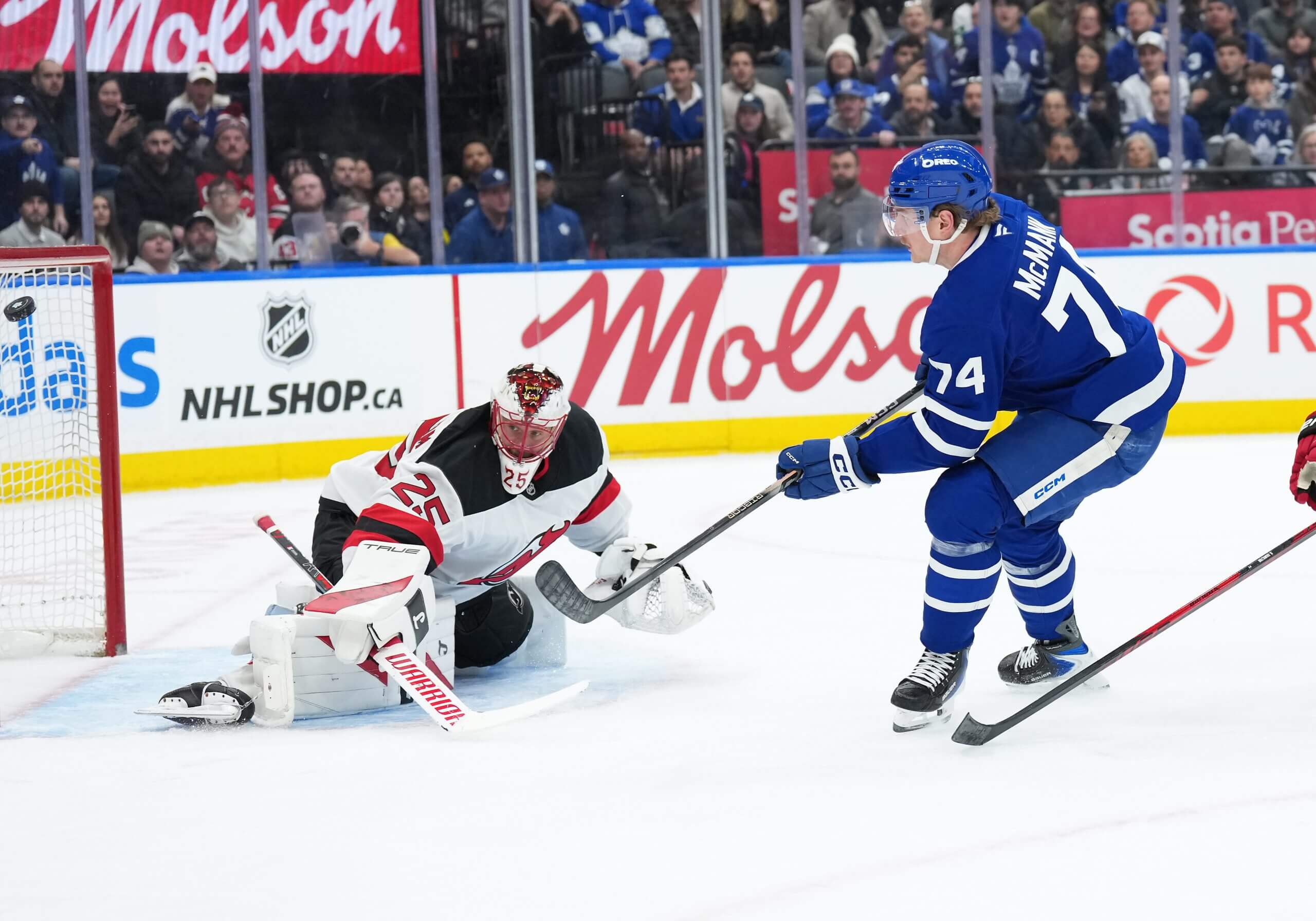
Bobby McMann saw his top-line gig disappear in William Nylander’s return. (Nick Turchiaro / Imagn Images)
7. Another penalty kill-related development that’s been going on for some time now: Oliver Ekman-Larsson’s removal from duty.
He ranked fourth among Leafs defenders in short-handed action last season, logging almost 83 minutes. Through 44 games this season, Ekman-Larsson sits eighth with only 18 minutes and change on the PK, and essentially nothing since the middle of November. And that’s with Chris Tanev and Brandon Carlo, two primary penalty-killers, missing major time.
The purpose feels obvious: to cross off one element of responsibility from Ekman-Larsson’s still-crowded nightly assignment. The 34-year-old is logging almost 21 minutes a game this season, even without PK duty. He logged 25 minutes last week in Philadelphia, 23 minutes two nights before that against his former Florida squad, and almost 27 minutes a few nights before that in New York.
8. The Leafs can only take that step with their second-oldest defenceman if they have options to replace him.
One of those options is Stecher, who has played major minutes since his arrival. Another is Morgan Rielly, who has almost doubled his workload from last season and has proven effective in a secondary role.
9. Tavares scored only his fifth goal in the last 26 games on Saturday, capitalizing on a Nylander swipe-and-pass sequence from 17 feet.
While he continues to punish teams from inside, Tavares just isn’t scoring from midrange like he used to, last season especially:
Tavares from midrange
SeasonGoalsSH%
2022-23
8
11.3
2023-24
12
17.7
2024-25
13
24.1
2025-26
3
9.7
10. The Leafs have done a much better job of managing Woll’s workload since he returned from injury, topping him out at four starts in a row.
The challenge will become more difficult this month, with a back-to-back to start this week and games every other day after that (plus an additional back-to-back) all the way to the Olympic break.
If they play it right, the Leafs can still get Woll in the net a bunch, squeezing in Hildeby, who’s exceeded expectations, here and there. (Anthony Stolarz’s return remains a giant question mark.)
Something like this stands to keep Woll as fresh and healthy as possible:
Potential starter schedule
DateOpponentStarter?
Jan. 12
@ Avalanche
Woll
Jan. 13
@ Mammoth
Hildeby
Jan. 15
@ Golden Knights
Woll
Jan. 17
@ Jets
Woll
Jan. 19
vs. Wild
Hildeby
Jan. 21
vs. Red Wings
Woll
Jan. 23
vs. Golden Knights
Woll
Jan. 25
vs. Avalanche
Hildeby
Jan. 27
vs. Sabres
Woll
Jan. 29
@ Kraken
Hildeby
Jan. 31
@ Canucks
Woll
Feb. 2
@ Flames
Woll
Feb. 3
@ Oilers
Hildeby
– Stats and research courtesy of Natural Stat Trick, Hockey Reference, NHL Edge and Evolving-Hockey