
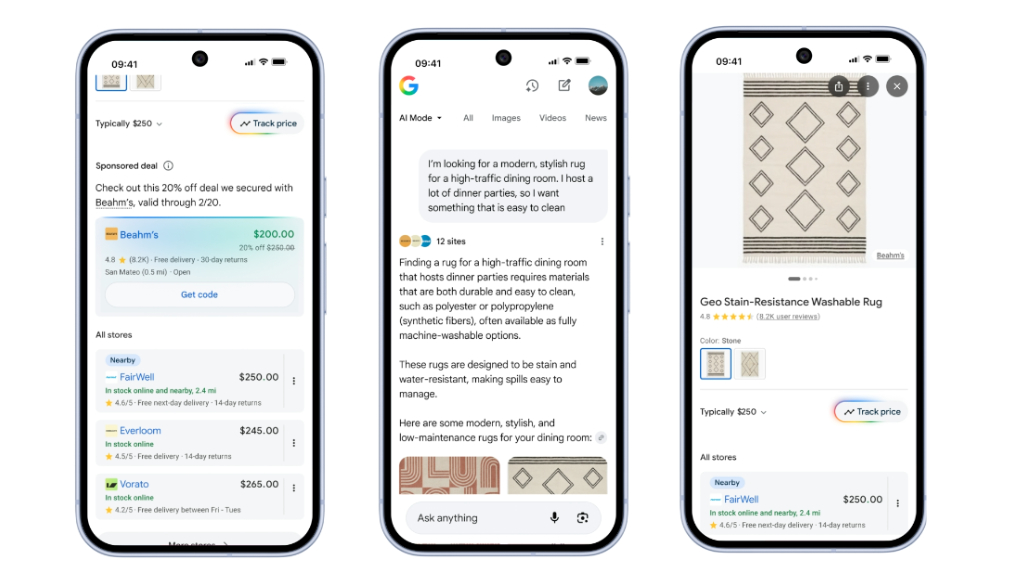
Google has become the latest technology giant to use AI-powered search to funnel consumers directly to checkout, allowing brands to offer exclusive discounts within AI Mode.
The discount AI shopping follows similar moves by OpenAI and Microsoft. Known as “Direct Offers”, Google’s pilot scheme means consumers don’t have to visit a retailers site at all.
The scheme is currently only available to US retailers. However, Google said it would aim to expand globally “in the coming months”, alongside rolling out other features including related products, loyalty schemes and “custom shopping experiences on Google.”
According to Google general manager for ads and commerce Vidhya Srinivasan, the pilot’s agentic AI ecosystem, known as the “universal commerce protocol”, was developed in partnership with retailers and e-commerce platforms including Shopify, Etsy, Wayfair, Target and Walmart and is “endorsed” by payment platforms such as Amex and Mastercard.
ADVERTISEMENT
Writing in a Google blog post, she said: “With direct offers, retailers set up relevant offers they want to feature in their campaign settings, and Google will use AI to determine when an offer is relevant to display.
“We are initially focusing on discounts for the pilot and will expand to support the creation of offers with other attributes that help shoppers prioritise value over price alone, such as bundles and free shipping.”
Advertisers such as pet brand Petco, make-up company Elf Cosmetics and luggage manufacturer Samsonite have already signed up to the pilot, Srinivasan said.
Enjoying Mumbrella? Sign up for our free daily newsletter.
Speaking to Mumbrella, TBWA\ Australia chief AI and innovation officer Lucio Ribeiro said the introduction represents not “just an incremental shift in where transactions happen, it’s a new AI moment of truth where discovery and purchase start to collapse into the same interaction.”
“Platforms like OpenAI’s Instant Checkout, Microsoft Copilot Checkout and Google’s personalised shopping ads all blur the line between search, recommendation and conversion, forcing brands to think beyond traditional keyword auctions to how they appear and perform in conversational, intent-rich AI contexts,” he explained.

TBWA’s Lucio Ribeiro: “Discovery and purchase start to collapse into the same interaction.”
“For advertisers, this means treating AI-enabled search and checkout placements less like a variant of traditional search and retail media and more like a new, dynamic channel of intent. The discounts and incentives Google is offering will probably encourage brands to test faster.”
Ribeiro added that the change also reflects a wider evolution in customer experience (CX).
“The real shift is that intent is no longer being handed back to a list of links or a marketplace shelf,” he said. “Discovery followed by intention is captured inside the AI experience itself. That’s the [AI] moment where a question, a recommendation and a decision collapse into one interaction.”
Meanwhile, WPP Media managing director of commerce Marc Lomas said the rise of AI checkouts “signals the end of the ‘browse and hope’ era of e-commerce.”
“We are witnessing the birth of the delegator economy, where consumers are shifting from active shoppers to delegators who entrust AI agents to find, compare, and now purchase products on their behalf,” he explained.
“For advertisers, this collapses the traditional funnel; discovery and transaction are now happening in the same conversational moment. This represents a seismic shift for advertisers as we move from the bedrock of B2C to agent-to-consumer (A2C) and agent-to-agent (A2A), a transition that will radically alter power dynamics for those who navigate it effectively.”
Google launched AI Mode in Australia in October 2025, a full-screen platform that lets users complete tasks like shopping, checkout, and chatting with brands.
AI Mode builds on AI Overviews (introduced in Australia a year ago), a more limited, top-of-page product that provides AI-generated summaries gleaned from multiple sources and delivered in a conversational tone, with bullet points and links.
While apparently good for retailers looking to eliminate steps in the customer’s path to purchase, the tools have sparked fears among publishers and media owners that informational clicks will disappear, putting their traffic at risk.
Google’s rollout of AI Mode and its new checkout feature follows similar moves by OpenAI and Microsoft.
OpenAI introduced its “instant checkout” for ChatGPT in September, allowing users to make purchases through the large language model’s platform while taking a cut of sales made on the platform.
Last week, Microsoft launched Copilot Checkout, which similarly offers recommendations and checkout directly within its AI chats.
Bonnie Dodemaide, head of digital at Dentsu’s iProspect, cautioned that the impact of these tools remains limited currently, noting that “while nearly half of Australians now use generative AI tools like ChatGPT, Copilot and now Google AI Mode… actual shopping and purchase behaviour, however, remains far slower to shift, suggesting discovery is increasing but buying via AI is still limited.”

iProspect’s Bonnie Dodemaide: “Discovery is increasing, but buying via AI is still limited.”
Advising marketers on how to stay ahead of AI commerce, Dodemaide suggested focusing on editorial content aligned with customers’ intent; maintaining “strong feed health”, including an agentic checkout API and payment integration and addressing technical issues, such as CMS integrations and bot-friendly setups.
Meanwhile, commenting on how Google’s introduction of AI commerce will affect advertisers’ media mix, as well as their test-and-learn appetite, Lomas said: “In any situation, while attractive for test-and-learn budgets, brands must look beyond any discount.
“The real opportunity isn’t just cheaper inventory; it’s mastering answer engine optimisation (AEO). Advertisers need to move from optimising for clicks to optimising for trust and machine-readability.
“This means structuring product data to be the most logical, authoritative answer an AI can find. Brands that treat their product feeds as frontline marketing assets will win the zero customer-acquisition cost in this new ecosystem, regardless of the platform.”
iProspect’s Maureen Doris Cheung, however, said the move would not “materially change the media mix or test-and-learn appetite because inventory pricing remains the same”.
“What it does change is how brands can enhance engagement and conversion through these new advancements, making AI Mode more attractive for commerce-focused advertisers,” she explained. “Brands should test these new features as part of their AI strategy, but not expect cheaper CPMs or CPCs.”