
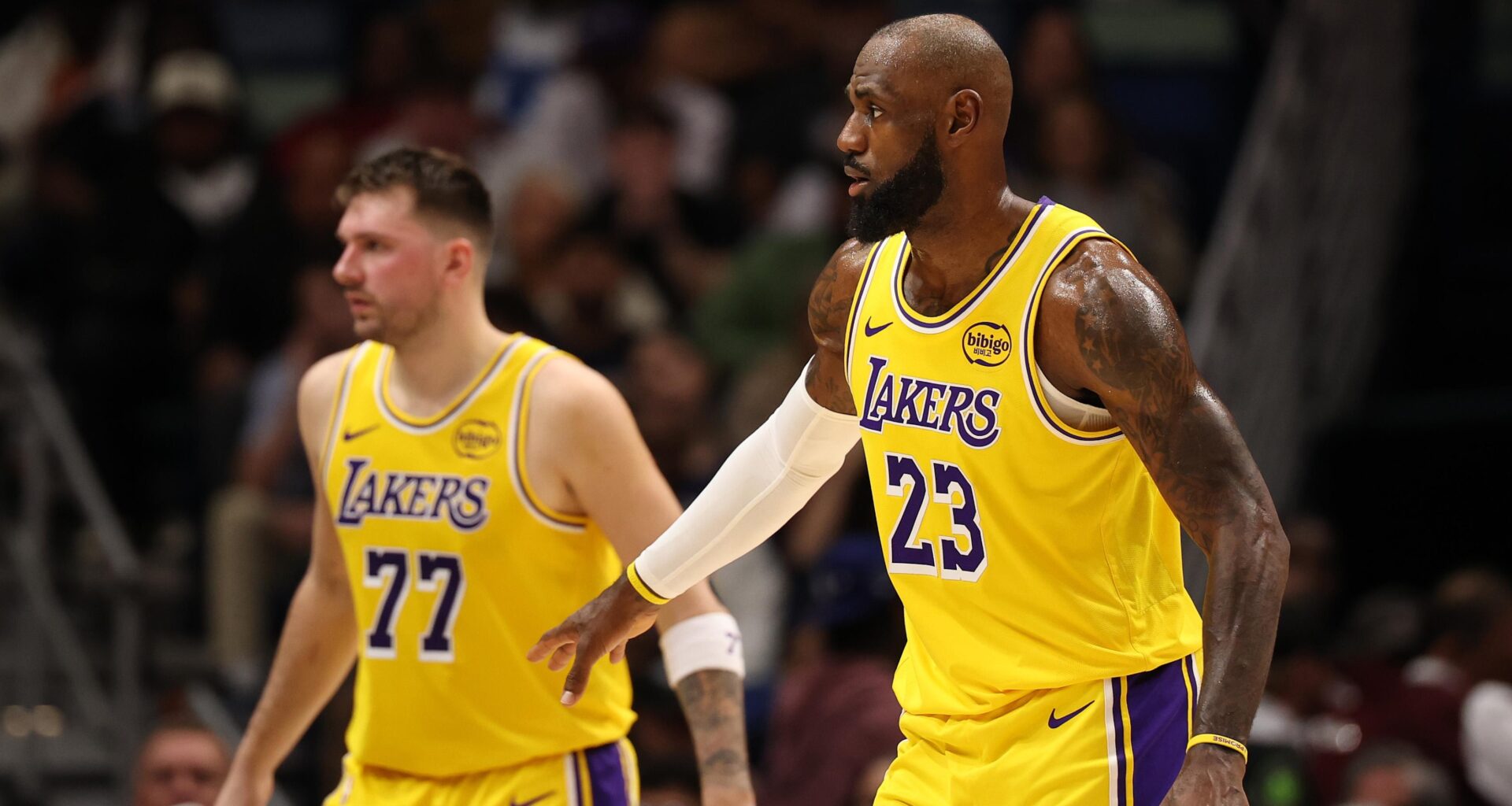
The NBA is not obligated to hand out All-Star starts based on what someone used to be. Even if that someone is a top-two GOAT candidate.
Every season resets the terms. That’s always been the deal, even if LeBron James spent two decades being the rare player whose selection was guaranteed.
That’s not the case anymore.
All-Star voting is often dismissed as a popularity contest, but popularity in the NBA is tethered to production. Fans reward players who produce like superstars. And when that changes, the voting follows.
Not even LeBron is exempt from this paradigm.
The Votes Say What People Don’t Want To
The second fan vote returns for the 2026 All-Star Game has LeBron breaking his 21 consecutive All-Star starts. LeBron’s Lakers teammate, Luka Dončić, sits at the top of the voting, miles ahead of the field at 2,229,811 votes. Nikola Jokić follows (1,998,560), with Stephen Curry right behind (1,844,903).
James sits eighth in the West and 13th overall at 1,059,855 votes, which means voters, even Lakers fans, are choosing his teammate Dončić but not also voting for LeBron.
But this checks out with reality. Starters should and usually are chosen for what they’re doing in real time, not what their basketball obituary will say.
For the first time in his career, LeBron is subject to the same standard every other NBA player lives under.
On paper, his numbers remain star-solid. He’s averaging 21.9 points, 5.6 rebounds, and 6.9 assists. To make sense of how his dip correlates to the fan vote, you have to pay attention to the context wrapped around it. He’s only played 18 out of 35 games and hasn’t appeared in any back-to-backs. His availability is being carefully managed and manicured in advance. Even LeBron has stopped pretending otherwise.
This Isn’t Bron’s Team Anymore
For the first time in his career, LeBron is no longer the gravitational center of his team. Rightly so, Dončić is the Lakers’ most essential player, with Austin Reeves as the No. 2.
There’s a sound argument that LeBron is now the third-most impactful player on the Lakers.
How laughable would that statement have sounded five years ago?
Meanwhile, the league is filled with players doing more than him—bonafide stars who carry their teams like The King once did. Look at the names ahead of James in the West and things start to make sense.
Jokić (although injured) remains the league’s most reliable ecosystem.
Shai Gilgeous-Alexander is Oklahoma City’s entire engine, playing heavy minutes and closing games behind the defending champs.
Victor Wembanyama has already become San Antonio’s nucleus, impacting games on both ends.
Even Anthony Edwards, sitting just ahead of James, is more available and a better League Pass watch in 2026.
LeBron beating out any of these Western Conference colleagues would be lame nostalgia bait. Fans are smarter than that.
Nostalgia Isn’t a Basketball Argument
There’s a cultural aspect that isn’t discussed honestly, for whatever reason.
LeBron’s relationship with the younger fan base has changed.
Gen Z doesn’t relate to him the same way Millennials do, who have been watching him his entire career. He’s less aspirational to youngbloods. You could even call him institutional, an old head, or worse, cringe.
All-Star voting may be half fan-driven, but fans vote for players who feel fresh. Wembanyama feels fresh. Shai’s brand lives on TikTok. Even Curry, older himself, still feels cool to imitate on the court.
LeBron simps will argue that LeBron deserves an All-Star spot every year until he retires. Partisanship is brain rot, no matter the sphere of influence. It does beg the question of the chicken or the egg hypothetical: did sports mirror politics first, or vice versa?
Either way, it’s annoying how echo chambers and “player fans” dominate conversations.
The All-Star Game isn’t where the league pays debts. It should be a celebration of the present.
This Is the End
This season has been the most fractured of LeBron’s career. Injuries have revealed cracks in his durability. Arthritis and sciatica have finally diminished his physical dominance. He’s just one missed game away from losing a 21-year streak of award eligibility.
The Lakers are good, not dominant, sitting at No. 5 in the Western Conference 36 games into the season. But more importantly to this conversation, their success no longer hinges solely on his presence.
For 20 years, LeBron outran every standard applied to him. Now the league is deeper, younger and global.
LeBron will get his moment to walk into the sun. That part is inevitable. His legacy is already exalted, already cemented in the history books, already immune to All-Star ballots and fan polls.
Nothing that happens in January can touch what he’s been for the sport.
But the All-Star Game is supposed to be about the best of the best right now—especially the starters. That just isn’t LeBron anymore. And that’s okay. He still has championship ambitions. He can still add chapters to his legacy, maybe another banner.
The All-Star Game, though, has passed him by. Especially the idea of him starting ever again.
We got 20 years of greatness without precedent.
For that, we should be grateful. But not entitled.