
When the 47th solar panel exploded, Henrik Eskilsson began to fear he’d signed on with a madman.
In his SUV, he and Anders Olsson were accelerating across Sweden’s Lunda Airfield, towing a trailer fitted with a steel mast that suspended the panel. As they gained speed, the panel did something unusual: it floated, catching the wind like a hang glider while staying anchored to the mast. The speedometer crept toward 100 kilometers per hour. Behind them, the device began vibrating. Suddenly, it snapped free, tumbled through the air and shattered on the runway.
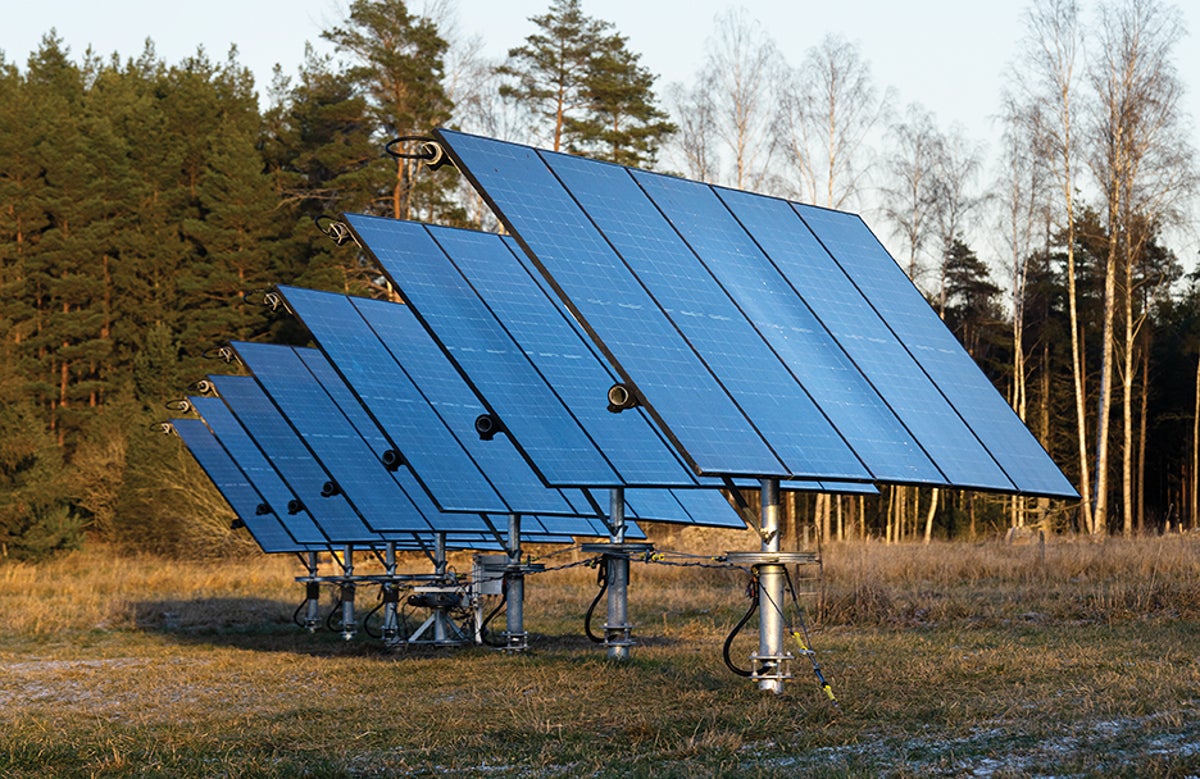
Eskilsson, who’d previously founded a company that makes eye-tracking software, stopped the car and contemplated why he’d committed to this quixotic project: to revolutionize solar power for more than half of the people living on Earth. Many areas in the Northern Hemisphere and some in the Southern lie in zones where traditional solar fields are inefficient, especially in winter—but also in the morning and evening. When the sun sits low, its rays hit horizontal panels at a shallow, grazing angle, delivering little energy. Vertical solar panels that track the sun even as it barely clears the tree line have proved too expensive, requiring multiple motors to rotate them, too much concrete to anchor them, and too much steel to keep the wind from tearing them apart.
On supporting science journalism
If you’re enjoying this article, consider supporting our award-winning journalism by subscribing. By purchasing a subscription you are helping to ensure the future of impactful stories about the discoveries and ideas shaping our world today.
The shattered prototype was part of Olsson and Eskilsson’s effort to solve this: Vaja, the vertical-tracking start-up they had co-founded in 2023. For years, Olsson had envisioned building solar systems that moved with the wind like leaves in a storm. He and Eskilsson had consulted with mechanical engineers, who said this design would be impossible. Olsson disagreed. Eskilsson trusted him, although he wondered how many more panels would first have to be destroyed.
They got out of the SUV, took brooms from the back and, in the brisk winter afternoon, began sweeping the runway.
Solar is the fastest-growing source of global electricity, accounting for 7 percent of the world’s generation in 2024, up from roughly 1 percent a decade earlier. In the 2010s, utility companies invested heavily in solar farms with fixed-tilt panels—stationary solar arrays oriented toward the equator to catch the sun’s light. Such systems produce the most electricity in the middle of the day. In markets with many solar farms, this is when electricity prices are lowest, making the panels less profitable. Then, as the sun goes down and electricity demand spikes, the panels cease to be productive.
Horizontal trackers address such limitations by following the sun. Mounted on a north-south spine, the panels tilt like a seesaw, turning east at dawn, lying flat at midday and facing west at sunset. They can deliver up to 35 percent more energy than fixed-tilt systems for a modest bump in cost. Horizontal tracking has “basically exploded over the past 10 to 15 years,” Eskilsson says.
But horizontal trackers suffer from the same latitudinal shortcomings as fixed-tilt: travel north or south from the equator, and the benefits diminish. Between the 30th and 40th parallels north—roughly aligned with Houston and Philadelphia, respectively—the equation shifts to favor vertical trackers: systems designed to intercept the light of a low-hanging sun that would otherwise skim over a horizontal array.
A handful of companies offer static vertical panels. In Europe, Norway’s Over Easy Solar and Germany’s Next2Sun and SOLYCO Solar provide a variety of vertical solar panels that harvest morning, evening and winter light. Making vertical trackers, which pivot around an upright axis like a revolving door, is far more challenging. All vertical panels catch the wind like sails. Stationary setups can be made to resist powerful gusts, but vertical trackers are more fragile because they are mobile and mounted on a single post. Imagine a heavy roadside sign perched on a pole: the wind doesn’t just push against the sign; it tries to twist the pole, too. Torsion around a vertical post is nastier than around a horizontal tracker’s low-slung backbone, leading more easily to broken panels and motors. Efforts at beefing them up priced them out of existence. “These kinds of vertical trackers, even today, cost like four times as much as horizontal trackers,” Eskilsson says. Developers in the north stuck with static systems, using more panels to make up for lost productivity.
Olsson, now 51 years old, became interested in solar in 2017, before it was common in his country. On a ski trip, he told a friend that Sweden didn’t receive enough sunlight for the technology to work. The friend disagreed and showed him the math. “I realized when I saw the numbers that solar does make sense,” Olsson says. The moment sparked his love for a challenge, and he spent the train ride home writing a business plan.
Soldags, Olsson’s first solar panel company, took off installing panels for consumers, usually on roofs. But two years in, he landed a contract to install panels on the ground, which required anchoring them with concrete blocks. “These things weighed 10 times more than the solar panels,” Olsson says. An engineering physicist by training and a recreational sailor, he knew how much torque wind could exert. Yet nature thrived in it—trees flexed, leaves feathered. Why did he have to burn money to hold panels still?
He shared his thoughts with his friend and fellow sailor Fredrik Lundell, a fluid dynamics professor and aerodynamics expert. As they spoke, they made sketches of a pivoting mount that might allow panels to feather in the wind.
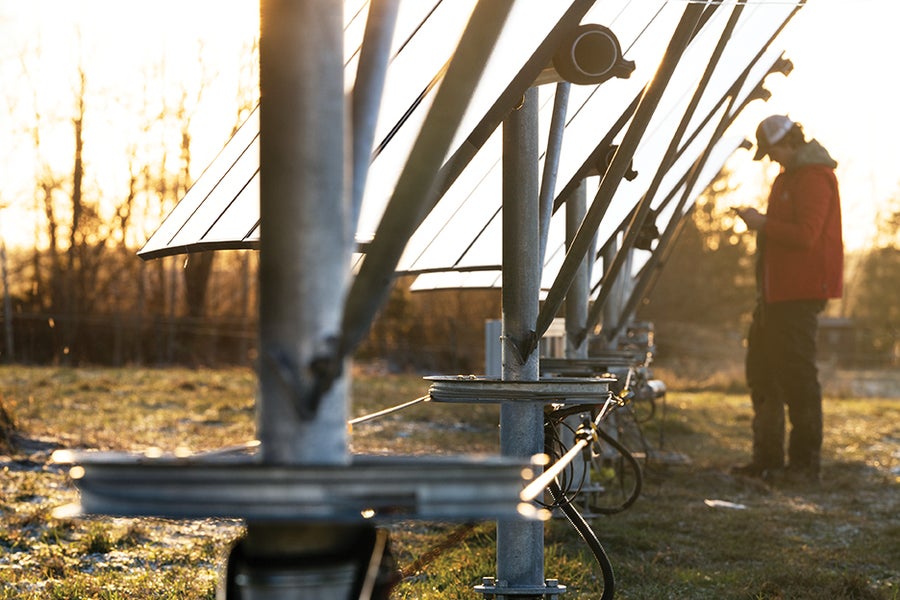
Vaja’s vertical panel arrays require no concrete. A row of more than 100 can rotate by a single motor and a cable system.
At a cocktail party in 2023, Olsson approached Eskilsson, whom he viewed as the Swede most capable of taking a company global. Since his youth, Eskilsson, now 51, loved business. At 15, he began buying and selling computers. Then, as an exchange student in Canada, he saw his first trampoline and started shipping them to Sweden. He later co-founded an eye-tracking company, Tobii, which bought a patent from Olsson in 2007; Olsson came with it and went on to work at the company for 10 years.
By the time of the party, Eskilsson had stepped down as Tobii’s CEO and was contemplating a sedate life serving on boards. Then Olsson pulled him aside to describe turning “the physics inside out” on solar farms, Eskilsson recalls.
The challenge wasn’t just exciting—it was urgent, Eskilsson says. Currently, when the sun is low, other energy sources compensate for solar’s decreased output. But some research suggests solar could make up 40 percent of global electricity production by 2050. At those rates, the difference between supply and demand would be too large for other energy sources to compensate. Reaching 40 percent penetration “is virtually impossible if you’re going to do static-mounted solar,” Eskilsson claims. But tracking solar remains unavailable to a significant portion of the globe. “Somebody has to be able to do vertical tracking in a way that’s actually cost-efficient,” he says.
They began working that September, the dwindling autumn sun a reminder of the faint light they intended to capture. Their challenge was to create a panel that wind couldn’t destroy. In less than a month they had prototypes that pivoted near their aerodynamic center so they could move in a storm.
Lundell became an adviser. There was a wind tunnel at Sweden’s KTH Royal Institute of Technology, where Lundell is a professor, but it was overbooked, and waiting for real storms was slow. He recommended they build an “inverted wind tunnel,” inspired by U.S. aerospace company Scaled Composites’ tests of SpaceShipOne’s tail in 2003, which involved driving prototypes on a truck across the Mojave Desert. About a week later, Olsson, Eskilsson and their first three employees had built their “trailer lab” and rented time on Lunda Airfield, 110 kilometers north of Stockholm.
The first months made clear why nobody had done this. “Everything broke,” Eskilsson says. They started with stiff plastic sheets in place of solar panels. As prototypes stabilized, the team switched to solar panels and kept fine-tuning. They couldn’t load up the frame with metal and increase its weight and cost. Soon they reached 80 kph in their test drives. Panel after panel vibrated until it snapped off. They stopped the car each time and walked back along the runway with their brooms.
“Turbulence gives rise to different kinds of oscillations and resonance effects,” Eskilsson says. “It can be things like flutter; it can be torsional phenomena, etcetera, that get amplified by resonance.” If you’ve watched the video of Washington State’s Tacoma Narrows Bridge wobbling as torsional flutter destroyed it in 1940, you might have a sense of the similar effect in play with the solar panels. During windstorms, early solar arrays got twisted into modern art.
Eskilsson has a summer house on an island in the Baltic Sea, and he and his colleagues set up panels on its dock with a camera feed. At home, when the news announced a storm, they sat at their computers, eating popcorn as wind destroyed their work. Sometimes they took a boat out as a storm rolled in and—in needling rain, screwdrivers in hand—adjusted the panels. “If you do it a little bit wrong, things start fluttering,” Olsson says.
When the mechanical-design experts the group hired said they doubted the project’s feasibility, Olsson was undeterred. Eskilsson recalls, “I had two of them taking me aside in the corridor without [Olsson] there, saying, ‘Henrik, you do understand this is not possible.’” As prototypes kept breaking, he had moments when he feared they might be right.
Lundell recalls identifying a distinct flutter a second before a particular panel failed, captured in videos from the trailer and the wind tunnel. With typically paced testing, understanding such a phenomenon could take years, he says. But the high-speed footage acted like a time-lapse movie of the destruction, allowing the team to map every oscillation in real time. “A few weeks later, we had the theory,” Lundell says—a mathematical model of the aerodynamic center, the precise pivot point where wind would push a panel into a neutral position rather than shaking it apart.
For six months, Olsson and Eskilsson kept shifting the axis, strengthening parts in increments, careful to keep the weight low. They moved away from trial-and-error reinforcement and toward a passive-stability approach—treating the panel not as a wall to be braced but as a weather vane to be balanced. By nudging the pivot axis millimeter by millimeter toward the leading edge, they made the wind do the work of holding the panel steady. By June 2024, they were reaching 100 kph on the airstrip. “We shifted the axis again, even further toward the front, and reinforced the sideways structure,” Eskilsson says. This time the speedometer kept rising. They hit 140 kph—which exceeded the worst gusts most solar farms are likely to see. The panel feathered calmly. “Once you get rid of the instabilities,” Olsson says, “suddenly you can double the speed.” They laughed; then, to see just how far they could push the prototype, Eskilsson jammed the gas and broke one more panel.
Now they could assemble the pieces. The vertical panel arrays require no concrete. And a row of more than 100 can be rotated with a single motor and a cable system, the way a string moves slats in a venetian blind with the twist of a rod. When a storm nears, the motor “stows” the panels so the wind hits their backs. “If the wind hits from right behind the panels, you have virtually no torque at all,” Olsson says.
Olsson and Eskilsson named the company Vaja, a Swedish word meaning “to sway.” Vaja now has five test sites, and when forecasts promise trouble, they still grab their laptops to watch their solar arrays. “I look at the weather forecast four times a day,” Eskilsson says. “I’m not looking for sunny weather.”
According to their data, Vaja’s system produces 25 to 30 percent more energy per year than a static array at many northern latitudes. Most of the company’s funding has come from $1.6 million in government grants and a similar amount from investors; it will need to raise much more to scale its operations. So far, it has four paying pilot customers lined up. Swedish company Rabbalshede Kraft, an independent renewable-energy producer, is starting a side-by-side pilot: Vaja trackers next to conventional arrays. The trackers must “survive the tooth of the climate,” says the company’s CEO Peter Wesslau. “There will also be more production because the panels will be moving across the day. Given that we will be able to produce in the more profitable hours, we also expect that we’ll be making more money.” If Vaja delivers what Eskilsson “promised in blood,” Wesslau says, “a lot more solar projects will come into the money in the Nordic regions.”
Eskilsson has shed any doubts. He likes to joke that he and Olsson have made it this far because, between the two of them, they have the three traits of entrepreneurship: a reasonable brain, a thick forehead to bang against the wall and enough naivete to keep trying.
They still run tests on the airstrip to validate panels coming out of production. The SUV accelerates and reaches the speed where, not long ago, everything went wrong. Soon they pass the equivalent of gale-force winds. On the mast, the panel feathers, calm as a coasting bird. They ease off the pedal and glide to a stop. The broom stays in the trunk.