
A completely dark, invisible object weighing 1 million times the mass of the Sun has been detected through its gravitational influence alone, without emitting any light. Hidden within a distant galaxy cluster, this mysterious disruptor has stunned scientists with a structure that doesn’t match anything known in current astrophysics.
First spotted in 2025 through subtle distortions it caused in surrounding light, the object is now the most distant mass ever discovered through gravitational lensing alone. It sits embedded in a complex system of galaxies located between 6.5 and 11 billion light-years from Earth, with no light signal and a baffling internal structure.
A Massive Object With An Irregular Structure
The team, led by Simona Vegetti from the Max Planck Institute for Astrophysics, managed to reconstruct the internal mass layout of the object. Unlike most known low-mass galaxies or stellar systems, this one appeared to have a densely packed core that stretches across vast distances.
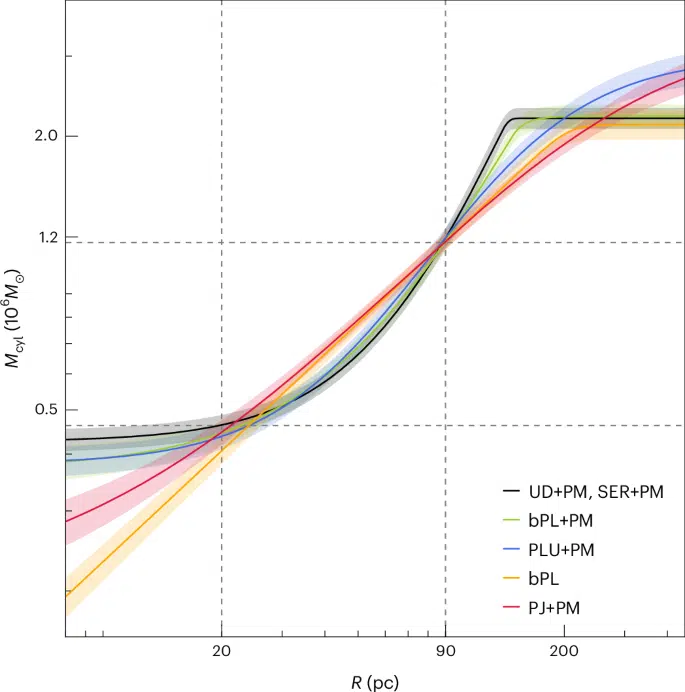 Comparison of mass distribution models for the JVAS B1938+666 object. Credit: Nature Astronomy
According to the study, published in Nature Astronomy, Vegetti described the process as both “extremely challenging” and “incredibly exciting.” What complicates the picture is that the object is uneven. As team member Davide Massari from Italy’s National Institute for Astrophysics noted:
“It has a very strange profile, because it’s particularly dense at the center, but it extends enormously,” he said. “So it’s not uniformly distributed: it’s as if there were an extremely compact object at the center, but then the profile continues to extend to distances much greater than those typically observed in galaxies or star systems of comparable mass.”
The system itself includes a large elliptical galaxy that acts as the main gravitational lens, but this disruptor, undetectable by light, interferes with the lensing arc in ways that indicate an unconventional, elongated mass distribution.
Current Dark Matter Models Fall Short
To try to understand what they were looking at, the scientists compared the object’s gravitational behavior to various dark matter models. The data was drawn from several radio telescopes, including the Green Bank Telescope, but none of the simulated models matched the behavior of the disruptor.
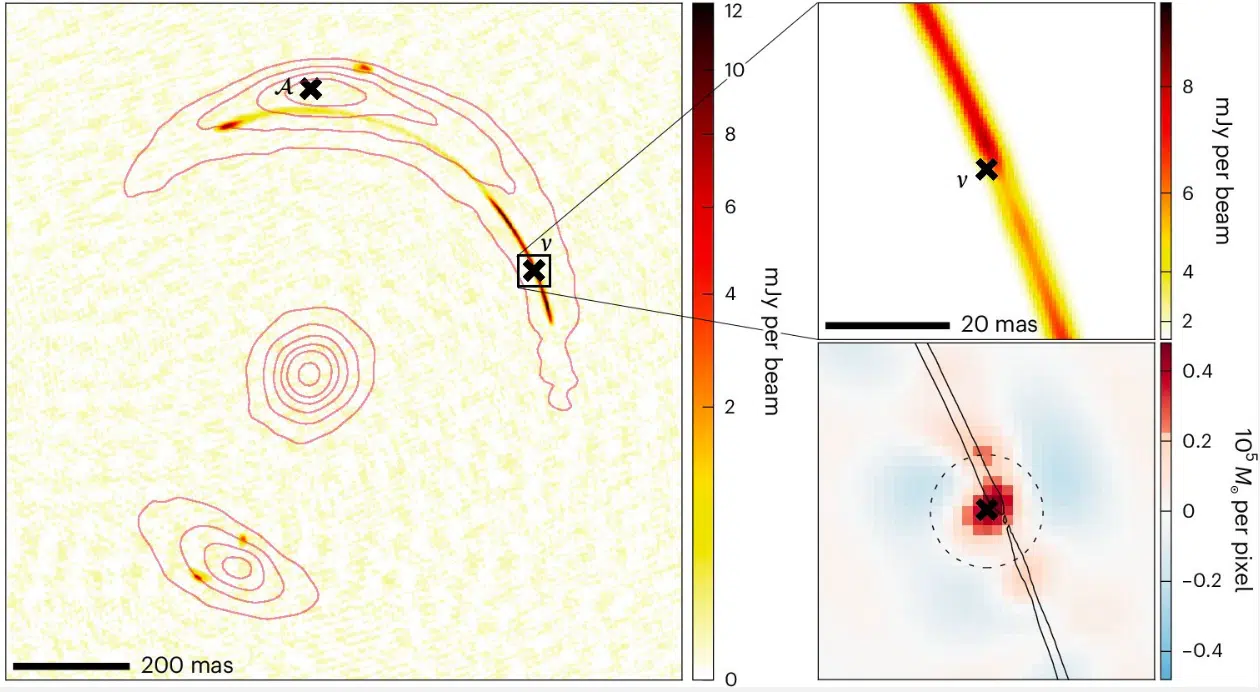 Left: Arc distortion from two perturbers. Right: Massive core disruptor. Credit: DM Powell & al.
“It has a very strange profile,” said Massari, emphasizing that while the core resembles something extremely compact, the outer spread is far larger than what’s typical for known structures. This disparity rules out familiar categories like dwarf galaxies or conventional dark matter halos.
As reported by Space.com, the team has been unable to reconcile the object’s characteristics with any established theory of low-mass systems or dark matter clustering. The gravitational perturbations it causes in the lensing arc stand as the only evidence of its presence so far, which raises questions about how common such objects might be and how many have gone unnoticed.
Infrared Sets the Course
With no light or radio signals detected so far, astronomers are now preparing to use other observational methods. Cristiana Spingola, another member of the research team, mentioned that infrared telescopes could reveal whether the object emits any light at different wavelengths. This includes instruments like the James Webb Space Telescope, which may provide crucial insights.
According to Spingola, if even JWST fails to pick up anything, scientists might be forced to consider that this object could belong to a new category altogether. But for now, its complete invisibility makes it difficult to draw conclusions beyond the evidence provided by gravitational distortion.