


January 15, 2026 — 5:00am
Save
You have reached your maximum number of saved items.
Remove items from your saved list to add more.
Save this article for later
Add articles to your saved list and come back to them anytime.
Got it
AAA
Tech giant Microsoft has signed a landmark agreement with Australia’s peak union body aimed at giving workers a formal voice in how artificial intelligence is rolled out across the economy, as AI adoption accelerates faster than regulation.
Under a new framework agreement signed on Wednesday, Microsoft Australia and the Australian Council of Trade Unions (ACTU) have committed to work together on AI skills, consultation and public policy. Both sides are pitching the agreement as an Australian first, and a model for how AI adoption can proceed with unions inside the tent instead of protesting from the outside.
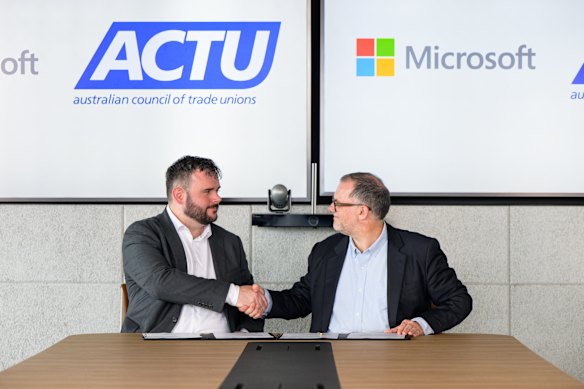 Joseph Mitchell, acting secretary of the Australian Council of Trade Unions (left) met with Steven Miller, area vice president for Microsoft Australia and New Zealand.Dan Gray
The agreement lands amid escalating tension over AI’s trajectory through Australian workplaces. Employers including Commonwealth Bank, Atlassian and WiseTech Global have shed roles while citing AI-driven efficiency gains in 2025, with unions challenging several decisions through the Fair Work Commission.
In August, CBA was forced to reverse 45 planned redundancies in its contact centres after the Finance Sector Union (FSU) demonstrated the bank was simultaneously hiring similar roles offshore.
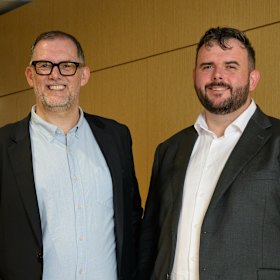 Microsoft’s Steven Miller (left), pictured with the ACTU’s Joseph Mitchell, says workers will be central to whether Australia ultimately benefits from AI. Dan Gray
While business leaders and governments talk up AI’s economic upside, unions have warned that poorly governed systems risk deskilling workers, entrenching surveillance and automating decisions without accountability.
Microsoft and the union said the framework is designed to address those concerns early, by bringing worker representatives into discussions about how AI systems are designed, developed and deployed.
At its core are three commitments: sharing information and training on AI, embedding worker input into technology development, and collaborating on policy and skills.
Microsoft will work with the ACTU Institute to deliver AI education for union leaders and staff, including formal learning sessions and curriculum resources, with the aim of improving workers’ ability to engage with AI systems introduced into their workplaces.
Steven Miller, Microsoft’s area vice president for Australia and New Zealand, said the deal had been about a year in the making. He said workers would be central to whether Australia ultimately benefited from AI, both as users of the technology and as contributors to how it evolves.
“They’re the ones who are going to be leveraging it. They’re the ones who are going to be driving adoption,” he told this masthead. “They’ll be a critical enabler of Australia’s prosperity, whether that’s creating new companies in the future or finding new ways to work better right now.”
The deal builds on an earlier memorandum of understanding between Microsoft and several unions, including the Australian Services Union, Professionals Australia and the Shop Distributive and Allied Employees Association, which formally recognised the rights of Microsoft employees to join unions and the protections of workplace delegates.
 While business leaders and governments talk up AI’s economic upside, unions have warned that poorly governed systems risk deskilling workers, entrenching surveillance and automating decisions without accountability.
iStock
ACTU assistant secretary Joseph Mitchell said the agreement responded directly to long-standing union concerns that AI was being rolled out without meaningful consultation.
“Workers through their unions have consistently raised concerns that AI is being developed and deployed without their voices being heard,” Mitchell said. “Microsoft’s commitments to recognise fundamental workplace rights and engage meaningfully with unions is a first for global technology companies operating in Australia.”
The framework also includes explicit language recognising the rights of creative and media workers, an increasingly sensitive issue as generative AI systems are trained on large volumes of text, images and audio.
The federal government has welcomed the agreement, framing it as a model for how AI could lift productivity while protecting workers. Assistant Minister for Science, Technology and the Digital Economy Andrew Charlton said it would give workers “a fair go”, while Employment and Workplace Relations Minister Amanda Rishworth said involving workers in AI implementation was critical to ensuring the benefits were fairly shared.
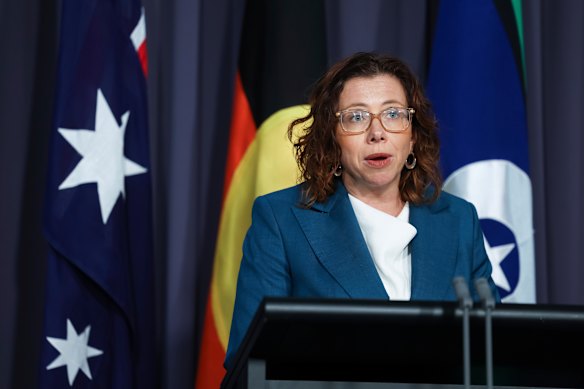 Minister for Employment and Workplace Relations Amanda Rishworth.Alex Ellinghausen
“With the right settings, AI will be a significant driver for Australia’s economic opportunity and productivity, supporting people into secure work and creating higher-paying jobs,” Rishworth said. “Involving workers’ voices and utilising their expertise in the rollout of AI is a valuable part of implementation.”
Microsoft estimates that AI could contribute up to $115 billion to Australia’s economy by the end of the decade, and the agreement aligns with the government’s National AI Plan, which emphasises workforce skills but leaves much of the detail to industry.
Related Article
The framework is explicitly not legally binding, however. It commits both parties to consult in good faith if disputes arise but creates no enforceable obligations. Miller said that flexibility was deliberate.
“The industry and the needs are moving at such a pace that something overly rigid risks becoming redundant,” he said. “The intent here is to partner deeply, with solid governance, while still being able to move as the technology evolves.”
Over the coming year, Microsoft and the ACTU plan to run joint learning sessions, establish regular worker feedback mechanisms and identify priority sectors for pilot projects.
The Business Briefing newsletter delivers major stories, exclusive coverage and expert opinion. Sign up to get it every weekday morning.
Save
You have reached your maximum number of saved items.
Remove items from your saved list to add more.
 David Swan is the technology editor for The Age and The Sydney Morning Herald. He was previously technology editor for The Australian newspaper.Connect via Twitter or email.From our partners